Band 5.0 IELTS Writing Task 1 Model Answer
Overall Band Score: 5.0 · Cambridge IELTS 17 · 2026-11-25
IELTS Writing Task 1 question
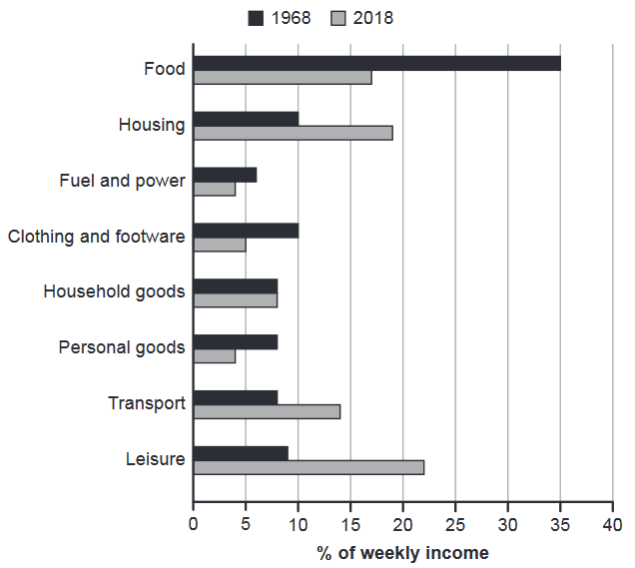
The chart below gives information about how families in one country spent their weekly income in 1968 and in 2018.
Summarise the information by selecting and reporting the main features, and make comparisons where relevant.
1968 and 2018: average weekly spending by families
Student answer (Band 5.0)
The chart summarises the information given about how families spent their weekly income and the comparison has been given from the year 1968 and 2018.
Talking about food at first about 35 percent of the weekly income was spent on food in 1968 comparing it to 2018 only about 18 percent goes into food.Housing like rents and accomodation took upto 10 percent of the income in 1968,in 2018 it is higher almost 20 percent.Fuel and power took around 5 percent both in 1968 and 2018.Clothing and footwear was 5 percent in 1968 and in 2018 its 10 percent.Household goods comparison takes the same amount of percentage almost 8 percent in both the years.Parental goods costed more in 1968 than in 2018.Transport in 2018 is expensive taking about 14 percent of the weekly income in 1968 it took around 8 percent.Leisure and other expenses cost more in 2018 around 22 percent in 1968 it was around 8 percent of the weekly income.
AI examiner evaluation
| Criterion | Band |
|---|---|
| Task Achievement / Task Response | 5.0 |
| Coherence and Cohesion | 5.0 |
| Lexical Resource | 5.0 |
| Grammatical Range and Accuracy | 5.0 |
| Overall | 5.0 |
Task Achievement / Task Response: Band 5.0
You identify several relevant categories and report some key comparisons, including food falling from about 35% to 18%, housing rising from about 10% to 20%, and leisure reaching about 22% in 2018. However, the response does not give a clear overall summary of the main pattern, such as the shift away from food towards leisure, housing and transport. Some figures are reversed: clothing and footwear was about 10% in 1968 and 5% in 2018, not the other way around; fuel and power also fell from about 6% to 4%, rather than remaining similar. Personal goods is not named accurately, and its figures are omitted. Select the largest changes and state them accurately to make the report more complete.
Coherence and Cohesion: Band 5.0
The response follows the chart categories in a generally understandable order, and comparison phrases such as “in 1968” and “in 2018” help readers follow the time periods. However, the information is presented as one continuous paragraph, with no distinct overview or clear grouping of the main trends. Several transitions are repetitive, and the opening phrase “Talking about food at first” does not create a clear progression. Some comparisons are also difficult to follow because clauses run together, for example the sentence about transport. Organise the report into an introduction, an overview, and grouped detail paragraphs, and use linking expressions to show contrast and change more precisely.
Lexical Resource: Band 5.0
You use relevant basic vocabulary, including “weekly income,” “spent,” “higher,” and “took around,” so the general subject is clear. However, the range is limited and some choices are inaccurate or awkward for describing chart data. “Parental goods” appears to be an incorrect label for “personal goods,” while “costed more” and “is expensive” do not precisely describe the share of income allocated to a category. There are also spelling errors, including “accomodation,” and inconsistent category naming. Use accurate chart labels and a wider set of reporting expressions, such as “accounted for,” “declined,” and “rose,” to make comparisons clearer and more formal.
Grammatical Range and Accuracy: Band 5.0
The response attempts to combine comparisons in longer sentences, but the range of sentence structures is limited and these attempts are often difficult to control. For example, “in 2018 it is higher almost 20 percent” lacks a clear grammatical link between the amount and the comparison, while “Transport in 2018 is expensive taking about 14 percent … in 1968 it took around 8 percent” joins separate ideas without suitable punctuation or structure. Tense use also shifts between past and present (“was,” “goes,” “is”), and several sentences run together. Use consistent past-tense reporting and separate comparisons into complete sentences, checking punctuation and clause structure.
See this exact question answered at other band scores. The same prompt compared across bands.
Browse more IELTS Writing model answers or get your own writing scored by the same AI examiner.