Band 5.5 IELTS Writing Task 1 Model Answer
Overall Band Score: 5.5 · Cambridge IELTS 17 · 2026-11-25
IELTS Writing Task 1 question
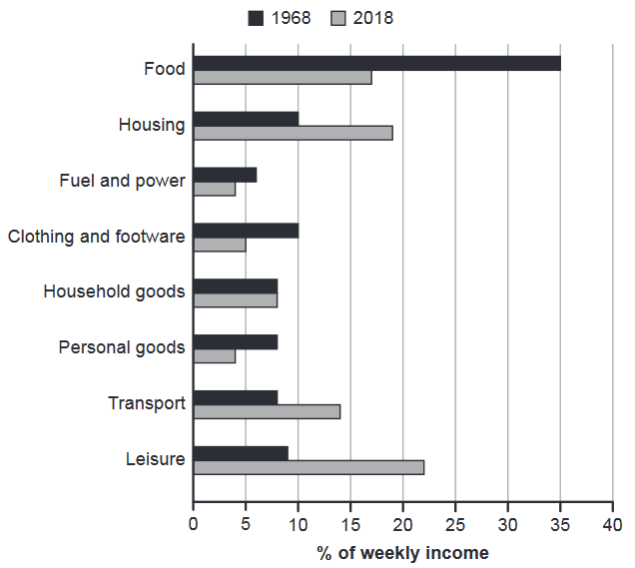
The chart below gives information about how families in one country spent their weekly income in 1968 and in 2018.
Summarise the information by selecting and reporting the main features, and make comparisons where relevant.
1968 and 2018: average weekly spending by families
Student answer (Band 5.5)
The bar chart illustrates the average spending of families in a week, compared to eight categories, between 1968 and 2018. Overall, it is clear that food shows the largest stipend in the past while leisure recorded more in other year.
Food is the leader in 1968 which covers a peak of 35% of weekly income while a recorded around 17% in 2018. Wherase In Leisure and Houcing provide a higher scor in 2018 achieved around 22% and 19%, respectivly, of weekly income, in constast a lower pergentage recorded in 1968 at only 9% and 10%, respectivly. Fuel and power remain the lower percentage of only 6% in 2018 while the lower proportion in 2018 was seen in personal goal ar 4%.
in the other categories recorded an moderate cover of weekly income in both transport and personal goal in 1968 showed the same exact stpend at 9%. while household goods recorded the exact same stipend in weekly incom in both years at around 7%.
AI examiner evaluation
| Criterion | Band |
|---|---|
| Task Achievement / Task Response | 5.5 |
| Coherence and Cohesion | 5.5 |
| Lexical Resource | 5.5 |
| Grammatical Range and Accuracy | 5.0 |
| Overall | 5.5 |
Task Achievement / Task Response: Band 5.5
You identify the main contrast: food was the largest category in 1968, while leisure and housing took larger shares in 2018. You also include several relevant figures, such as food at 35% and 17%, and leisure at 9% and 22%. However, coverage is partial and some details are inaccurate: fuel and power was 4% in 2018, not 6%, and transport was 8% in 1968, not 9%. The statement that household goods were about 7% in both years is also imprecise; the chart shows 8%. The overview is present but vague, and the final paragraph does not clearly report the main changes across the remaining categories. Select the key rises and falls and check each figure against the chart.
Coherence and Cohesion: Band 5.5
The response has a basic structure, with an introduction, an overview and paragraphs containing comparisons. This helps the reader recognise the topic and some of the main features. However, progression is uneven: the final paragraph begins with the unclear fragment “in the other categories recorded an moderate cover,” then moves between transport, personal goods and household goods without a clear organising principle. Linking expressions such as “while” and “in contrast” are attempted, but some are awkwardly placed or do not connect complete ideas. Improve the flow by grouping the largest changes together, then summarising the smaller or unchanged categories, and use complete, clearly linked sentences.
Lexical Resource: Band 5.5
You attempt a range of chart-related vocabulary, including “average spending,” “weekly income,” “proportion” and “recorded,” and you use comparison language to describe differences. However, word choice and spelling errors are frequent enough to make parts difficult to understand. Examples include “stipend” for spending or share, “Houcing,” “respectivly,” “pergentage,” and “personal goal” for personal goods. Some phrases are also unnatural, such as “higher scor” and “moderate cover.” Use precise, familiar terms consistently: “share of weekly income,” “accounted for,” “rose,” and “fell” are suitable for this chart. Proofreading category names and spelling would make your meaning clearer.
Grammatical Range and Accuracy: Band 5.0
You attempt both simple and more complex comparisons, including a sentence contrasting leisure and housing across the two years. However, the range is limited, and complex sentences are often faulty or incomplete. For example, “while a recorded around 17%” lacks a clear subject and has an incorrect verb construction; “in the other categories recorded an moderate cover” is also incomplete. Capitalisation and punctuation are inconsistent, as in the lower-case opening “in” and the full stop after “Wherase.” These errors sometimes make relationships between figures hard to follow. Practise building complete sentences with a clear subject and verb, and check articles, tense and punctuation before finishing.
See this exact question answered at other band scores. The same prompt compared across bands.
Browse more IELTS Writing model answers or get your own writing scored by the same AI examiner.