Band 5.5 IELTS Writing Task 1 Model Answer
Overall Band Score: 5.5 · Cambridge IELTS 17 · 2026-11-26
IELTS Writing Task 1 question
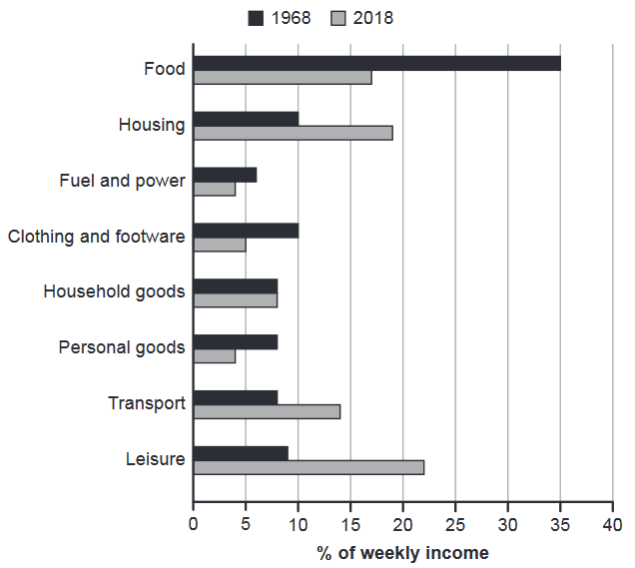
The chart below gives information about how families in one country spent their weekly income in 1968 and in 2018.
Summarise the information by selecting and reporting the main features, and make comparisons where relevant.
1968 and 2018: average weekly spending by families
Student answer (Band 5.5)
The illustration gives information about average weekly food spending by families in 1968 and 2018. Overall, 1968 families their weekly income spending food and personal goods and clothing footware. In contrast 2018 families major amount of weekly income spending housing and liesure and transport.
It is quite evident from in 2018 families approximately 17% of their weekly income spending their food and in 1968 families spending vast amont their food. In 2018 families aboutly 20% weekly income invest their housing in contrast in 1968 families very short amount of their income spending their housing. Both in 2018 and 1968 individuals 5% investing their fuel and power.
Furthermore, in 1968 families 10% spending their clothing and footware on the other side 2018 families spending half amount as compared to 1968 families. Finally 1968 families approximatly 9% spending their leisure and in 2018 families aboutly 22% of their weekly income spending leisure.
AI examiner evaluation
| Criterion | Band |
|---|---|
| Task Achievement / Task Response | 5.5 |
| Coherence and Cohesion | 5.5 |
| Lexical Resource | 5.0 |
| Grammatical Range and Accuracy | 5.0 |
| Overall | 5.5 |
Task Achievement / Task Response: Band 5.5
You identify the broad contrast between 1968, when food took the largest share, and 2018, when leisure and housing were prominent. Several figures are also reported reasonably: food at about 17% in 2018, housing near 20%, and leisure at roughly 9% and 22% in the two years. However, the overview is unclear and partly inaccurate: personal goods and clothing are not among the leading 1968 categories, and transport is not mentioned in the detailed comparison despite being a major 2018 item. The fuel comparison is also incorrect: the chart shows about 6% in 1968 and 4% in 2018, not 5% in both years. More accurate selection of key features and a clearer overview would make the summary more complete.
Coherence and Cohesion: Band 5.5
The response has a basic paragraph structure, moving from an opening and overview to comparisons of food, housing, fuel, clothing and leisure. Linking expressions such as “In contrast,” “Furthermore” and “Finally” help signal changes in focus. However, progression is uneven: the overview mentions personal goods and clothing, while the later paragraphs do not develop personal goods and omit transport, an important category. Some links are awkward or unclear, particularly “Both in 2018 and 1968 individuals 5% investing,” which makes the comparison difficult to follow. Organise the body around the largest changes or group categories with similar trends, and use clear comparison sentences so that each paragraph develops the overview.
Lexical Resource: Band 5.0
You use some relevant chart vocabulary, including “weekly income,” “approximately,” “in contrast” and “spending,” so the topic is generally understandable. However, the range is limited and several word choices or collocations are inaccurate or repetitive. Phrases such as “major amount,” “very short amount,” “aboutly” and “invest their housing” do not express the intended comparisons naturally; “spending” is also repeated frequently. There are noticeable spelling errors, including “liesure,” “amont” and “approximatly,” which reduce precision. Build a more reliable set of terms for proportions and change, such as “accounted for,” “share,” “rose” and “fell,” and check spelling and collocations when editing.
Grammatical Range and Accuracy: Band 5.0
The response attempts comparisons and some longer sentence forms, but grammatical control is inconsistent, and many sentences are incomplete or faulty. For example, “Overall, 1968 families their weekly income spending food” lacks a correctly formed verb phrase, while “In 2018 families approximately 17% of their weekly income spending their food” has the same problem. Subject–verb forms and sentence construction also need attention in “1968 families spending vast amount” and “families 10% spending their clothing.” Articles and prepositions are often missing or misplaced, and punctuation around introductory phrases is limited. Practise complete subject–verb–object sentences first, then combine them with accurate contrast clauses; this will make the comparisons easier to understand.
See this exact question answered at other band scores. The same prompt compared across bands.
Browse more IELTS Writing model answers or get your own writing scored by the same AI examiner.