Band 5.5 IELTS Writing Task 1 Model Answer
Overall Band Score: 5.5 · Cambridge IELTS 17 · 2026-11-26
IELTS Writing Task 1 question
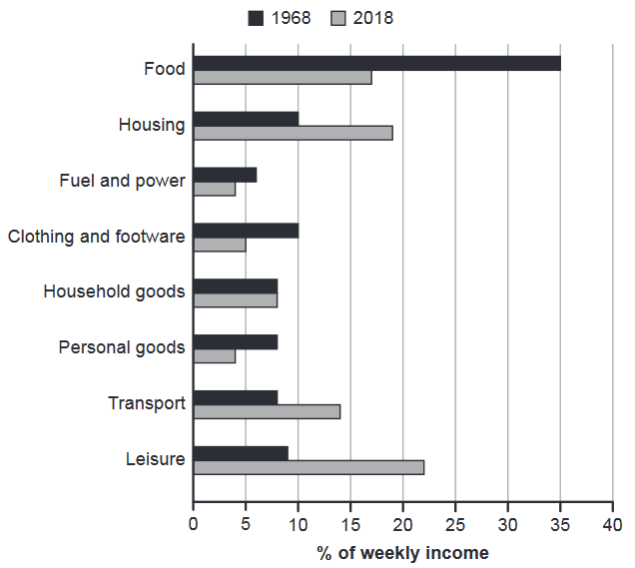
The chart below gives information about how families in one country spent their weekly income in 1968 and in 2018.
Summarise the information by selecting and reporting the main features, and make comparisons where relevant.
1968 and 2018: average weekly spending by families
Student answer (Band 5.5)
The bar chart illustrates the information that how families in one state use their weekly amount in from 1968 to 2018.
Overview, the highest rate of weekly income spend on food in 1968, and the lowest ratio in 2018, spend on personal goods, and fuel, power are same.
In 1968, food have highest proportion and 35% money was spend on it, in 2018, it was decreased to 17%. Moreover, 18% money spend on housing in 2018, in contrast, 10% in 1968. Leisure ratio is 23% in 2018, and 9% in 1968. In addition, 14% income is spend on transport in 2018, which was 7% in 1968. 10% money used on Clothing and footware in 1986, and it was decreased to 5% in 2018. Household goods are aproximately same in both years, which is 8%. Personal goods is between 3% to 10% in these years. Fuel and power have ratio between 4% to 7% in these years.
AI examiner evaluation
| Criterion | Band |
|---|---|
| Task Achievement / Task Response | 5.5 |
| Coherence and Cohesion | 5.5 |
| Lexical Resource | 5.5 |
| Grammatical Range and Accuracy | 5.0 |
| Overall | 5.5 |
Task Achievement / Task Response: Band 5.5
You identify the main contrast that food took the largest share in 1968 and fell substantially by 2018, and you include several relevant category comparisons. However, the overview is incomplete and partly inaccurate: in 2018, leisure—not housing—was the largest category, while fuel and personal goods were tied for the smallest at about 4%. Some figures are also misreported: transport in 1968 was about 8%, not 7%, and clothing is given as 1986 rather than 1968. The statement that personal goods were “between 3% to 10%” is too vague to show the change clearly. A more selective overview of the biggest rises and falls, supported by accurate comparisons, would make the report more complete.
Coherence and Cohesion: Band 5.5
The response follows a broadly sensible order: it gives an overview and then reports figures for individual categories. Linking expressions such as “Moreover,” “In contrast,” and “In addition” help connect comparisons. However, the overview is not clearly separated from the detailed reporting, and the paragraphing does not make the stages of the report easy to follow. Several sentences list categories one after another without grouping the main increases and decreases, while “Personal goods is between 3% to 10%” and the following fuel sentence leave the reader to infer the comparison. Organise the response into a concise overview and a body grouped by trends, and use clearer references such as “this figure” where appropriate.
Lexical Resource: Band 5.5
You use relevant chart vocabulary, including “proportion,” “ratio,” “decreased,” and “in contrast,” and the reader can generally understand the categories being compared. However, some word choices and collocations are unnatural or imprecise, such as “weekly amount,” “highest rate,” and “money was spend.” Repeating “ratio” and “money” also limits the range of language used to describe shares. There are spelling errors in “aproximately” and “footware,” and “spend” is not the appropriate form in “income is spend.” Use standard terms such as “share,” “percentage,” and “accounted for,” and check spelling of category labels to make the report more precise and natural.
Grammatical Range and Accuracy: Band 5.0
You attempt both simple statements and longer comparisons, for example, “Moreover, 18% money spend on housing in 2018, in contrast, 10% in 1968.” However, grammatical errors occur throughout and sometimes make relationships between figures difficult to follow. Examples include “The highest rate of weekly income spend on food,” “food have highest proportion,” and “Personal goods is,” which show problems with sentence structure, verb forms, and subject–verb agreement. Articles and prepositions are also often missing, as in “18% money” and “spend on personal goods.” Build more reliable sentence patterns, such as “Families spent 18% of their income on housing,” and check agreement and verb forms before adding longer comparisons.
See this exact question answered at other band scores. The same prompt compared across bands.
Browse more IELTS Writing model answers or get your own writing scored by the same AI examiner.