Band 6.0 IELTS Writing Task 1 Model Answer
Overall Band Score: 6.0 · Cambridge IELTS 17 · 2026-11-27
IELTS Writing Task 1 question
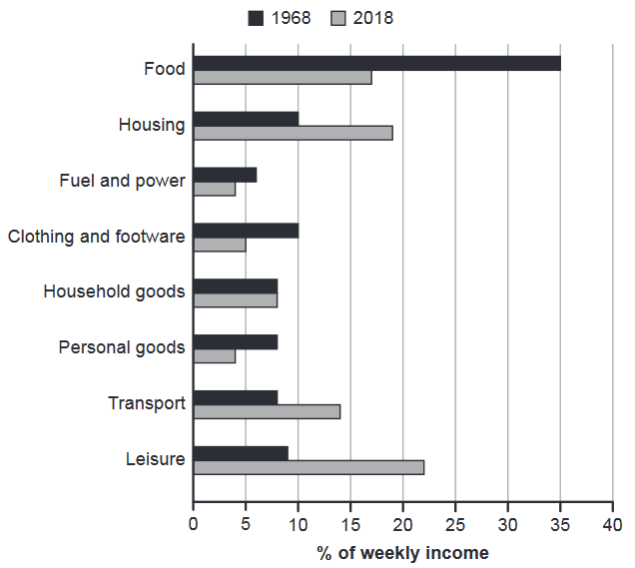
The chart below gives information about how families in one country spent their weekly income in 1968 and in 2018.
Summarise the information by selecting and reporting the main features, and make comparisons where relevant.
1968 and 2018: average weekly spending by families
Student answer (Band 6.0)
The bar chart demonstrates the report on how weekly income are spent by families during 1968 and 2018. The categories are divided into 8 different sections which is shown on the y-axis and the percentage of weekly income on the x-axis.
It is evident that food was most spend category amongst the others, followed by evenly stabled housing and clothing and footware during 1968. Whereas, in 2018, leisure activities were spent extensively, followed by housing and food dropped to the third position.
Looking at the details closely, food peaked at 35% of weekly income by families in 1968, following housing and clothing accounted at 10% of the weekly income. Meanwhile, in 2018, the expenditure for food dropped to third position approximately 17% and leisure soared from 9% to around 23% of the income. The other factors are spent below 10% such as fuel and power, household goods, personal goods and transport.
AI examiner evaluation
| Criterion | Band |
|---|---|
| Task Achievement / Task Response | 6.0 |
| Coherence and Cohesion | 6.0 |
| Lexical Resource | 6.0 |
| Grammatical Range and Accuracy | 5.5 |
| Overall | 6.0 |
Task Achievement / Task Response: Band 6.0
You identify the main shift clearly: food falls from the largest share in 1968 to a smaller share in 2018, while leisure becomes the leading category. The figures of 35%, 10% and about 17% are broadly accurate, and the comparison gives the response a relevant overview. However, some details are incomplete or inaccurate: housing and clothing were tied at 10% in 1968, but housing rose to 19% in 2018, a major change that is not reported. Transport also increased to 14%, so it was not “below 10%” in 2018. The overview could cover these important contrasts more fully, and the chart’s categories are on the horizontal axis, not the y-axis.
Coherence and Cohesion: Band 6.0
The response has a clear overall arrangement: an introduction, a summary of the main pattern, and a paragraph with selected figures. Linking expressions such as “Whereas,” “Meanwhile,” and “Looking at the details closely” help signal comparisons and progression. However, the final paragraph groups several categories together without clearly distinguishing their 1968 and 2018 values, and the claim that these factors were all below 10% makes the comparison difficult to follow. Some transitions also connect ideas awkwardly, particularly “Whereas” at the start of a sentence. To strengthen progression, organise the details by the largest changes or by year, and use explicit comparisons between the two bars for each selected category.
Lexical Resource: Band 6.0
You use a reasonable range of chart vocabulary, including “peaked,” “dropped,” “soared,” “accounted for,” and “expenditure,” which helps describe changes and proportions. Some choices are inaccurate or unnatural, however: “most spend category” and “evenly stabled” do not express the intended meanings, while “leisure activities were spent extensively” incorrectly suggests that activities themselves were spent. “Footware” is also misspelled; the chart label is “footwear.” These issues do not prevent the reader from understanding the main message, but they reduce precision. Aim for standard collocations such as “the largest spending category,” “remained stable,” and “families spent a larger share on leisure,” and use consistent terms for spending shares.
Grammatical Range and Accuracy: Band 5.5
You attempt a mix of simple and more complex sentences, including comparisons introduced by “Whereas” and “Meanwhile,” and most of the message remains understandable. Some grammatical errors are noticeable. For example, “how weekly income are spent” has an agreement problem and an awkward passive construction; “categories … which is shown” does not agree with the plural noun; and “food was most spend category” is missing an article and has an incorrect form. The sentence beginning “Whereas, in 2018” is also a fragment because the subordinate clause is not joined to a main clause. Practise accurate subject–verb agreement, articles, and complete complex sentences, while keeping the useful variety of structures you already attempt.
See this exact question answered at other band scores. The same prompt compared across bands.
Browse more IELTS Writing model answers or get your own writing scored by the same AI examiner.