Band 4.5 IELTS Writing Task 1 Model Answer
Overall Band Score: 4.5 · Cambridge IELTS 17 · 2026-11-27
IELTS Writing Task 1 question
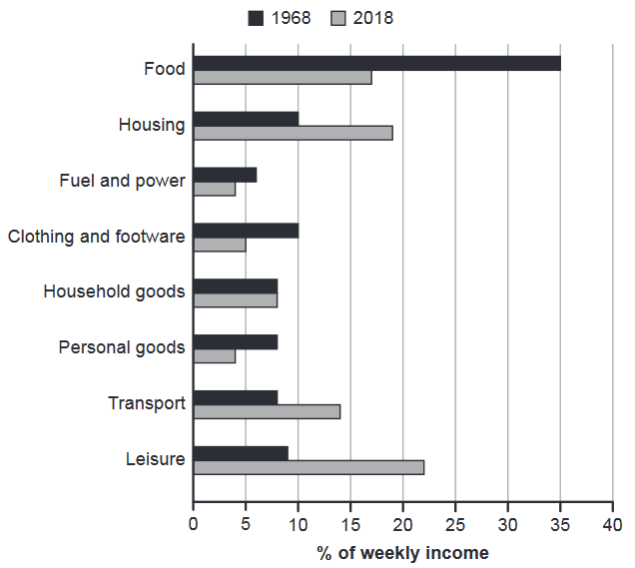
The chart below gives information about how families in one country spent their weekly income in 1968 and in 2018.
Summarise the information by selecting and reporting the main features, and make comparisons where relevant.
1968 and 2018: average weekly spending by families
Student answer (Band 4.5)
in this graph it is shown that it gives the information about how families in one country spent their weekly income in 1986 and in 2018
in 1986 families spends on food the most then after in the housing then less on fuel and power then housing after that bit higher in clothing and footwear then again on less in household goods and same as on personal goods so this was the weekly average spending families in the year 1986 overall that was there weekly average of spending money
in the year 2018 the average weekly spending by families on the food in on an average and on housing is bit higher then on food and on fuel and power it was very less after that on household goods is high then clothing and foot wear and in last there if very less on the personal goods
overall the families in one country spend more in 2018 then in 1986 accept in housing
AI examiner evaluation
| Criterion | Band |
|---|---|
| Task Achievement / Task Response | 4.0 |
| Coherence and Cohesion | 4.5 |
| Lexical Resource | 4.5 |
| Grammatical Range and Accuracy | 4.5 |
| Overall | 4.5 |
Task Achievement / Task Response: Band 4.0
You identify the chart’s general subject and mention several spending categories, but the response reports the wrong first year: the chart compares 1968 and 2018, not 1986. This substantially weakens the account of the data. Some comparisons are also inaccurate or unclear: in 2018, leisure is the largest category at about 22%, while your description focuses on food and housing and does not mention leisure or transport. The final claim that families spent more in 2018 except on housing is not supported by the chart; housing rose from about 10% to 19%. To improve, give a clear overview of the main changes and select accurate figures, especially the largest categories and the notable rises and falls.
Coherence and Cohesion: Band 4.5
The response has separate paragraphs for the two years and a concluding sentence, so there is an attempt to organise the information by time period. However, the progression within the paragraphs is difficult to follow, and several comparisons are repeated or contradictory. For example, the 2018 paragraph says housing is higher than food, then describes food as average, without clearly establishing the ranking. Linking phrases such as “after that” and “then” are used repeatedly but do not make the relationships between categories precise. Grouping the main increases and decreases, and using clear comparison language such as “whereas” or “by contrast,” would make the account easier to follow.
Lexical Resource: Band 4.5
You use relevant chart vocabulary, including “weekly spending,” “average,” and category names such as “fuel and power” and “household goods.” However, the range is basic and repetitive, with frequent reliance on “then,” “less,” and “higher.” Some expressions are unclear or unnatural, such as “on an average” and “in last there if very less,” which make parts of the report hard to interpret. There are also spelling inconsistencies in “footwear” and “accept” where “except” is intended. Aim for precise terms for describing proportions and change, and check category names carefully. More accurate phrasing would help you compare the figures without relying on vague descriptions.
Grammatical Range and Accuracy: Band 4.5
The response mainly uses simple sentence patterns, and errors occur often enough to make several statements difficult to understand. For example, “families spends” has incorrect subject–verb agreement, while “in the year 2018 the average weekly spending by families on the food in on an average” lacks a clear grammatical structure. Sentence boundaries and punctuation are also weak: the long 1968 paragraph joins several ideas without clear stops, and the opening sentence repeats “it is shown” and “it gives.” Practise writing short, complete comparison sentences first, with accurate verb forms and articles, then combine related ideas using controlled clauses. This will make your meaning clearer and allow more variety.
See this exact question answered at other band scores. The same prompt compared across bands.
Browse more IELTS Writing model answers or get your own writing scored by the same AI examiner.