Band 6.0 IELTS Writing Task 1 Model Answer
Overall Band Score: 6.0 · Cambridge IELTS 17 · 2026-11-27
IELTS Writing Task 1 question
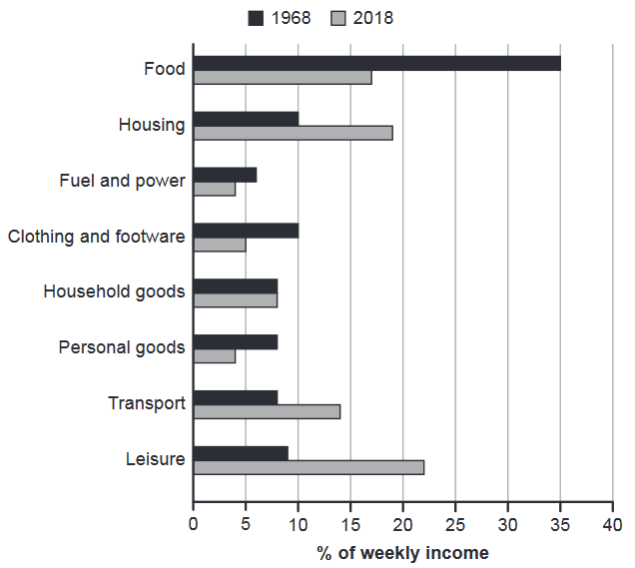
The chart below gives information about how families in one country spent their weekly income in 1968 and in 2018.
Summarise the information by selecting and reporting the main features, and make comparisons where relevant.
1968 and 2018: average weekly spending by families
Student answer (Band 6.0)
The chart illustrates the five aspects people spent their weekly salaries in during 2 years 1968 and 2018.
Overall, Food and leisure were the most sections people spent their money on. Houshold goods had the same figure in the 2 years .
In 1968, biggest figure of the total income were spent on food which is 35%. Housing and clothing and footwear had only 10% . Fuel and power consumed over 6% while other remaining sections including lesiure, transport and personal goods had same figures hovering around 8%.
By 2018, budget designated for food has declined dramatically reaching over 17%. Clothing and footware figure decline by half to 5% while housing budget has nearly been doubled reaching around 19%. Categories like personal goods and fuel and power experienced modest decrease reaching over 4% respectively. Leisure and transport sections had grown significantly reaching just 19% and over 22% respectively. Household goods had same figures in the 2 years accounting for just 7.5% of the total weekly income.
AI examiner evaluation
| Criterion | Band |
|---|---|
| Task Achievement / Task Response | 6.5 |
| Coherence and Cohesion | 6.5 |
| Lexical Resource | 6.0 |
| Grammatical Range and Accuracy | 5.5 |
| Overall | 6.0 |
Task Achievement / Task Response: Band 6.5
You identify the main pattern that food spending fell and leisure and housing became more prominent, and you include relevant figures such as 35% for food in 1968 and about 19% for housing in 2018. The overview also notes that household-goods spending was unchanged. However, some details are inaccurate or unclear: in 2018 leisure was about 22% and transport about 14%, but these are reversed in your final comparison. The 1968 figures for leisure, transport and personal goods were not all the same: they were approximately 9%, 8% and 8%. Also, “over 6%” and “over 17%” are imprecise descriptions of values around 6% and 17%. The main features are covered, but more precise reporting and a clearer overview would strengthen the response.
Coherence and Cohesion: Band 6.5
The response has a clear overall structure: an introduction, an overview, and separate paragraphs for the two years. This makes the broad comparison easy to follow, and time markers such as “In 1968” and “By 2018” help organise the data. The progression is generally logical, but some sentences group several categories together without making their relationships clear, particularly the sentence about the remaining 1968 sections. The final sentence also reverses the 2018 leisure and transport figures, disrupting the comparison. Use more precise links and organise details by meaningful changes—for example, categories that rose, fell or stayed stable—rather than listing them in a crowded sentence.
Lexical Resource: Band 6.0
You use a reasonable range of task-related vocabulary, including “declined dramatically,” “modest decrease,” “designated,” and “accounting for.” These attempts help describe change, although some choices are unnatural or imprecise: “the five aspects people spent their weekly salaries in” does not clearly introduce the chart, and “biggest figure of the total income were spent” is awkward. There are also spelling errors in “Houshold,” “lesiure,” and “footware,” which reduce accuracy. Prefer standard terms such as “categories of weekly spending” and “accounted for,” and check spelling carefully. More precise vocabulary would make the comparisons sound more natural and controlled.
Grammatical Range and Accuracy: Band 5.5
You attempt both simple and more developed sentence forms, including clauses with “while” and participial phrasing such as “reaching around 19%.” Most of the message remains understandable, but some grammatical errors recur. For example, “Food and leisure were the most sections” has an incorrect construction, while “biggest figure … were spent” has faulty agreement and sentence structure. The opening phrase “in during 2 years” also uses an incorrect preposition pattern, and spacing before punctuation is inconsistent. Aim for straightforward, accurate comparisons, such as “Food accounted for the largest share in 1968,” then check subject–verb agreement and articles. Greater control of these patterns would make the range of structures more effective.
See this exact question answered at other band scores. The same prompt compared across bands.
Browse more IELTS Writing model answers or get your own writing scored by the same AI examiner.