Band 6.0 IELTS Writing Task 1 Model Answer
Overall Band Score: 6.0 · Cambridge IELTS 17 · 2026-11-28
IELTS Writing Task 1 question
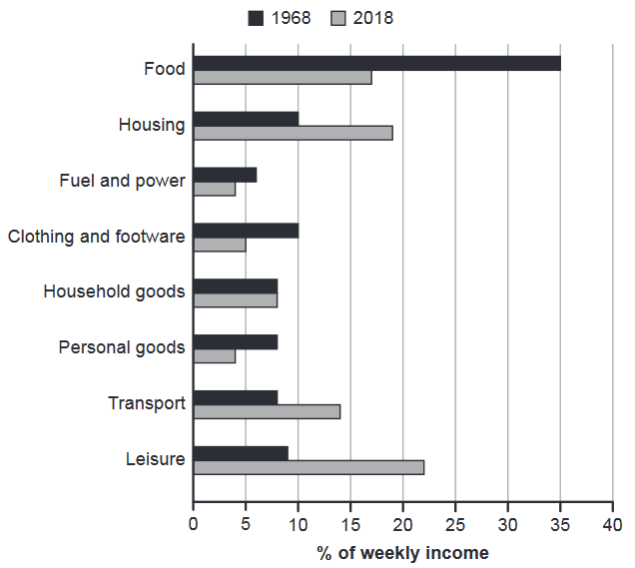
The chart below gives information about how families in one country spent their weekly income in 1968 and in 2018.
Summarise the information by selecting and reporting the main features, and make comparisons where relevant.
1968 and 2018: average weekly spending by families
Student answer (Band 6.0)
THE CHART ILLUSTRATES THE PROPOTION ABOUT HOW FAMILIES IN A COUNTRY SPENDING THIER WEEKLY INCOME BETWEEN 1968 AND 2018.
OVERALL, AVERAGE WEEKLY INCOME SPENT BY FAMILIES ON FOOD CONSIDERABLY DECREASED OVER THE PERIOD, WHILE, SPENDING ON HOUSING AND LEISURE SIGNIFICANTLY INCREASED OVER THE YEARS, IN CONTRAST, HOUSEHOLD GOOD REMANIN SAME AND TRANSPORT WERE ROSED.
IN 1968, THE AVERAGE PERCENTAGE OF WEEKLY SPENDING BY FAMILIES ON FOOD WAS 35% IN 1968 AND 18% IN 2018 , HOWERVER, SPENT ON HOUSING INCREASED FROM 10% IN 1968 TO 19% IN 2018, AND THE SPENT OF INCOME ON LEISURE WERE ALSO ROSED FROM 9% IN 1968 TO 22% IN 2018.
BY 2018, THE INCOME SPENT ON FUEL AND POWER SLIGHTY DECREASED AND ON CLOTHING AND FOOTWARE WERE REDUCE BY THE 2018, WHILE THE AVERAGE PERCENTAGE OF INCOME ON TRANPORT INCREASED FROM 8% IN 1968 TO 14% IN 2018 HOWEVER THE SPENT ON PERSONAL GOOD DROPED FROM 8% IN 1968 TO 4% IN 2018.
AI examiner evaluation
| Criterion | Band |
|---|---|
| Task Achievement / Task Response | 6.5 |
| Coherence and Cohesion | 6.0 |
| Lexical Resource | 5.5 |
| Grammatical Range and Accuracy | 5.0 |
| Overall | 6.0 |
Task Achievement / Task Response: Band 6.5
You identify the main shifts clearly: food spending fell substantially, while housing, leisure and transport rose; you also note that household-goods spending was stable. The figures you give for food, housing, leisure, transport and personal goods are broadly consistent with the chart, although food is shown as 17% in 2018 rather than 18%, a small difference. This covers the key features and supports the overview. However, the changes in fuel and power and clothing are only described vaguely, without figures, and the overview’s wording about household goods and transport is unclear. To strengthen the response further, report these smaller changes precisely and make the overall comparisons more explicit.
Coherence and Cohesion: Band 6.0
The response has a recognisable structure: an introduction, an overview and two paragraphs of details. The information is generally grouped sensibly, with the largest changes discussed before the remaining categories. However, progression within the paragraphs is sometimes weakened by long, crowded sentences and mechanical linking. For example, the first detail paragraph joins food, housing and leisure with repeated “and” and “however,” while the final paragraph contains several comparisons in one sentence. Some punctuation also makes relationships between ideas unclear. Use shorter sentences and clearer transitions, such as grouping increases together and decreases together, so readers can follow each comparison without having to untangle the connections.
Lexical Resource: Band 5.5
You use relevant chart vocabulary, including “percentage,” “decreased,” “increased” and “from … to …,” which helps communicate the comparisons. There is also some attempt to vary the language, but inaccurate word forms, spelling and collocations are noticeable and sometimes make the meaning less clear. Examples include “propotion,” “thier,” “were rosed,” “the spent of income” and “personal good.” These errors limit the precision expected for describing data, even though the main trends can usually be understood. Build a reliable set of expressions for proportions and change, and check spelling and noun forms carefully; accurate, natural phrasing is more useful than forcing variety.
Grammatical Range and Accuracy: Band 5.0
You attempt to combine comparisons in longer sentences, using structures such as “increased from 10% … to 19%” and “while,” but control is inconsistent. Several sentences have faulty verb forms or agreement, as in “families … spending,” “household good remanin same” and “the spent … were also rosed.” Sentence boundaries and punctuation are also problematic: the overview and final paragraph run several clauses together, and commas sometimes replace full stops. These issues can make relationships between figures harder to follow. Practise accurate simple comparison sentences first, then combine them with “while” or “whereas,” checking that each clause has a clear subject and correctly formed verb.
See this exact question answered at other band scores. The same prompt compared across bands.
Browse more IELTS Writing model answers or get your own writing scored by the same AI examiner.