Band 6.0 IELTS Writing Task 1 Model Answer
Overall Band Score: 6.0 · Cambridge IELTS 17 · 2026-11-28
IELTS Writing Task 1 question
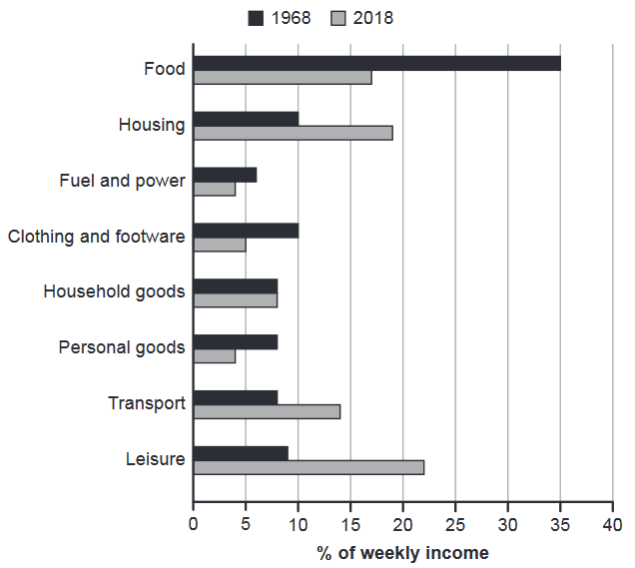
The chart below gives information about how families in one country spent their weekly income in 1968 and in 2018.
Summarise the information by selecting and reporting the main features, and make comparisons where relevant.
1968 and 2018: average weekly spending by families
Student answer (Band 6.0)
The given bar graph represents information about how people in a specific country spent their weekly income in the year 1968 and 2018. Most of the wages were seen invested on eight major categories such as food, housing, fuel and power, clothing and foot ware, household goods, personal goods, transport and leisure.
The major noticeable approach in the graph is that people spent the highest percentage of their income in the year 1968 with approximately 35% was on food and showed rapid decrease in the year 2018 reaching under 20%.
Whereas, In 2018 the weekly income was spent majorly on leisure stuff with about 22% and almost 19% on housing. The least spending of money in both 1968 and 2018 simultaneously was seen on fuel consumption and power utilization with about 6 percent in 1968 and 5% in the year 2018. Housing and leisure has also shown a rapid increase from 1968 to 2018.
AI examiner evaluation
| Criterion | Band |
|---|---|
| Task Achievement / Task Response | 6.0 |
| Coherence and Cohesion | 6.0 |
| Lexical Resource | 6.0 |
| Grammatical Range and Accuracy | 5.5 |
| Overall | 6.0 |
Task Achievement / Task Response: Band 6.0
You identify the main contrast: food was the largest category in 1968, while leisure and housing were prominent in 2018, and you note that housing and leisure increased. These are relevant features and the broad direction of change is clear. However, the overview is incomplete: it does not mention the substantial rise in transport or the declines in clothing, personal goods, and fuel and power, nor that household goods stayed about the same. There is also a factual error in calling fuel and power the lowest category in both years; in 2018, personal goods was equally low at about 4%, while fuel and power was also around 4% (not 5%). Develop the comparisons more fully and report the key figures accurately.
Coherence and Cohesion: Band 6.0
The response has a recognisable progression from an introduction to comments on 1968 and then 2018, so the reader can follow its general focus. The contrast marker “Whereas” also signals a shift between years. However, the information is not grouped into a fully balanced comparison: several categories are omitted, and the final sentence repeats the increase in housing and leisure rather than adding a new comparison. Some linking is awkward or unclear, particularly “The major noticeable approach” and the opening “Whereas” fragment. Organise the body around the largest changes—for example, declining categories and rising or stable categories—and use clear links to show how the years compare.
Lexical Resource: Band 6.0
You use a reasonable range of topic vocabulary, including “percentage,” “categories,” “rapid decrease,” and “increase,” and the meaning is generally understandable. There are also attempts at more formal phrasing, but some choices are unnatural or imprecise for describing a chart. “Wages were seen invested” and “spent majorly on leisure stuff” do not express the data naturally, while “approach” is not an appropriate label for a trend. “Foot ware” is misspelled and should be “footwear”; “fuel consumption and power utilization” is also less direct than the chart’s category name. Prefer concise, accurate reporting language such as “accounted for,” “share of weekly income,” and “rose/fell.”
Grammatical Range and Accuracy: Band 5.5
You attempt both simple and more complex sentence forms, including a comparison between the two years, and the main message can usually be understood. However, some grammatical errors make the writing less controlled. In “with approximately 35% was on food,” the clause structure is faulty; write “approximately 35% was spent on food.” “Housing and leisure has” has a subject–verb agreement error and should be “Housing and leisure have.” The sentence beginning “Whereas” is not a complete sentence as written, and “in the year 1968 and 2018” needs a clearer construction such as “in 1968 and 2018.” Aim for complete sentences and check agreement and clause structure.
See this exact question answered at other band scores. The same prompt compared across bands.
Browse more IELTS Writing model answers or get your own writing scored by the same AI examiner.