Band 5.5 IELTS Writing Task 1 Model Answer
Overall Band Score: 5.5 · IELTS Complete Catalyst · 2026-11-10
IELTS Writing Task 1 question
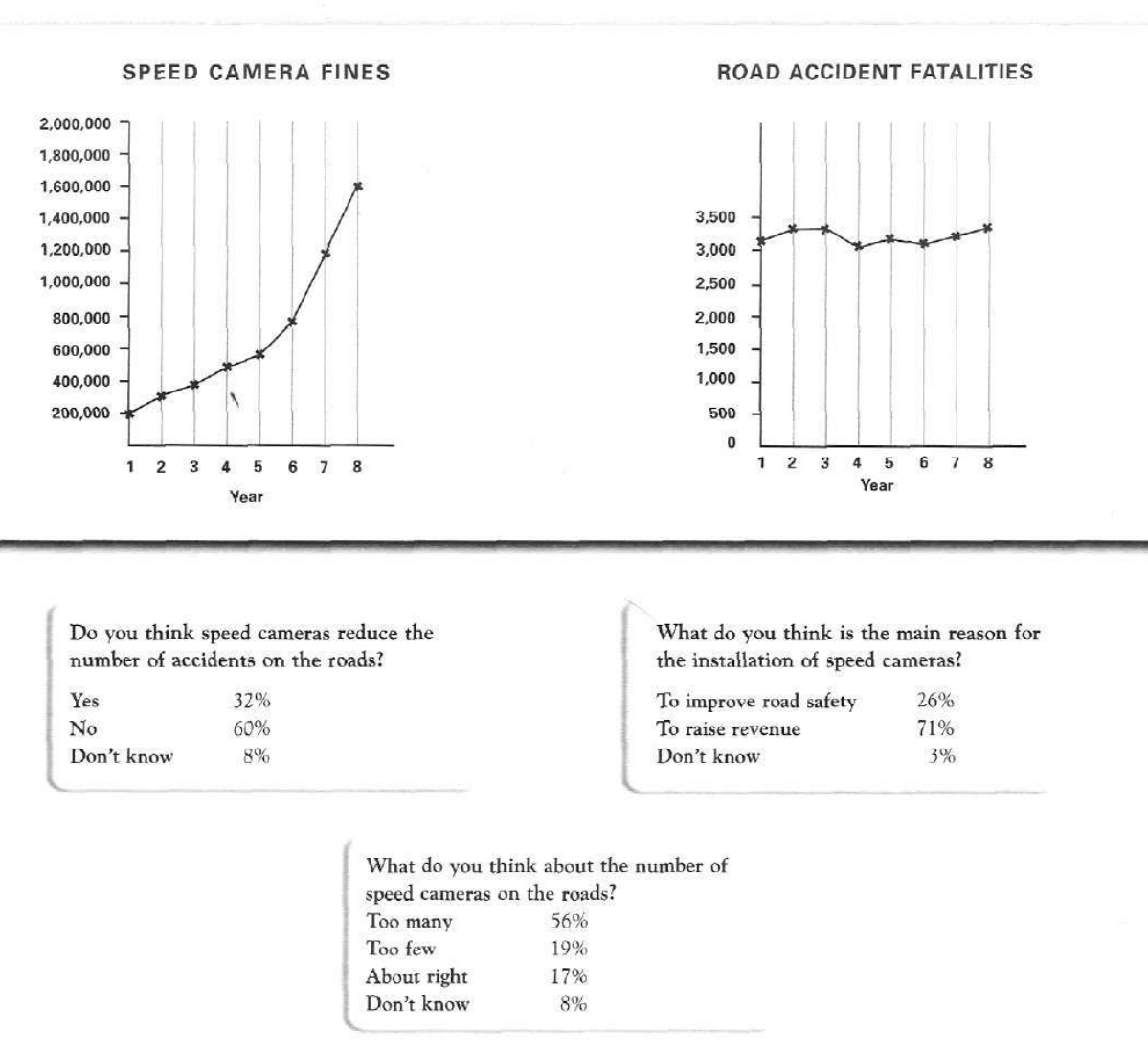
The graphs below show the number of drivers in Britain who have been caught driving too fast by speed cameras placed on roads, and the number of people killed in road accidents, over an eight-year period since the introduction of speed cameras. The tables show the results of a survey on people's opinions on speed cameras.
Write a report for a university lecturer describing the information below.
SPEED CAMERA FINES and ROAD ACCIDENT FATALITIES
Student answer (Band 5.5)
The first line chart of SPEED CAMERA FINES shows that there is a rapid growth in fines from year 1 to 8, amount of fines reached from 200,000 1,600,000.
The secound line ROAD ACCIDENT FATALITIES shows that their is almost no decrease in fatalities from year 1 to 8. minor ups and downs throught out the time period.
a survey has been conducted in which the first question was Do you think speed camera reduce hte number of accidents on the road? 32% of the population said yes, 60% said no and 8% said don't know.
Then next question asked is What do you think is the main reason for the installation of speed cameras? 26% people said to improve road safety, 71% said to raise revenue and 3% dont know.
thuird and the last question is What do you think about the number of speed camers on the roads? 56% people said that too many ,19% too few, 17% about right and 8% dont know.
AI examiner evaluation
| Criterion | Band |
|---|---|
| Task Achievement / Task Response | 5.5 |
| Coherence and Cohesion | 5.5 |
| Lexical Resource | 5.0 |
| Grammatical Range and Accuracy | 5.0 |
| Overall | 5.5 |
Task Achievement / Task Response: Band 5.5
You report the main direction of both charts and include all three survey questions with their percentages. The sharp rise in fines from 200,000 to 1.6 million and the broadly stable fatalities are relevant features. However, the overview is brief and does not clearly compare the two chart trends; fatalities fluctuate around 3,100–3,350 rather than showing a clear decrease. The phrase “amount of fines reached from 200,000 1,600,000” also makes the endpoint relationship unclear. The survey figures are generally accurate, but the report mostly lists responses instead of selecting and highlighting the strongest contrasts, such as the 60% who reject the cameras’ effect and the 71% who believe revenue is the main motive. A clearer overview and more precise comparisons would strengthen coverage.
Coherence and Cohesion: Band 5.5
The response follows a broadly sensible order: it describes the two charts first and then presents the survey questions in sequence. This makes the source of most information easy to identify. However, the report has no clear paragraphing or developed overview, and the progression is largely a list of chart labels and survey questions. Connectors such as “Then next question” and “third and the last question” are repetitive and mechanical. The chart descriptions would be easier to follow if grouped into a paragraph with a concise comparison, followed by a separate paragraph summarising the survey’s main findings. Use linking language to show contrasts and relationships, rather than simply moving from one question to the next.
Lexical Resource: Band 5.0
You use some relevant task vocabulary, including “fines,” “fatalities,” “survey,” “installation,” and “road safety,” so the topic is generally clear. However, the range is limited and several word-choice or spelling problems reduce precision: “rapid growth” is less natural than “sharp increase,” “amount of fines” is awkward for a count, and “minor ups and downs” is informal for an academic report. There are also noticeable misspellings, including “secound,” “throught,” “hte,” “thuird,” and “camers.” Aim for accurate, formal collocations and vary the language used to describe trends and proportions. Proofreading spelling and choosing more precise terms would make the report clearer and more appropriate to the task.
Grammatical Range and Accuracy: Band 5.0
Most sentences use simple structures, and the reader can usually understand the intended information. However, grammatical errors occur frequently and sometimes make relationships unclear. For example, “amount of fines reached from 200,000 1,600,000” lacks a clear construction and the preposition needed to express the change. In “their is almost no decrease,” the subject–verb form is incorrect, while “minor ups and downs throught out the time period” is a fragment rather than a complete sentence. The survey introductions also shift awkwardly between tenses, as in “Then next question asked is.” Practise complete sentences, consistent past-tense reporting, and accurate articles and verb forms. Adding a few controlled complex sentences would also broaden the range.
See this exact question answered at other band scores. The same prompt compared across bands.
Browse more IELTS Writing model answers or get your own writing scored by the same AI examiner.