Band 6.0 IELTS Writing Task 1 Model Answer
Overall Band Score: 6.0 · IELTS Complete Catalyst · 2026-11-12
IELTS Writing Task 1 question
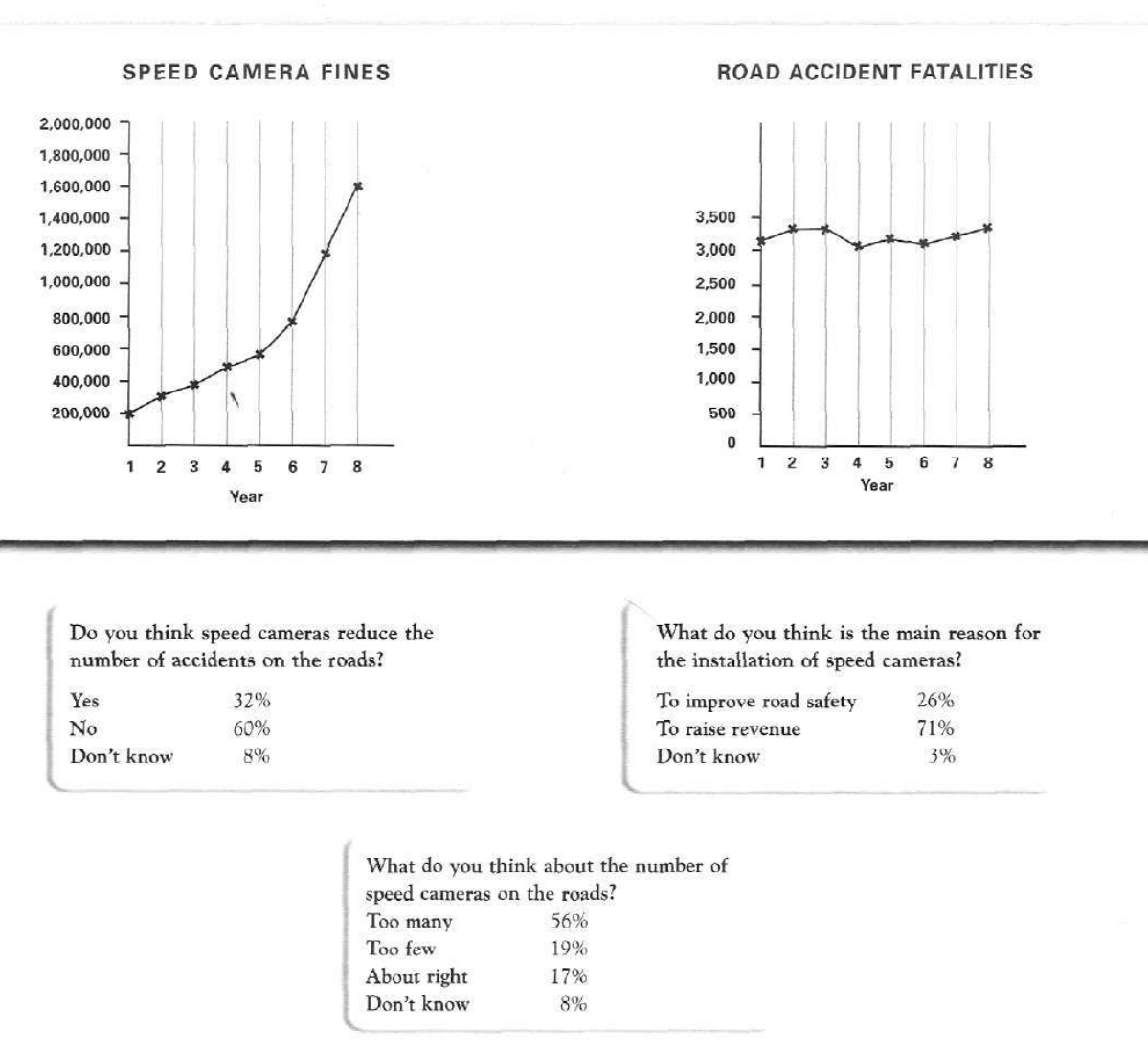
The graphs below show the number of drivers in Britain who have been caught driving too fast by speed cameras placed on roads, and the number of people killed in road accidents, over an eight-year period since the introduction of speed cameras. The tables show the results of a survey on people's opinions on speed cameras.
Write a report for a university lecturer describing the information below.
SPEED CAMERA FINES and ROAD ACCIDENT FATALITIES
Student answer (Band 6.0)
The given illustrations represent the information about the number of people overspeeding that were captured by cameras on roads and the number of deaths due to road accidents over the time period of eight years in Britain. People's opinions on speed cameras were also shown in the tables with the help of a survey.
Firstly, the number of drivers fined for speed driving was 200,000 in the beginning, and it kept increasing in the given time period by being upto 500,000 in the fourth and 600,000 in the fifth year. In year seven, in jumped to 1,200,000 and reached to the peak of 1,600,000 in the last year of the given time period. Whereas, the number of deaths caused by road accidents ranged between 3,000 and 3,500 for the whole eight years.
In the survey conducted to know people's opinion on speed cameras resulted with 32% people in the favour of cameras while 60% disagreements. 71% of people opined that the main reason for camera installation was to raise revenue while 26% of the people thought that it was for road safety. Majority of people ( 56%) considered the number of cameras more than needed while 19% say that they are too less. 17% of the people agreed with the number of installings.
Overall, majority of people were not in the favour of speed cameras but they assist to catch speed drivers easily.
AI examiner evaluation
| Criterion | Band |
|---|---|
| Task Achievement / Task Response | 6.0 |
| Coherence and Cohesion | 6.5 |
| Lexical Resource | 5.5 |
| Grammatical Range and Accuracy | 5.5 |
| Overall | 6.0 |
Task Achievement / Task Response: Band 6.0
You cover both charts and the survey, and the main pattern in fines is clear: they rise from 200,000 to 1.6 million, while fatalities remain within a relatively narrow range. The survey figures are also mostly reported accurately, including the 60% who say cameras do not reduce accidents and the 71% who believe revenue is the main reason for installation. Some details are imprecise: fines in year five are about 580,000, not 600,000, and the year-seven figure is about 1.18 million. The overview is less effective because the final claim that cameras “assist to catch speed drivers easily” is not demonstrated by the data, and it does not clearly summarise the stable fatality trend or the survey’s overall scepticism. Develop these key comparisons more explicitly.
Coherence and Cohesion: Band 6.5
The report has a clear overall arrangement: an introduction, a paragraph on the two time-series, a paragraph on survey results, and a concluding statement. This makes the information easy to locate, and linking expressions such as “Firstly,” “Whereas,” and “Overall” help signal movement between points. The progression is generally logical, though the final overview introduces an unsupported conclusion rather than drawing together the main findings already described. Some connections are also mechanical or unclear, particularly “In the survey conducted to know people's opinion on speed cameras resulted with…”. A more direct topic sentence and clearer links between the survey’s three questions would improve flow. The paragraphing is appropriate; aim for more precise referencing and a conclusion that synthesises the data.
Lexical Resource: Band 5.5
You use a reasonable range of task-related vocabulary, including “fined,” “ranged,” “installation,” “revenue,” and “road safety,” so the main information is understandable. However, several choices are awkward or inaccurate for a formal data report: “speed driving,” “deaths caused by road accidents,” “in the favour,” and “number of installings.” “People overspeeding that were captured” is also an imprecise way to describe drivers caught by cameras. These collocation and word-form problems make the writing less natural and sometimes reduce precision, although the intended meaning is usually recoverable. Prefer standard reporting phrases such as “drivers caught speeding,” “fatalities,” and “the number of cameras.” Check that nouns and phrases fit the context before using less familiar forms.
Grammatical Range and Accuracy: Band 5.5
You attempt both simple and more complex sentence forms, for example, “Whereas, the number of deaths… ranged…” and the sentence comparing the survey responses. Meaning is generally clear, but some grammatical errors remain. In “In year seven, in jumped,” the subject pronoun is incorrect; “it” is needed. The construction “In the survey conducted… resulted with” lacks a clear grammatical subject, while “19% say” and “17%… agreed” shift tense inconsistently in a report about survey results. There are also issues with articles and sentence boundaries, such as the comma after “Whereas” and the phrasing “in the beginning.” Work on complete sentence structures, consistent past-tense reporting, and accurate subject–verb patterns. These corrections would make your varied sentences more controlled.
See this exact question answered at other band scores. The same prompt compared across bands.
Browse more IELTS Writing model answers or get your own writing scored by the same AI examiner.