Band 5.0 IELTS Writing Task 1 Model Answer
Overall Band Score: 5.0 · IELTS Complete Catalyst · 2026-11-12
IELTS Writing Task 1 question
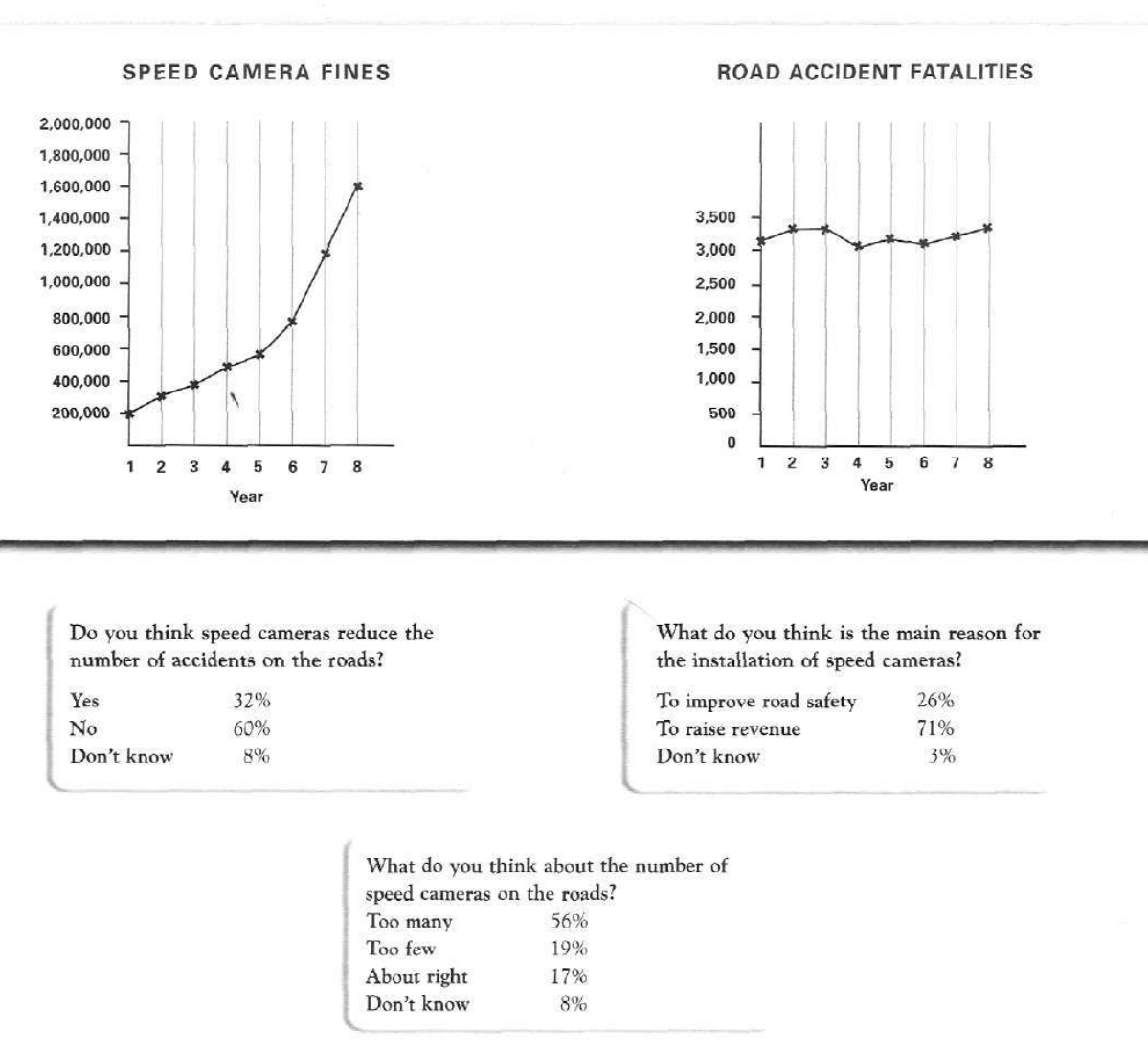
The graphs below show the number of drivers in Britain who have been caught driving too fast by speed cameras placed on roads, and the number of people killed in road accidents, over an eight-year period since the introduction of speed cameras. The tables show the results of a survey on people's opinions on speed cameras.
Write a report for a university lecturer describing the information below.
SPEED CAMERA FINES and ROAD ACCIDENT FATALITIES
Student answer (Band 5.0)
The line graph illustrates; the speed camera fines and road accident fatalities on britain, While the tables show the results of a survey people opinion on camera.
Overall; it has been observed that in eight years it was same in number of percentage on three tables.
Looking at the, table on spped camera fines it was constantly rise up from 200,000 to 1,600,000 on eight years. Although, on road accident fatalities was decreased on year four up to 2,000. Futhermore, it was again increased up to 1,000 and on three years it was rise up and become 3,400.
In terms of tables, I think the speed cameras does not reduce the number of accidents on the roads because 60% of people said no in box. Meanwhile, The younger raise revenue is the main reason for the installation of speed camera on road and In last , I think too many up to 56% number of speed cameras on the roads said by the government.
AI examiner evaluation
| Criterion | Band |
|---|---|
| Task Achievement / Task Response | 4.5 |
| Coherence and Cohesion | 5.0 |
| Lexical Resource | 5.0 |
| Grammatical Range and Accuracy | 4.5 |
| Overall | 5.0 |
Task Achievement / Task Response: Band 4.5
The response identifies the two charts and survey tables and includes several relevant figures, such as fines rising from 200,000 to 1,600,000 and 60% believing cameras do not reduce accidents. However, the overview is inaccurate: “it was same in number of percentage on three tables” does not summarise the main findings. The fatalities did not fall to 2,000; they fluctuated around 3,100–3,350, ending slightly higher than they began. The account of the survey also omits the 32% who answered yes and the 26% who cited road safety, while “said by the government” is unsupported. Select the key trends accurately and compare the survey results rather than adding personal opinions.
Coherence and Cohesion: Band 5.0
There is a basic attempt to organise the report, moving from an introduction and overview to chart details and then survey results. Linking expressions such as “Overall,” “Furthermore,” and “Meanwhile” show an effort to connect ideas. However, progression is difficult to follow because the overview is unclear and the chart and table information are not consistently separated. “Looking at the, table on speed camera fines” misidentifies a graph as a table, and “In last” does not clearly signal the final survey point. Some connectors are used inaccurately or mechanically. Use clear paragraphs for the overview, graph trends, and survey findings, and make each transition express the relationship between ideas precisely.
Lexical Resource: Band 5.0
The response uses some task-related vocabulary, including “speed camera fines,” “road accident fatalities,” “reduce,” and “installation,” so the topic is generally recognisable. However, the range is limited and several word choices or collocations make the meaning awkward: “constantly rise up,” “decreased on year four,” and “The younger raise revenue” do not express the intended data clearly. There are also spelling errors such as “spped” and “Futhermore,” and “number of percentage” is not an appropriate phrase. Build a small set of accurate trend expressions, such as “rose steadily,” “fluctuated,” and “accounted for,” and check spelling and word forms before finishing.
Grammatical Range and Accuracy: Band 4.5
The response attempts both simple statements and longer sentences, but control is weak and errors frequently make relationships between ideas unclear. For example, “it was constantly rise up” has an incorrect verb form, while “the speed camera fines and road accident fatalities on britain” is not a complete, well-formed introduction. Agreement and sentence construction are also problematic in “the speed cameras does not reduce,” and punctuation is inconsistent, with unnecessary semicolons and capitalisation such as “While” and “The” mid-sentence. Practise accurate past-tense reporting and complete sentence patterns, for example, “Fines rose steadily, whereas fatalities fluctuated.” Use full stops to separate the main points.
See this exact question answered at other band scores. The same prompt compared across bands.
Browse more IELTS Writing model answers or get your own writing scored by the same AI examiner.