Band 4.5 IELTS Writing Task 1 Model Answer
Overall Band Score: 4.5 · IELTS Complete Catalyst · 2026-11-12
IELTS Writing Task 1 question
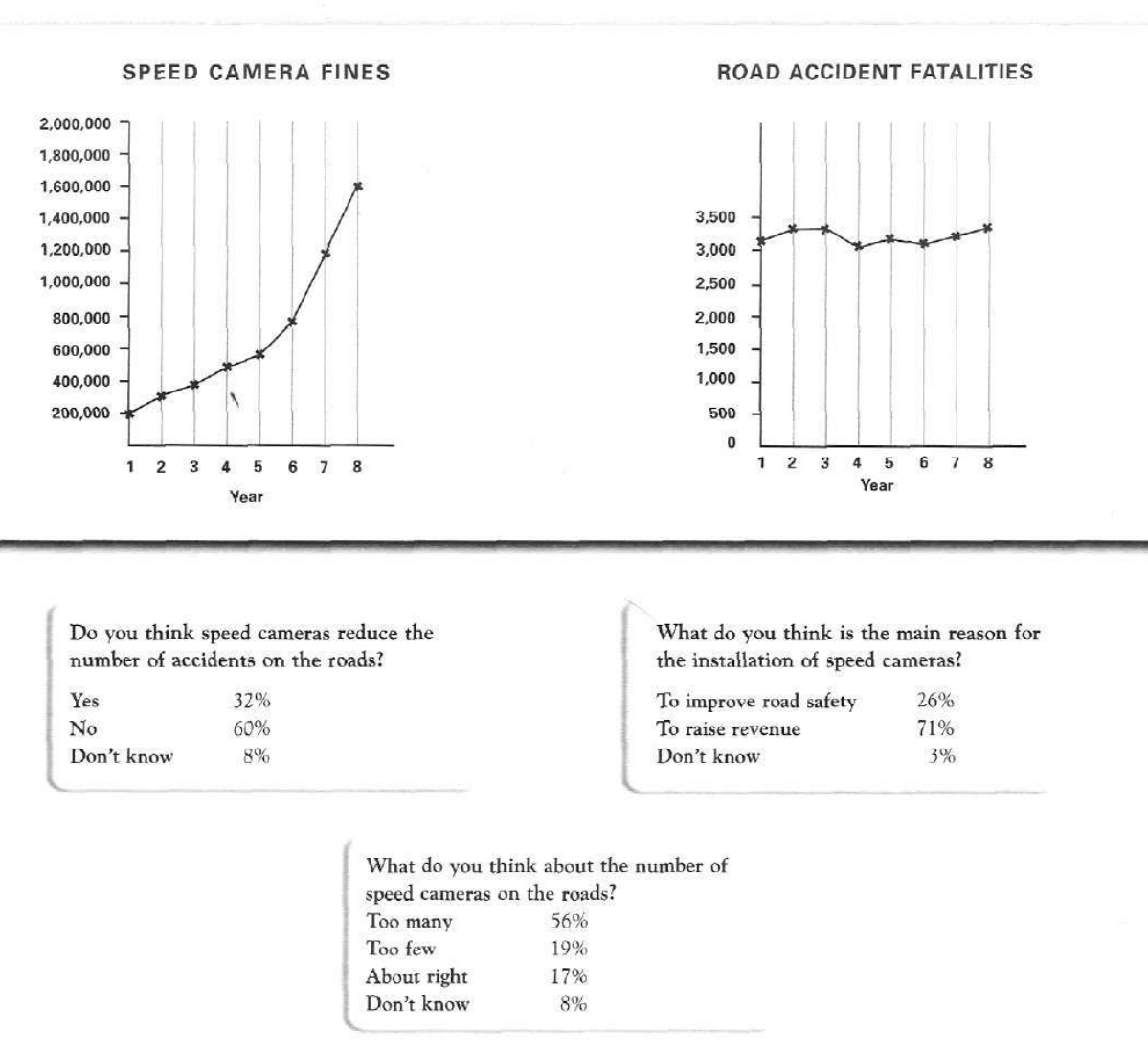
The graphs below show the number of drivers in Britain who have been caught driving too fast by speed cameras placed on roads, and the number of people killed in road accidents, over an eight-year period since the introduction of speed cameras. The tables show the results of a survey on people's opinions on speed cameras.
Write a report for a university lecturer describing the information below.
SPEED CAMERA FINES and ROAD ACCIDENT FATALITIES
Student answer (Band 4.5)
According to the graphs of the speed camera fines and road accident fatalities, I observe this, it is a good inovation for the big cities becouse they contain heaivy traffic. The number of fines was increas every year and the number of rood accident remains same. So, according to me, if we follow the rules we will save our lives and as wall as others life. Becaus life is the most important thing in the world.
But people have different views about speed cameras, most of them said that speed cameras cannot reduce the accidents, some said that yes speed cameras reduce the accedents and a little bit of them said they don't know about this.
At other hand, most people think that government install speed cameras to raise their revenue, some said that they install them to improve saf
AI examiner evaluation
| Criterion | Band |
|---|---|
| Task Achievement / Task Response | 4.0 |
| Coherence and Cohesion | 4.5 |
| Lexical Resource | 4.5 |
| Grammatical Range and Accuracy | 4.5 |
| Overall | 4.5 |
Task Achievement / Task Response: Band 4.0
You identify two broad patterns: fines increased, while fatalities stayed roughly stable, and you report several survey opinions, including that 60% rejected the idea that cameras reduce accidents and 71% thought revenue was the main reason. However, the report is incomplete and only minimally addresses the visual data. It gives no figures or stages for the graph trends, omits the survey result about the number of cameras, and ends mid-sentence at “improve saf…”. The personal comments about big cities and saving lives do not replace an objective summary of the data. The response is also below the required 150 words. To improve, complete the report and select key figures and comparisons from both graphs and all three survey questions.
Coherence and Cohesion: Band 4.5
There is a basic attempt to group the graph information first and survey opinions afterwards, and phrases such as “But” and “At other hand” signal a change in focus. However, the progression is difficult to follow because the opening combines data description with personal opinion, and the final paragraph is cut off before its point is completed. Connections between ideas are often unclear, as in “I observe this, it is a good innovation…” and “So, according to me…”. The survey results are presented as a loose sequence rather than organised comparisons. Use a clear overview followed by separate paragraphs for the graph trends and survey findings, and connect each claim directly to its supporting figures.
Lexical Resource: Band 4.5
The response uses some relevant topic vocabulary, including “speed camera fines”, “road accident fatalities”, “reduce the accidents” and “raise their revenue”, so the general subject is recognisable. However, the range is basic and several spelling and word-choice errors make the report less clear, such as “inovation”, “heaivy”, “rood”, “accedents” and “as wall as”. Some expressions are also unsuitable for a formal data report, particularly “according to me” and “the most important thing in the world”. Aim for precise, neutral language to describe trends and survey proportions. For example, use “rose steadily” or “increased sharply” for the fines, and “remained broadly stable” for fatalities, rather than relying on general statements.
Grammatical Range and Accuracy: Band 4.5
You attempt both simple and joined sentences, including “The number of fines was increas every year and the number of rood accident remains same.” However, errors in verb forms, agreement, articles and sentence construction are frequent, and they sometimes make relationships between ideas unclear. For instance, “was increas” needs a correct past-tense form, while “the number of road accident remains same” needs agreement and an article. The opening also joins clauses awkwardly in “I observe this, it is…”, and the final sentence is incomplete. Practise writing complete, controlled sentences in the past tense for the eight-year data, checking singular/plural agreement and articles. A few accurate complex sentences would help express comparisons more clearly.
See this exact question answered at other band scores. The same prompt compared across bands.
Browse more IELTS Writing model answers or get your own writing scored by the same AI examiner.