Band 5.5 IELTS Writing Task 1 Model Answer
Overall Band Score: 5.5 · IELTS Complete Catalyst · 2026-11-13
IELTS Writing Task 1 question
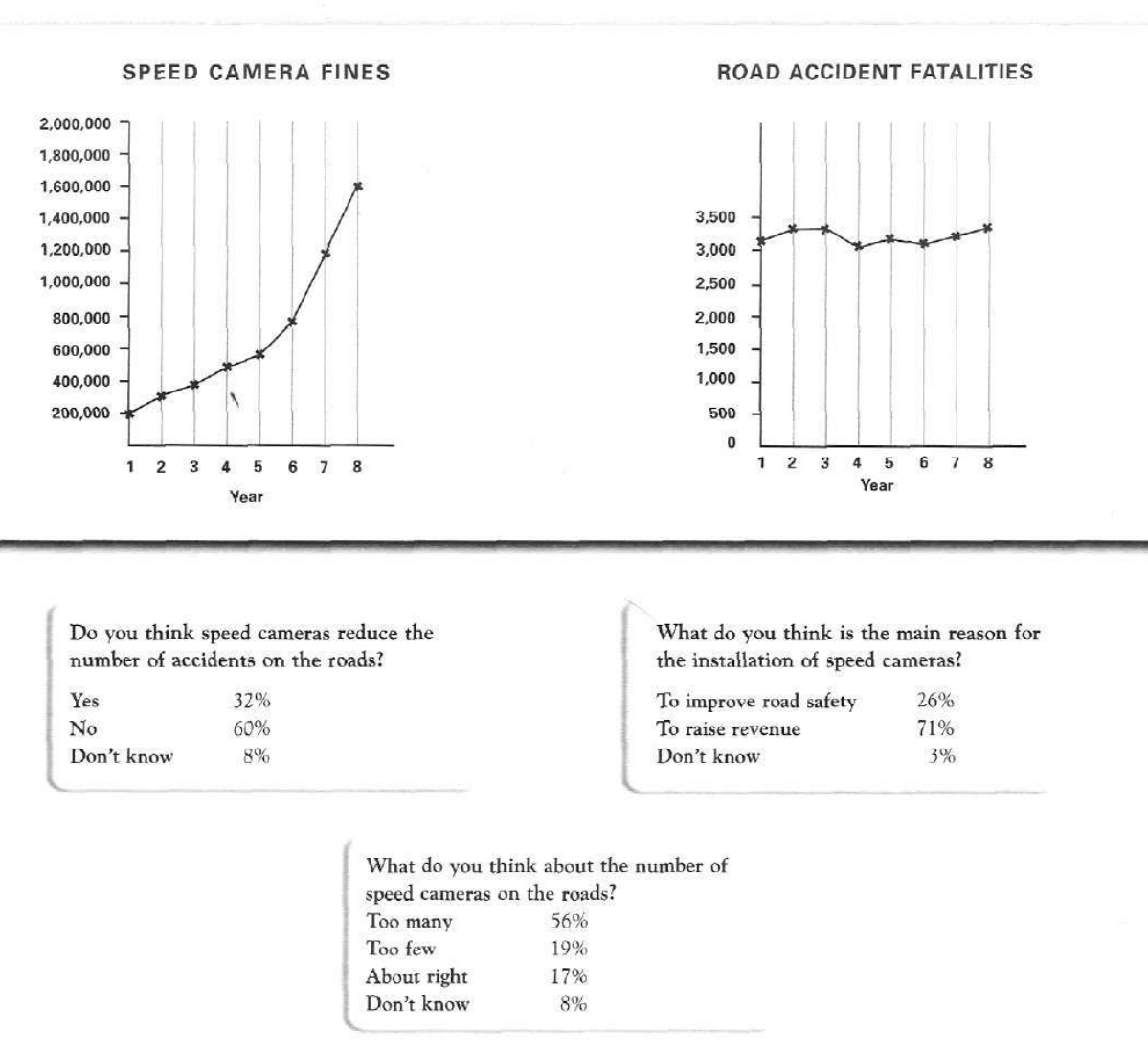
The graphs below show the number of drivers in Britain who have been caught driving too fast by speed cameras placed on roads, and the number of people killed in road accidents, over an eight-year period since the introduction of speed cameras. The tables show the results of a survey on people's opinions on speed cameras.
Write a report for a university lecturer describing the information below.
SPEED CAMERA FINES and ROAD ACCIDENT FATALITIES
Student answer (Band 5.5)
It is a graph that is showing the number of people who caught driving too fast by the cameras placed on the road. Over an eight year period, the government recieved a lot of money as fines. At the start of the installation of speed cameras, less people were paying fines but as they showed progress the people who pay fines increased. Altough there was a steady increase in the amount of fine, the people who die in road accidents remain almost similar. On an average, almost 3000 individuals lose their lives every year due to road accidents. In addition to this, a survey was conducted in Britain to check the effectivness of cameras as well as to know the level of satisfaction of people by their installation. Half of the British believe that they donot have reduced the number of accidents on road and they also think that generation of revenue was the main purpose behind installing the cameras. More than half of the population says that the number of cameras on the roads is too much while some people suggest that there must be more like them on the roads.
AI examiner evaluation
| Criterion | Band |
|---|---|
| Task Achievement / Task Response | 6.0 |
| Coherence and Cohesion | 5.0 |
| Lexical Resource | 5.5 |
| Grammatical Range and Accuracy | 5.5 |
| Overall | 5.5 |
Task Achievement / Task Response: Band 6.0
You cover both the charts and the survey, and identify the main contrast: fines rose while fatalities stayed broadly stable. The statement that around 3,000 people died annually is a useful overview, and you correctly report that most respondents viewed revenue as the main purpose and considered there to be too many cameras. Some details, however, are imprecise or incomplete. “Half” is not an accurate summary of the 60% who said cameras do not reduce accidents, and “some people” obscures the specific survey proportions. The fines trend is described generally but lacks figures to show its substantial rise from about 200,000 to 1.6 million. A clearer overview and a few selected comparisons from both charts and all three survey questions would make the report more fully informative.
Coherence and Cohesion: Band 5.0
The response follows a broadly sensible order: it introduces the charts, describes the two trends, and then turns to the survey. Linking phrases such as “Although” and “In addition to this” help signal relationships between ideas. However, the whole report is presented as one paragraph, so the shift from chart data to survey findings is not clearly marked. Several ideas are also joined into long sentences, particularly the final sentence, which combines opinions about camera numbers without clearly distinguishing the survey results. Use separate paragraphs for the charts and survey, and organise each around a clear main point. More precise referencing and transitions would help the reader follow the comparisons rather than relying on a sequence of loosely connected statements.
Lexical Resource: Band 5.5
You use relevant vocabulary for the topic, including “fines,” “road accidents,” “revenue,” and “installation,” and the meaning is generally clear. There are also attempts at more formal reporting language, such as “On an average” and “the main purpose.” However, some word choices and collocations are inaccurate or vague: “people who caught driving too fast” does not clearly express that drivers were caught, while “showed progress” is unsuitable for describing a rising figure. “The number of cameras … is too much” is also imprecise when reporting a survey response. Spelling errors such as “recieved” and “effectivness” reduce accuracy. Build a more precise range for describing trends and survey proportions, and check spelling and natural word combinations.
Grammatical Range and Accuracy: Band 5.5
You attempt a mixture of simple and more complex sentences, including a contrast with “Although” and a clause beginning “while.” Most of the message remains understandable, but some grammatical errors affect clarity. For example, “the number of people who caught driving too fast” is missing a suitable passive construction, and “the people who die … remain almost similar” has an awkward tense and subject–verb relationship. In “they donot have reduced,” the auxiliary and verb form are incorrect; the intended meaning needs a correctly formed present perfect. There are also issues with articles and sentence boundaries. Practise accurate passive forms and verb patterns, and divide longer sentences where several ideas are being reported. This would improve control while retaining your attempts at complex structures.
See this exact question answered at other band scores. The same prompt compared across bands.
Browse more IELTS Writing model answers or get your own writing scored by the same AI examiner.