Band 6.0 IELTS Writing Task 1 Model Answer
Overall Band Score: 6.0 · IELTS Complete Catalyst · 2026-11-15
IELTS Writing Task 1 question
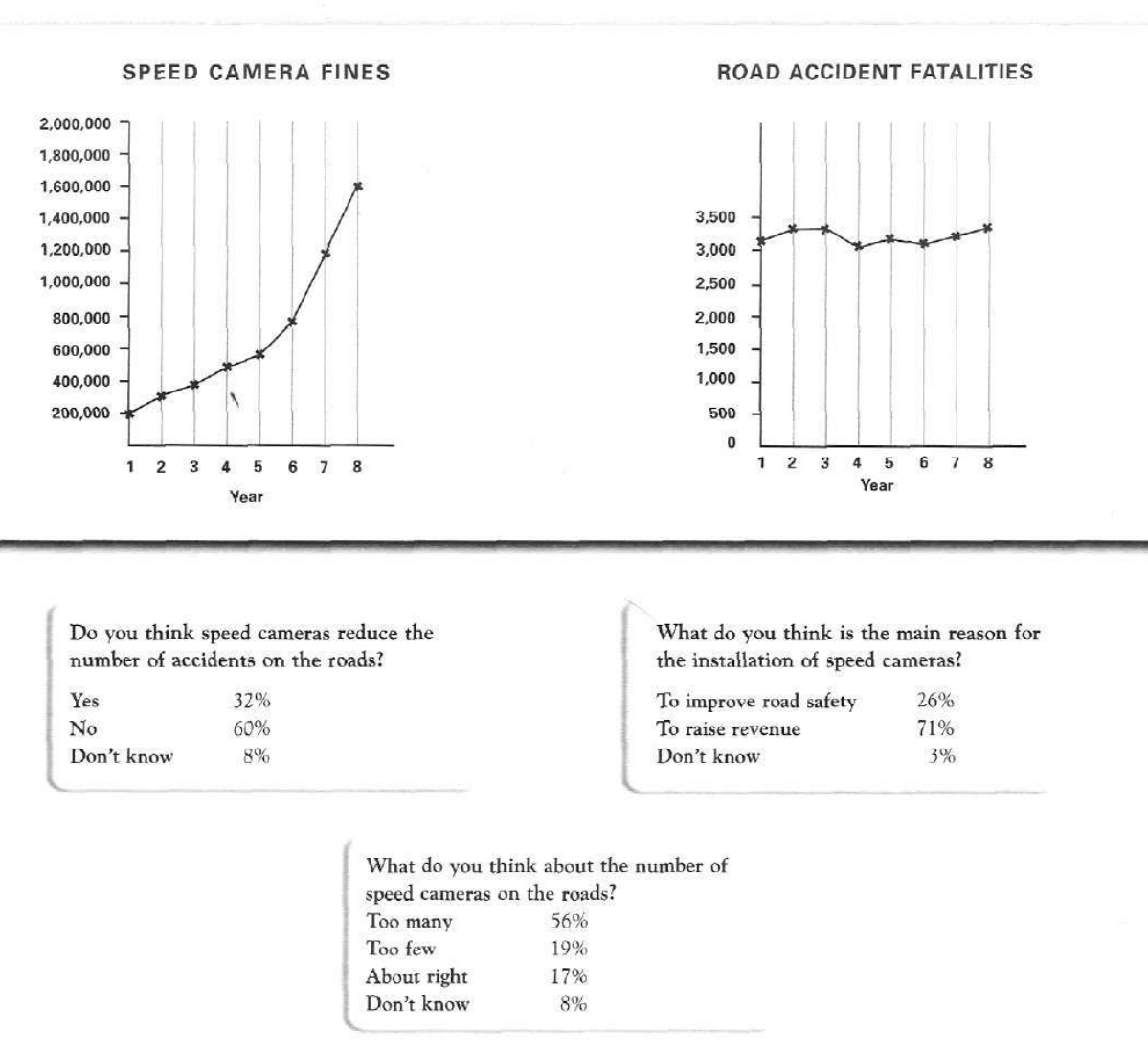
The graphs below show the number of drivers in Britain who have been caught driving too fast by speed cameras placed on roads, and the number of people killed in road accidents, over an eight-year period since the introduction of speed cameras. The tables show the results of a survey on people's opinions on speed cameras.
Write a report for a university lecturer describing the information below.
SPEED CAMERA FINES and ROAD ACCIDENT FATALITIES
Student answer (Band 6.0)
The statistical analysis illustrated traffic camera, accidents on roads and survey about cameras installed on roads. Overall, speed camera fines rose abruptly in the last three years while road accidents were steady, also the reviews of the people were negative.
Initialy, the speed camera fines were not too high and in the first year it was only 2 lac and with slow incline each year, the fines rose to 5 lac in the 5th year. But, for the 6th year onward, drivers made more mistakes and in the 6th, 7th and 8th year, fines reached to 16 lac with quick sansations. The road fatalities due to accidents were almost same with no matigation or increase.
The opinions of the people about raod safety cameras were mostly not supportive as 60 percent masses told that number of accidents did not decrease with cameras. While, 32% people said that the cameras installation has matigate the number of accidents and 8% were neutral. Asking about safety cameras' reasons, 71% told that governments want to rise the revenue but 26% ideas were different and they belive that this will improve raod safety while 3% were neutral. When, people were questioned about number, 56% answered too many, 19% told 'too few', 17% said ok while 8% were on either side.
AI examiner evaluation
| Criterion | Band |
|---|---|
| Task Achievement / Task Response | 6.5 |
| Coherence and Cohesion | 6.0 |
| Lexical Resource | 5.0 |
| Grammatical Range and Accuracy | 5.5 |
| Overall | 6.0 |
Task Achievement / Task Response: Band 6.5
You cover both charts and all three survey questions, and your overview identifies the main contrast: fines rise sharply while fatalities remain broadly stable. The survey figures are also mostly reported accurately, including the 60% who said cameras do not reduce accidents and the 71% who thought revenue was the main reason for installation. This meets the task well, with some features more fully handled than others. However, the fines description becomes inaccurate when you say they “reached to 16 lac” across years 6–8; the figures rise from about 7.8 lakh to 11.8 lakh and then 16 lakh. The overview that public reviews were “negative” is also broad: views differ across the questions. Clarify these points and describe the fatalities’ small fluctuations more precisely to strengthen the report further.
Coherence and Cohesion: Band 6.0
The response has a recognisable report structure: an introduction and overview are followed by chart details and then survey results. This gives the reader a coherent overall route through the information. Some linking is effective, such as “Overall” and “While,” but transitions are occasionally mechanical or awkward, including “But, for the 6th year onward” and “When, people were questioned.” The final paragraph also packs three survey questions into one long sequence, making comparisons harder to follow. Use separate sentences or clearer grouping for each question, and make the relationship between the overview and the detailed figures more explicit. These changes would improve progression and make cohesion less dependent on repeated linking words.
Lexical Resource: Band 5.0
You use relevant vocabulary for the topic, including “fines,” “road fatalities,” “revenue,” and “neutral,” and you attempt more formal expressions such as “statistical analysis.” However, inaccurate word choice and spelling are noticeable and sometimes make the meaning unclear. “Quick sansations” does not convey the intended increase in fines, while “matigation” appears where you mean a reduction or mitigation; “reviews” is also an imprecise description of survey opinions. There are spelling errors such as “Initialy,” “raod,” and “belive,” alongside unnatural phrases such as “60 percent masses.” Aim for precise, conventional collocations and check spelling carefully. A more controlled vocabulary would make the report clearer without requiring unnecessarily elaborate wording.
Grammatical Range and Accuracy: Band 5.5
You attempt a mix of simple and complex sentences, including clauses beginning “while” and “as,” and the main message is generally understandable. Some grammatical errors remain, particularly in sentence construction and punctuation. For example, “Overall, speed camera fines rose abruptly in the last three years while road accidents were steady, also the reviews…” joins ideas awkwardly; use a full stop or a suitable conjunction. “Asking about safety cameras’ reasons” is not a complete, natural clause, and “When, people were questioned” has an unnecessary comma after the introductory word. There are also article and number-pattern issues in phrases such as “the cameras installation.” Review clause boundaries, articles, and sentence openings, while continuing to use varied structures. More consistent control would make the report easier to read.
See this exact question answered at other band scores. The same prompt compared across bands.
Browse more IELTS Writing model answers or get your own writing scored by the same AI examiner.