Band 4.0 IELTS Writing Task 1 Model Answer
Overall Band Score: 4.0 · IELTS Complete Catalyst · 2026-11-18
IELTS Writing Task 1 question
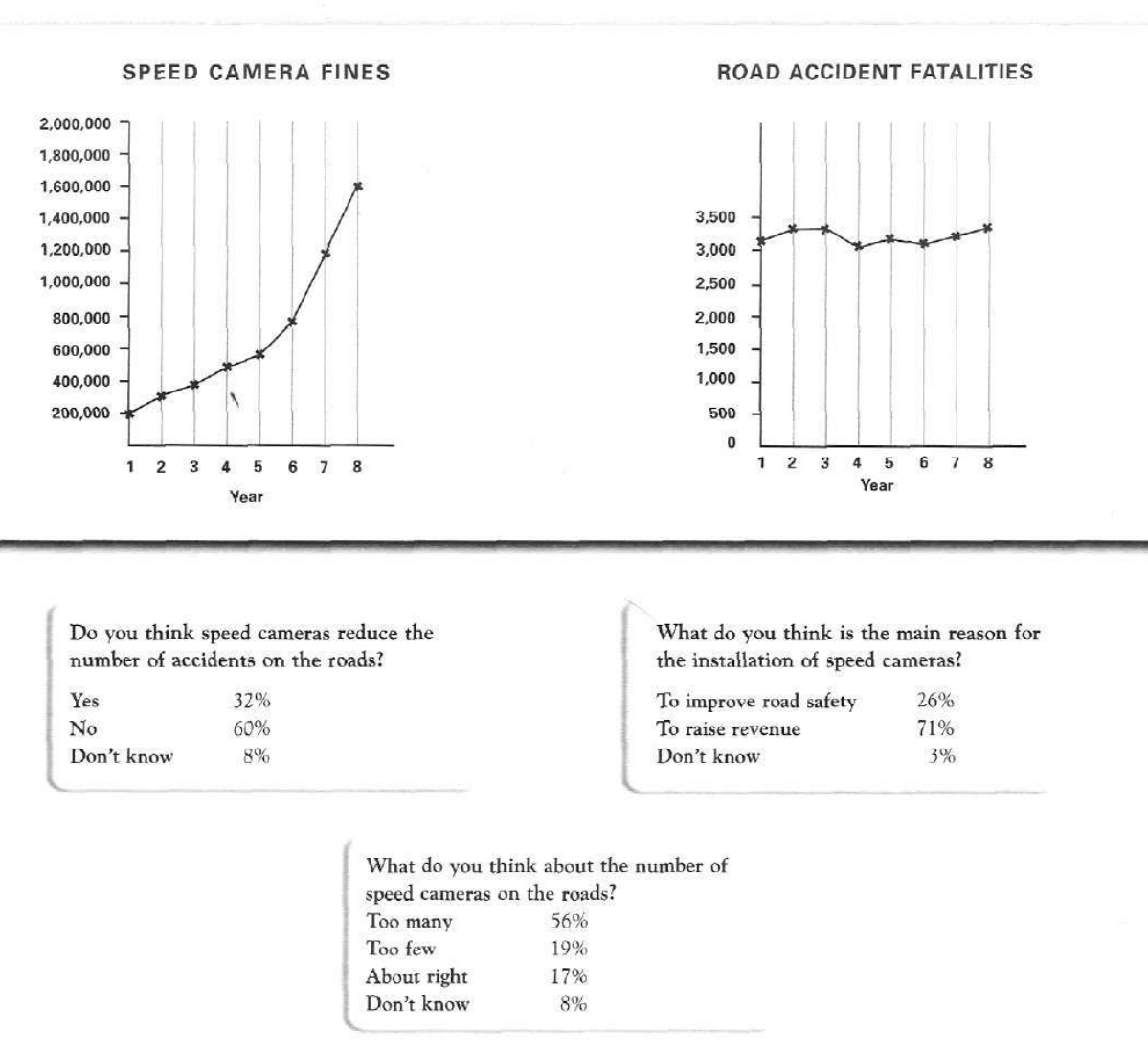
The graphs below show the number of drivers in Britain who have been caught driving too fast by speed cameras placed on roads, and the number of people killed in road accidents, over an eight-year period since the introduction of speed cameras. The tables show the results of a survey on people's opinions on speed cameras.
Write a report for a university lecturer describing the information below.
SPEED CAMERA FINES and ROAD ACCIDENT FATALITIES
Student answer (Band 4.0)
THE GRAPH LINE ILLUSTRATE THE AMOUNT OF DRIVERS IN BARTAIN WHO HAVE BEEN FASETER DRIVERS CAUGHT CAMERAS PLACED ON ROADS ANDHOW MANY INDIVIDUALS KILL IN THE ROAD ACCIDANT ,TOTALY AN 8YEARS BETWEEN THE INTRODUCTION OF SPEED CAMERAS .
INOVERALL, TOTALLY DIRVERS HWO TO MUCH SPEED ON THE ROAD .AND HOW MANY KILLS ROAD ACCIDENT FATALITIES OVERAL 3000 KILL SO INCREASE TO SOMETHING 3500 KILL .
AND THE OTHOR HAND SPEED CAMERA FINES 2 LAKH START TO ALMOST CLIMBED UP TO ABOUT 4 LAKH ITS NATRULLY TREND BECAUSE DRIIVER SPEED CONTINULY UP TO TREND .AND THE SECOND HAND ROAD ACCIDENT FATALITEIES EVERY YEAR FLUCTUATIONS .AND SPEED CAMERA LAST FINE A RISE TO AUROUND 16 LAKH IN THE LAST YAER
AI examiner evaluation
| Criterion | Band |
|---|---|
| Task Achievement / Task Response | 3.0 |
| Coherence and Cohesion | 4.0 |
| Lexical Resource | 4.5 |
| Grammatical Range and Accuracy | 4.0 |
| Overall | 4.0 |
Task Achievement / Task Response: Band 3.0
The response identifies the broad subject of both line graphs and notes that fines rise while fatalities fluctuate, so it includes a few relevant observations. However, coverage is very incomplete: none of the three survey results is reported, and the overview is unclear. Some figures are inaccurate or confusing: fatalities are described as rising from about 3,000 to 3,500, although they remain roughly between 3,100 and 3,350; fines are said to rise from 2 lakh to almost 4 lakh before later reaching 16 lakh, which does not accurately summarise the steady increase. The report is also 32 words below the required minimum. To improve, cover both graphs and all survey questions, give a clear overview, and select accurate comparisons.
Coherence and Cohesion: Band 4.0
There is a basic attempt to organise the response into an opening, an overview-like paragraph, and a final paragraph about the graphs. The reader can recognise that fines and fatalities are being discussed, and phrases such as “on the other hand” attempt to signal a contrast. However, the ideas are not arranged coherently enough: the final paragraph moves between fines and fatalities without a clear sequence, and the overview does not clearly state the main trends. Several sentences are difficult to follow because connections between clauses are missing or unclear. Use separate paragraphs for the overview, graph details, and survey findings, and present each set of figures in a consistent order.
Lexical Resource: Band 4.5
The response uses some task-related vocabulary, including “speed camera fines,” “road accident fatalities,” “fluctuations,” and “increase,” which shows an attempt to describe data rather than rely only on general language. However, spelling and word-choice problems frequently make the meaning difficult to recover, as in “BARTAIN,” “FASETER drivers,” “accidant,” and “natrullly trend.” Some expressions are also unnatural or imprecise, such as “totally drivers who to much speed” and “last fine a rise.” Build a reliable set of chart-description phrases and check spelling carefully. For example, use “the number of drivers caught speeding” and “fines rose steadily” instead of the unclear phrases in the response.
Grammatical Range and Accuracy: Band 4.0
The response attempts to form several sentences and uses a few linking expressions, but grammatical control is very limited. Errors in sentence structure and verb forms often obscure the intended meaning: “The graph line illustrate” lacks agreement, while “how many individuals kill in the road accident” does not form a correct clause. Articles, plurals, and tense are also frequently missing or inconsistent, as in “overal 3000 kill” and “every year fluctuations.” Most sentences are fragments or run together, and punctuation does not reliably separate ideas. Practise writing complete subject–verb sentences in the past tense, such as “The number of fines increased, while fatalities fluctuated,” before attempting longer structures.
See this exact question answered at other band scores. The same prompt compared across bands.
Browse more IELTS Writing model answers or get your own writing scored by the same AI examiner.