Band 6.5 IELTS Writing Task 1 Model Answer
Overall Band Score: 6.5 · IELTS Complete Catalyst · 2026-11-20
IELTS Writing Task 1 question
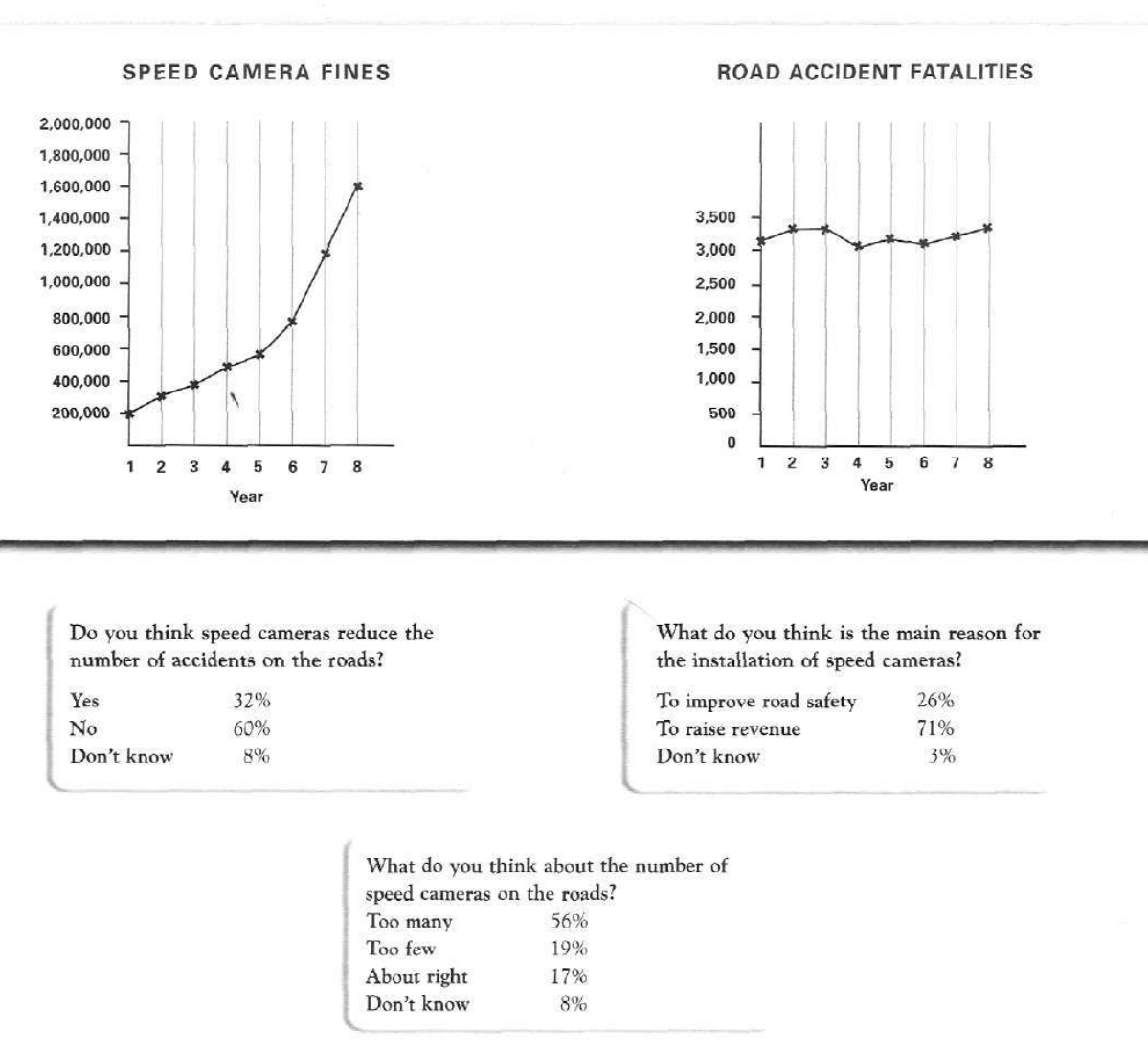
The graphs below show the number of drivers in Britain who have been caught driving too fast by speed cameras placed on roads, and the number of people killed in road accidents, over an eight-year period since the introduction of speed cameras. The tables show the results of a survey on people's opinions on speed cameras.
Write a report for a university lecturer describing the information below.
SPEED CAMERA FINES and ROAD ACCIDENT FATALITIES
Student answer (Band 6.5)
The line chart and table illustrate the figure of drivers who were fined for speeding by camera and killed in road accident; and the opinions of people on speed cameras in Britain.
Overall, while the number of speed camera fines rose, there was lots of fluctuation in amount of fatalities by road accidents between year 1 and 8.
Looking at the chart in detail, around 200,000 drivers were caught and fined for speeding by speed camera in the first year, which steadily climbed to almost 600,000 in year 5, before it significantly increased to 1,600,000 in the final year. Similarly, about 3100 people were killed in road accident in year 1, which fluctuated through the period between 3000 and 3500; and stood at around 3200 in year 8.
According to the survery, 60% of the people disagreed that speed cameras would reduce the number of accidents on the road and 71% thought that the main reason for the installation of camera was to raise the revenue. Over half of them agreed that there were too many cameras on the road.
AI examiner evaluation
| Criterion | Band |
|---|---|
| Task Achievement / Task Response | 6.5 |
| Coherence and Cohesion | 6.5 |
| Lexical Resource | 6.0 |
| Grammatical Range and Accuracy | 6.0 |
| Overall | 6.5 |
Task Achievement / Task Response: Band 6.5
The report covers both the charts and the survey, and its overview identifies the main contrast: fines rose substantially while fatalities fluctuated. The figures selected are generally accurate, including about 200,000 fines in Year 1, nearly 600,000 by Year 5, and 1.6 million in Year 8; the survey’s 60% and 71% results are also correctly reported. This gives the response a clear, relevant account of the main features. However, some details are less fully developed: the fines increase is described as steady even though it accelerates markedly in the later years, and the survey’s 32% who answered “yes” and the remaining opinions on camera numbers are omitted. More precise comparisons and fuller coverage would strengthen the report further.
Coherence and Cohesion: Band 6.5
The information is arranged in a sensible sequence: an introduction, a brief overview, chart details, and then survey findings. Linking phrases such as “Overall,” “Looking at the chart in detail,” and “According to the survey” help signal these stages, and the reader can follow the comparison between the two chart series. The organisation is coherent, though the overview is quite brief and the final paragraph groups survey results without covering all three questions. Some linking is also mechanical, particularly the repeated use of “and” to join separate details. To make progression more flexible, use clearer contrasts between the rising fines and relatively stable fatalities, and organise the survey findings by question or by the strongest response in each.
Lexical Resource: Band 6.0
The vocabulary is adequate for describing the visuals, with relevant terms such as “fluctuation,” “climbed,” “increased,” and “installation.” These choices communicate the main trends, and the response uses some appropriate paraphrasing rather than simply repeating the chart labels. However, several expressions are imprecise or awkward, including “the figure of drivers,” “killed in road accident,” and “raise the revenue.” “Disagreed” is also less exact than “said no” when reporting a survey response. There is a spelling error in “survery,” and “camera” is sometimes used where the plural is needed. Aim for more natural collocations and precise survey-reporting language, while varying trend verbs to distinguish gradual growth from the sharp late increase.
Grammatical Range and Accuracy: Band 6.0
The response uses a mix of simple and more complex forms, including a subordinate clause in “while the number of speed camera fines rose” and a time sequence with “before it significantly increased.” Most sentences remain understandable, and the main comparisons are not obscured. Some grammatical errors persist, however. In “between year 1 and 8,” the years need clearer parallel phrasing, and “people were killed in road accident” lacks an article or plural form. The opening sentence also uses an awkward construction before the semicolon, which interrupts the sentence structure. Articles, plurals, and sentence boundaries need more consistent control. Continue using complex structures, but check each noun phrase and ensure that clauses joined by punctuation form a complete, well-balanced sentence.
See this exact question answered at other band scores. The same prompt compared across bands.
Browse more IELTS Writing model answers or get your own writing scored by the same AI examiner.