Band 5.5 IELTS Writing Task 1 Model Answer
Overall Band Score: 5.5 · IELTS Complete Catalyst · 2026-11-22
IELTS Writing Task 1 question
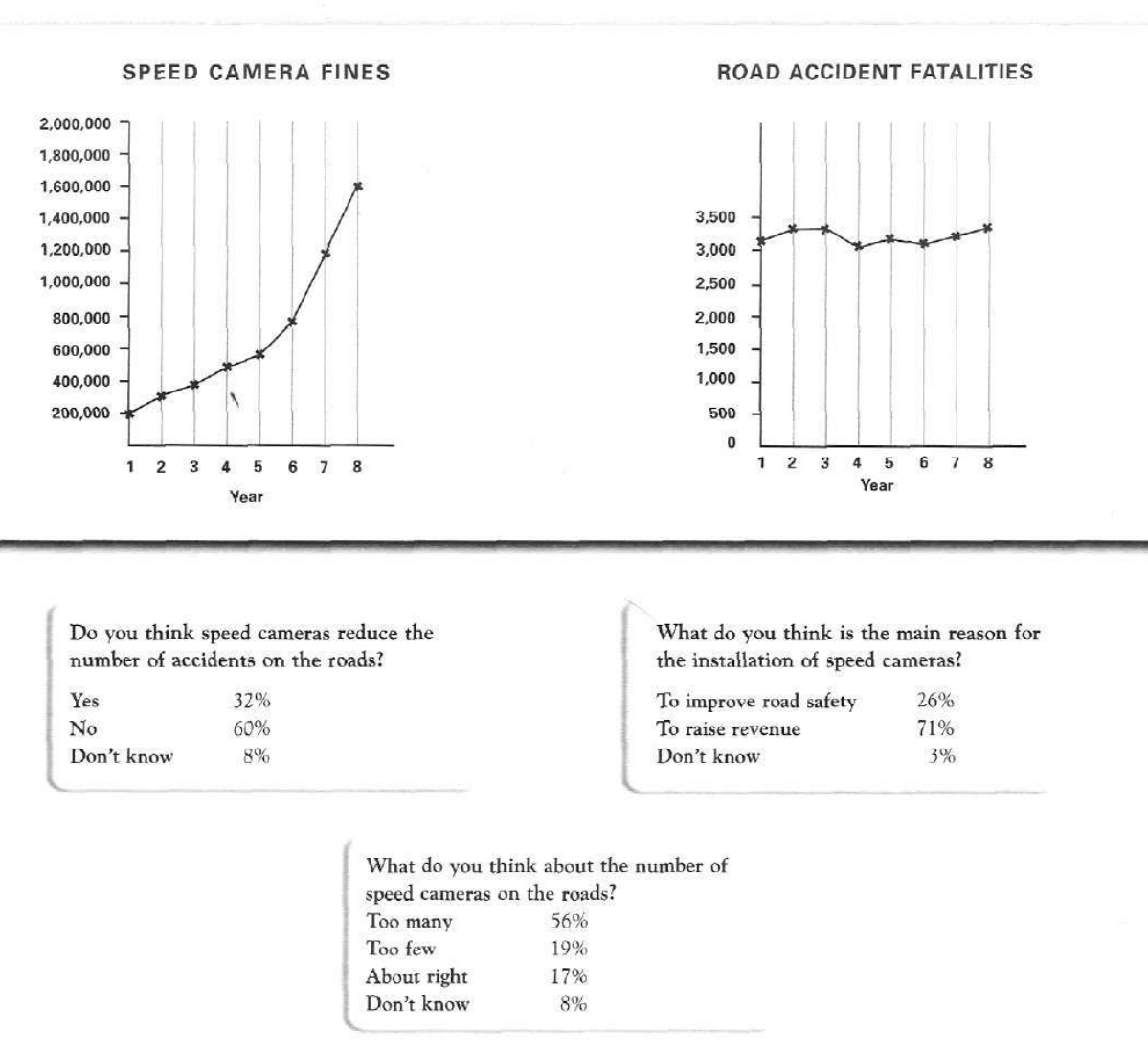
The graphs below show the number of drivers in Britain who have been caught driving too fast by speed cameras placed on roads, and the number of people killed in road accidents, over an eight-year period since the introduction of speed cameras. The tables show the results of a survey on people's opinions on speed cameras.
Write a report for a university lecturer describing the information below.
SPEED CAMERA FINES and ROAD ACCIDENT FATALITIES
Student answer (Band 5.5)
The supplied graph illustrates depicts information about the number of drivers who drives too fast and who have been cought by cameras on roads, and the number of peopls whose dead in roads accident in Britain over 8 years .
What is more stricking when we look at the data is the overall increase in the speed camera fines over the 8 years ,they achieve a jump arround 1.4 million , even though, the fatalities of roads approximately still between 3000 and 3500 over the time.
Moving ahead,60% of public disagree that the speed cameras placed decrease the number of accident, moreover,less than three quarter of citizens think that the essential reason of speed cameras was to gain cash but the other quarter think that the cameras make the roads more safe,in addition,more than a half of peole assume that the roads has a huge number of cameras, while 19% of other think that its too few.
AI examiner evaluation
| Criterion | Band |
|---|---|
| Task Achievement / Task Response | 5.5 |
| Coherence and Cohesion | 5.5 |
| Lexical Resource | 5.0 |
| Grammatical Range and Accuracy | 5.0 |
| Overall | 5.5 |
Task Achievement / Task Response: Band 5.5
You identify the main contrast in the charts: fines rise substantially, while fatalities remain within a relatively narrow range. You also report several survey findings, including that 60% do not think cameras reduce accidents and that 71% believe revenue is the main reason for installing them. However, the overview is imprecise: fatalities are described as staying between 3,000 and 3,500, but the key point is that they fluctuate without a sustained trend. The increase in fines is called a jump of “around 1.4 million,” rather than giving the approximate starting and ending figures. The survey summary also omits the 8% who are unsure about accident reduction and the 17% who think camera numbers are about right. Select and compare the most important figures more precisely.
Coherence and Cohesion: Band 5.5
The response moves from the charts to the survey and uses some linking expressions, such as “What is more” and “Moving ahead,” so the reader can recognise the broad sequence of information. However, the report is presented as one continuous block, with no clear paragraphing to separate the overview, chart details and survey results. Several ideas are crowded into long sentences, especially the final sentence, where “moreover,” “but” and “in addition” connect multiple survey findings without clear boundaries. Some transitions, including “Moving ahead,” do not clearly signal the relationship between sections. Organise the report into distinct paragraphs and use simpler, more precise links so each comparison is easy to follow.
Lexical Resource: Band 5.0
You use some relevant vocabulary for describing the visuals, including “overall increase,” “fatalities” and “approximately,” and the reader can generally understand the intended comparisons. However, the range is limited and several word choices or collocations are inaccurate, such as “the essential reason,” “gain cash,” “decrease the number of accident” and “the roads more safe.” Spelling errors, including “cought,” “peopls,” “stricking” and “peole,” also make the writing less clear and weaken the report’s formal tone. Aim for standard chart language such as “the main reason,” “raise revenue,” “reduce the number of accidents” and “improve road safety.” Check spelling carefully and choose precise terms rather than informal or translated-sounding phrases.
Grammatical Range and Accuracy: Band 5.0
The response attempts some complex sentences, using clauses and connectors such as “even though” and “while,” but control is inconsistent and errors occur frequently. For example, “the number of drivers who drives” has a subject–verb agreement error, while “the number of peopls whose dead” does not form a correct relative clause. There are also problems with articles, plurals and sentence boundaries, as in “the number of accident” and the long final sentence, which joins several complete ideas with commas. These errors sometimes make relationships between ideas difficult to follow. Practise accurate simple sentence patterns first, then combine them with controlled clauses; check agreement, plural nouns and punctuation when editing.
See this exact question answered at other band scores. The same prompt compared across bands.
Browse more IELTS Writing model answers or get your own writing scored by the same AI examiner.