Band 6.5 IELTS Writing Task 1 Model Answer
Overall Band Score: 6.5 · IELTS Complete Catalyst · 2026-11-27
IELTS Writing Task 1 question
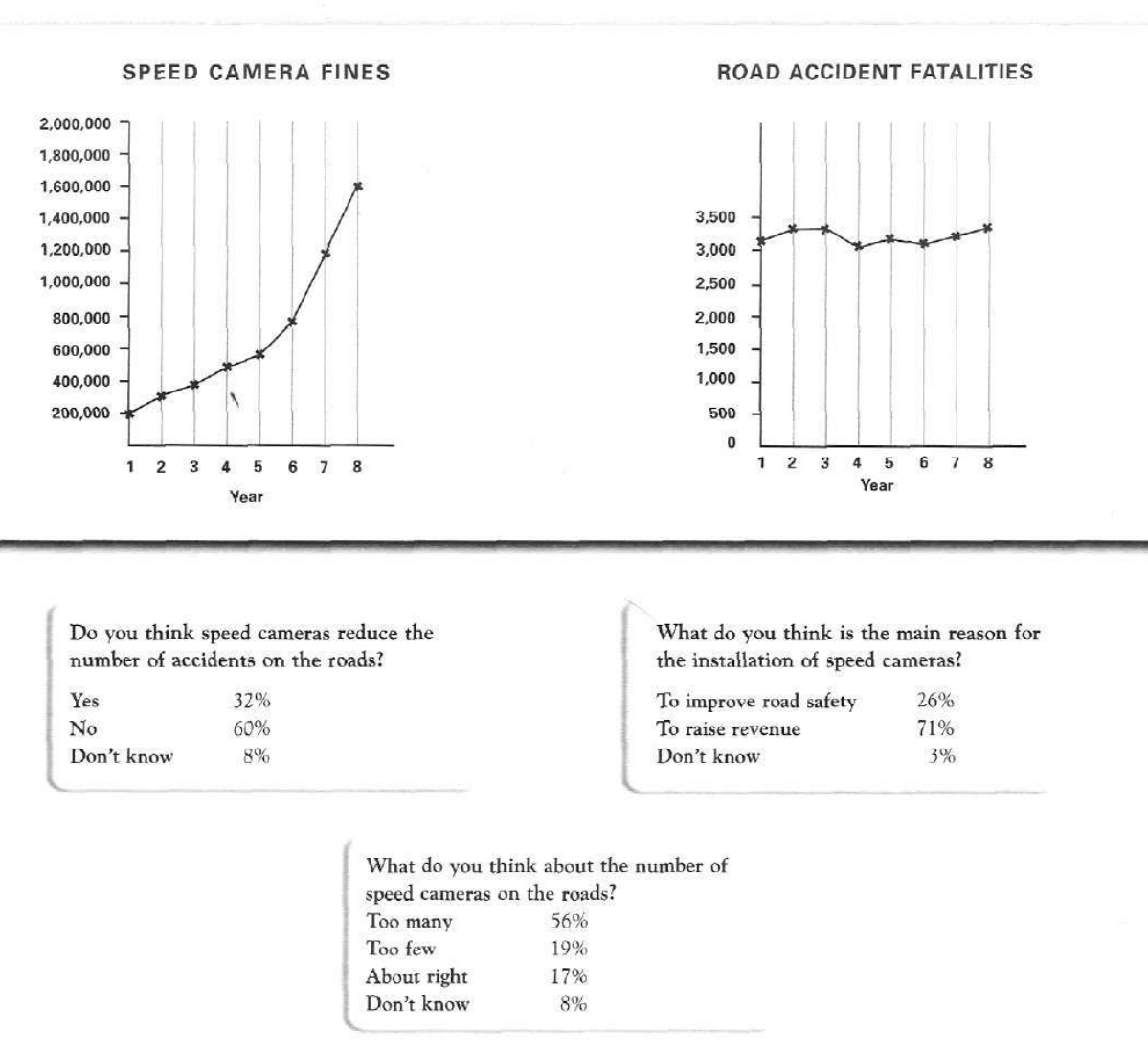
The graphs below show the number of drivers in Britain who have been caught driving too fast by speed cameras placed on roads, and the number of people killed in road accidents, over an eight-year period since the introduction of speed cameras. The tables show the results of a survey on people's opinions on speed cameras.
Write a report for a university lecturer describing the information below.
SPEED CAMERA FINES and ROAD ACCIDENT FATALITIES
Student answer (Band 6.5)
The given graphs illustrates the amount of speed camera fines and the number of death caused by road accidents over an eight-year period. The tables represent the outcome of a survey on people's thoughts on speed cameras.
Overall, speed camera fines have increased considerably, whereas number of deaths caused by road accidents remained relatively stable over the past eight years. According to the given table, most of the people think, speed cameras were ineffective in reducing the number of accideents on the roads. To most of them the installation of speed cameras was to raise revenue, not to mention the fact that they think the number of speed cameras on the roads are too many.
The amount of speed camera fines has surged from [redacted phone] to [redacted phone] in 8 years. Still, the number of deaths by road accidents remained constant, which was around 3000 over the period. 60% people think that the speed cameras have no effect and 32% think the opposite. According to 26% individuals, the installation was to improve road safey and to 71% of people, it was installed for industrial benefits.
As for the number of speed cameras, 56% people thought it was too many and 19% thought the opposite. 17% people think it was just right and the other had no opinion.
AI examiner evaluation
| Criterion | Band |
|---|---|
| Task Achievement / Task Response | 7.0 |
| Coherence and Cohesion | 6.5 |
| Lexical Resource | 6.0 |
| Grammatical Range and Accuracy | 5.5 |
| Overall | 6.5 |
Task Achievement / Task Response: Band 7.0
The report covers both charts and all three survey questions, and it gives a clear overview: fines rose substantially while fatalities stayed broadly stable. The main figures are generally accurate, including the rise from 200,000 to 1.6 million and the survey results of 60%, 32%, 71% and 56%. The description of fatalities as “around 3000” is a reasonable summary, although the figures fluctuate between roughly 3,100 and 3,350 rather than remaining entirely constant. One interpretation is inaccurate: the 71% who selected raising revenue are described as believing cameras were installed for “industrial benefits”; this should be stated as revenue generation. The response otherwise selects relevant features and addresses the task clearly, though some comparisons could be developed further.
Coherence and Cohesion: Band 6.5
The response has a clear overall structure: an introduction, an overview, a paragraph on fines and fatalities, and a final paragraph on camera numbers. This makes the information easy to follow, and transitions such as “Overall” and “As for” help signal the stages of the report. However, the organisation within the third paragraph is less smooth because it moves from the chart figures to survey opinions without a clear distinction between the two sources. Some linking is also mechanical, particularly the repeated use of “According to” and “As for.” The overview’s long final sentence combines several survey findings, which slightly weakens clarity. Grouping the chart data together and then presenting the survey results in a more systematic order would make progression more controlled.
Lexical Resource: Band 6.0
There is an adequate range of vocabulary for describing the charts, including “increased considerably,” “remained relatively stable,” and “surged.” These choices communicate the main trends, and the response uses relevant terms such as “installation” and “survey.” However, some word choices are imprecise or unnatural: “industrial benefits” does not accurately express raising revenue, while “the opposite” is vague when referring to respondents who thought cameras were not too numerous. There are also spelling errors, including “accideents” and “safey,” and repeated use of “number” and “people” limits variety. Aim for precise chart language and natural collocations, such as “generate revenue,” “fatalities,” and “respondents.” This would improve flexibility and accuracy while retaining the clear meaning of the report.
Grammatical Range and Accuracy: Band 5.5
The report attempts a mix of simple and more complex sentences, including the contrast in “fines have increased considerably, whereas number of deaths… remained relatively stable.” Meaning is generally clear, but some errors in agreement, articles and sentence construction remain. For example, “The given graphs illustrates” should use a plural verb, and “whereas number of deaths” needs an article. In “most of the people think, speed cameras were ineffective,” the comma is misplaced and the tense shifts awkwardly. The sentence “60% people think” also needs “of,” while “the number of speed cameras on the roads are too many” has a singular-plural agreement problem. More consistent control of these patterns, alongside varied sentence forms, would make the writing more accurate and fluent.
See this exact question answered at other band scores. The same prompt compared across bands.
Browse more IELTS Writing model answers or get your own writing scored by the same AI examiner.