Band 5.0 IELTS Writing Task 1 Model Answer
Overall Band Score: 5.0 · IELTS Complete Catalyst · 2026-11-27
IELTS Writing Task 1 question
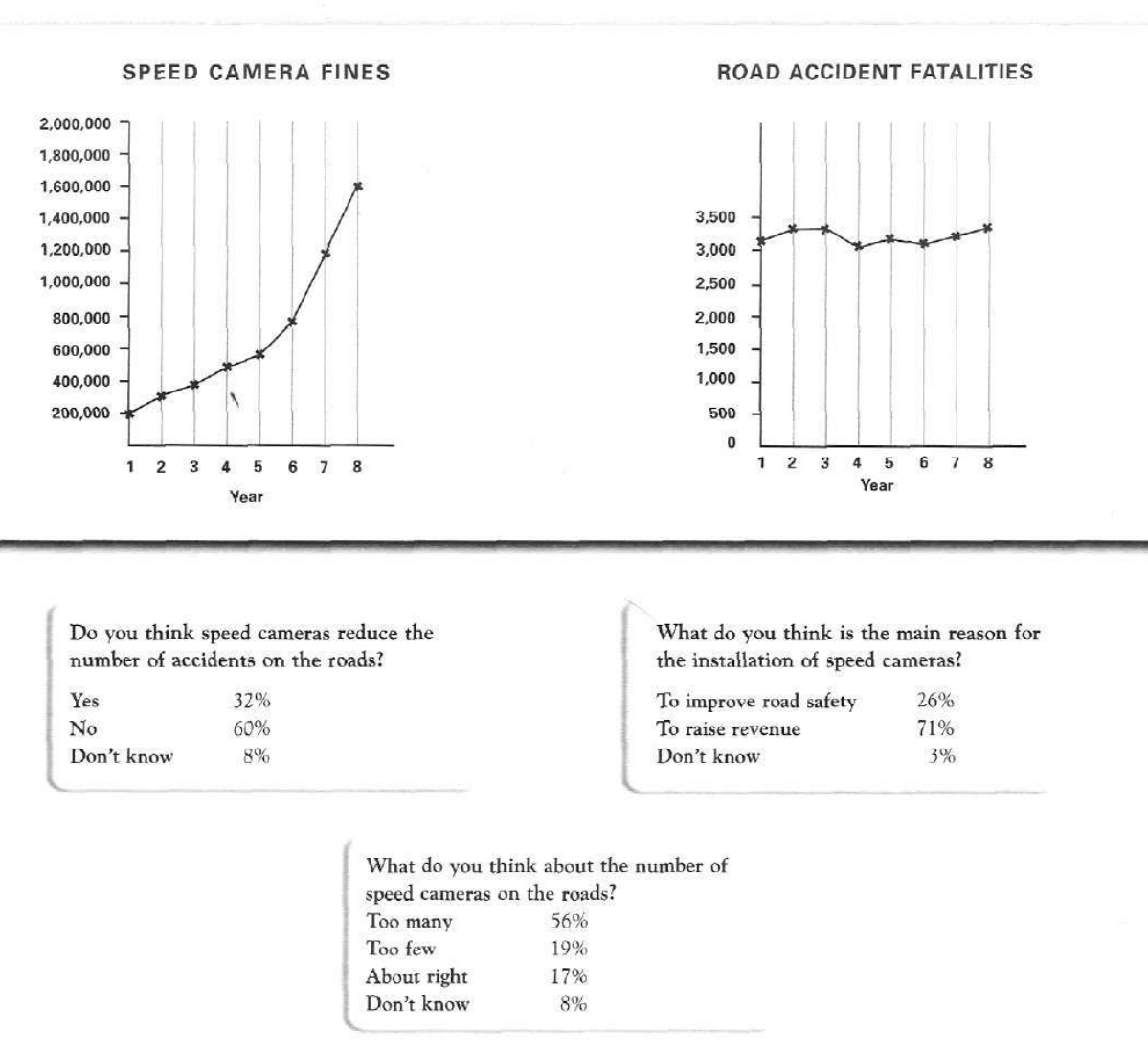
The graphs below show the number of drivers in Britain who have been caught driving too fast by speed cameras placed on roads, and the number of people killed in road accidents, over an eight-year period since the introduction of speed cameras. The tables show the results of a survey on people's opinions on speed cameras.
Write a report for a university lecturer describing the information below.
SPEED CAMERA FINES and ROAD ACCIDENT FATALITIES
Student answer (Band 5.0)
As far as this graphic descri[ption is concerned, I would like to highlight the main trends of the given graph.I think the given graph presents a comprehensive picture of speed camera fines and road accident fatalities. Firstly, i would like to talk about speed cameras fines In 1st year the fines are [redacted phone], and in year 8 the fines will increased 1,600,000 people pay the fine. so with the passage of years fine will increases. On the other hand, Road accident fatalities, In year 1 the accident rates are probably 3,050, and In year 2 accident rates were increase by litlle amount. and in third year accident rates remain same, and in 4th year accident rates were decreased, in 5th year accident rates were increased by 3,010, in 6th year accident rates were decreased by little. In the last year the accident rate were increased by little amount. So in my perspective, In some years accident rates are fewer and on the other years accidents rates were decreased. so i think speed cameras can't reduce the number of accidents on the road. The main reason for the installation of speed cameras are fines. people cannot break the traffic rules if cameras are installed. It is convinient way for government. The numbers of speed cameras are too many we couldn't count them.
In short, foci of given data is that the speed cameras are useful for govenment and also for people. The accidents rates would become fewer and the government easily fine people because, it is a convienient way.
AI examiner evaluation
| Criterion | Band |
|---|---|
| Task Achievement / Task Response | 4.0 |
| Coherence and Cohesion | 5.0 |
| Lexical Resource | 5.0 |
| Grammatical Range and Accuracy | 5.0 |
| Overall | 5.0 |
Task Achievement / Task Response: Band 4.0
You identify the two main subjects and note that fines rise substantially, from 200,000 in the first year to 1.6 million in the eighth. However, the report only minimally covers the task: it omits the survey results entirely, despite three tables being provided. Several figures are also inaccurate or unclear: fatalities are about 3,150 in year one, not 3,050, and the year-five figure is around 3,180, not 3,010. The overview is contradictory, claiming both that cameras cannot reduce accidents and that accident rates become fewer, while the chart shows fatalities fluctuating without a sustained decline. Focus on a concise, accurate overview and report the key survey findings alongside the chart trends.
Coherence and Cohesion: Band 5.0
The response has a basic sequence, moving from fines to fatalities and then to comments about cameras, and phrases such as “On the other hand” and “In short” signal transitions. However, progression is weakened by repeated statements and unclear links between evidence and conclusions. For example, the account of fatalities lists yearly movements but ends with the confusing claim that rates are “fewer” in some years and “decreased” in others. The final paragraph also repeats the idea that cameras benefit the government without clearly summarising the data. Use separate paragraphs for the chart overview, key figures, and survey results, and connect each conclusion directly to the relevant evidence.
Lexical Resource: Band 5.0
You use some task-related vocabulary, including “speed camera fines,” “road accident fatalities,” “installation,” and “increased,” so the topic is generally recognisable. However, the range is limited and several expressions are repetitive or imprecise, such as “little amount,” “accident rates,” and “people pay the fine.” Some word forms and spellings also reduce accuracy, including “convinient,” “govenment,” and “convienient.” Choose precise terms for the data: distinguish the number of fatalities from an accident rate, and describe fines as rising or increasing rather than saying people pay a particular number of fines. A wider range of accurate trend language would make the report clearer and more suitable for an academic description.
Grammatical Range and Accuracy: Band 5.0
You attempt both simple and longer sentences, and the reader can usually identify the topic of each section. However, control is inconsistent, particularly in verb forms, agreement, articles, and sentence boundaries. Examples include “the fines will increased,” “accident rates were increase,” and “the accident rate were increased”; these should use consistent past-tense forms such as “increased” and singular agreement such as “the rate was.” Capitalisation is also inconsistent, and several sentences run together, as in “the graph.I think” and “fine. so.” These recurring errors sometimes make relationships between ideas difficult to follow. Practise accurate past-tense reporting and punctuate each complete sentence clearly, while varying sentence structures carefully.
See this exact question answered at other band scores. The same prompt compared across bands.
Browse more IELTS Writing model answers or get your own writing scored by the same AI examiner.