Band 5.0 IELTS Writing Task 1 Model Answer
Overall Band Score: 5.0 · IELTS Complete Catalyst · 2026-11-06
IELTS Writing Task 1 question
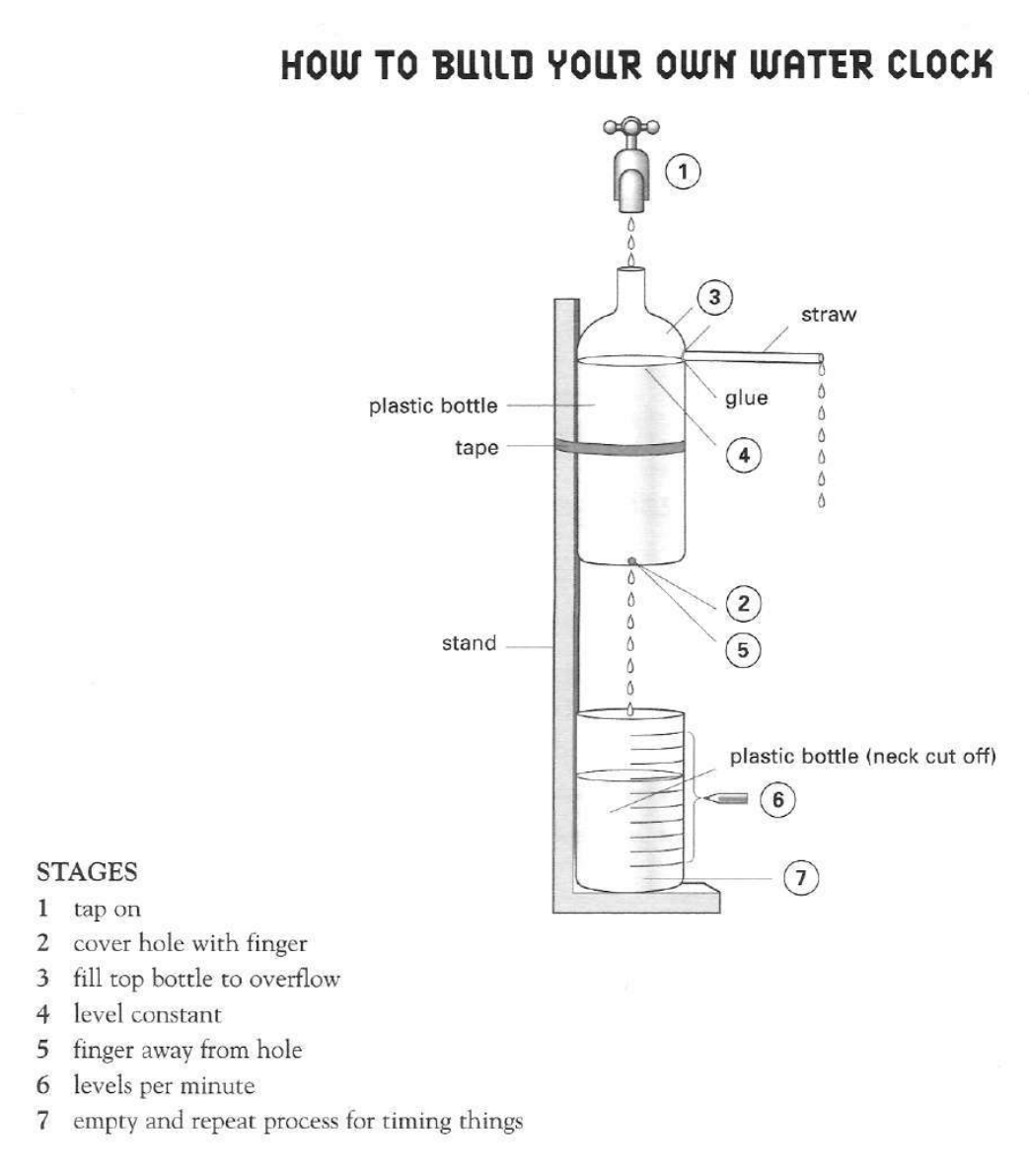
The diagram below shows the process for making a water clock.
Write a report for a university lecturer describing the information below.
HOW TO BUILD YOUR OWN WATER CLOCK
Student answer (Band 5.0)
The given diagram illustrates the procedure of making a water clock,it mainly depends on seven different stages.
Overall, this process start with exit water from tap and flowing in the bottle.it also goes through many stages and finally ends with empty bottle and processing to show the time.
Its firsly begin with, turning on the tap for fill the water into the plastic bottle,when the bottle is over half and full then the water is flow thourgh the whole which is loacted at the bottom of the bottle.Following this, a straw also placed at upper right side of the bottle where the water is also flow drop by drop.After that, also check the coverage of water in the bottle, so that the water must be half and over should be available in the bottle.Like that, a tape also be attach with the bottle and stand to attach both of them.after the complete this stage the stage also start,leaking water from water drop by drop realativly.moreover, a one more bottle where water is flow and the water flow with quantity ,finally that the last stage the the bottle empty and show the time for things.
AI examiner evaluation
| Criterion | Band |
|---|---|
| Task Achievement / Task Response | 5.0 |
| Coherence and Cohesion | 5.0 |
| Lexical Resource | 5.0 |
| Grammatical Range and Accuracy | 5.0 |
| Overall | 5.0 |
Task Achievement / Task Response: Band 5.0
You identify the diagram as a water-clock process and mention that it has seven stages, with the tap starting the process and emptying the bottle at the end. However, the description only partially reports the actual sequence and contains several important misreadings. For example, the upper bottle is filled until water overflows, not merely until it is “over half,” and the straw is an overflow outlet rather than a route for water to drip into the lower bottle. The response also omits key steps: covering the hole with a finger, keeping the water level constant, then removing the finger and marking levels per minute. Describe the apparatus accurately, then summarise how the stages produce a usable timer.
Coherence and Cohesion: Band 5.0
There is an attempt to organise the report with an opening, an overview and a sequence of process details. Words such as “Overall,” “Following this” and “After that” signal progression. However, the stages are not presented in a clear, reliable order, and several transitions connect ideas that do not logically follow—for instance, the straw, water coverage and attaching the stand are introduced as if they were successive operating stages. The long final paragraph also combines construction and operation without clear separation. Use one paragraph to describe the apparatus and another to explain the numbered stages, with each step linked in the correct order and references such as “the upper bottle” kept clear.
Lexical Resource: Band 5.0
The response uses some relevant process vocabulary, including “tap,” “bottle,” “straw,” “stand,” “stage” and “drop by drop,” so the reader can recognise the general topic. However, the range is limited and several word choices or collocations make the description difficult to interpret, such as “exit water from tap,” “coverage of water” and “the water flow with quantity.” There are also noticeable spelling errors, including “thourgh,” “loacted” and “realativly.” Choose precise terms from the diagram and use natural process language: for example, water “flows through a hole,” the straw “acts as an overflow outlet,” and the lower bottle is “marked with calibration lines.” Proofreading spelling would improve clarity.
Grammatical Range and Accuracy: Band 5.0
You attempt to use both simple statements and longer clauses, including “when the bottle is over half and full then…” and “so that the water must be…”. However, the longer constructions are often faulty, and frequent errors in verb forms, agreement, articles and sentence boundaries make the process hard to follow. Examples include “this process start,” “Its firsly begin with,” “the water is flow,” and “a straw also placed.” Several sentences run together without appropriate punctuation, as in the opening and the final sequence. Practise accurate passive forms for process descriptions (“is attached,” “is filled”) and simple present verbs (“water flows”), then build longer sentences only when the relationships between steps are clear.
See this exact question answered at other band scores. The same prompt compared across bands.
Browse more IELTS Writing model answers or get your own writing scored by the same AI examiner.