Band 5.0 IELTS Writing Task 1 Model Answer
Overall Band Score: 5.0 · IELTS Complete Catalyst · 2026-11-07
IELTS Writing Task 1 question
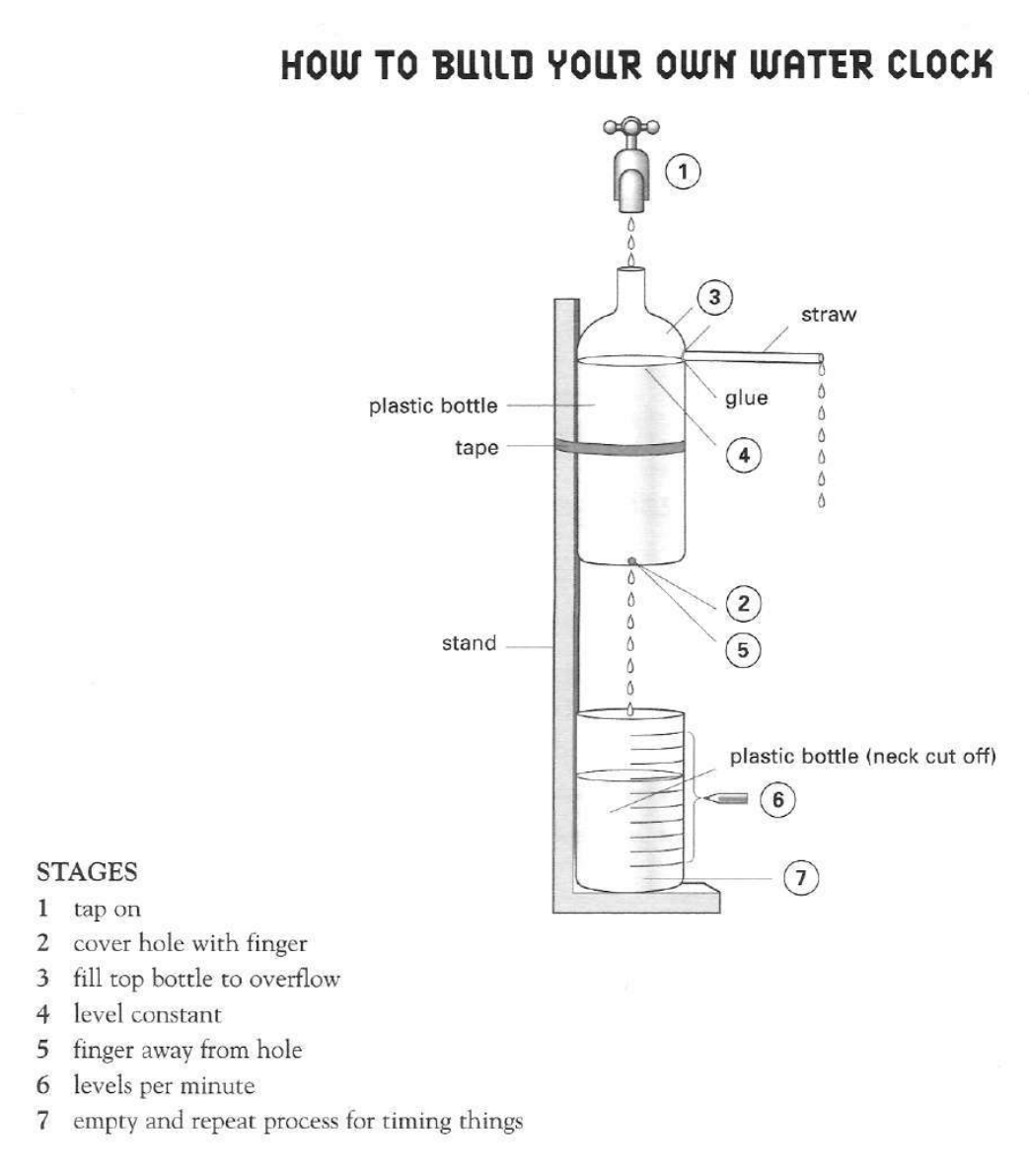
The diagram below shows the process for making a water clock.
Write a report for a university lecturer describing the information below.
HOW TO BUILD YOUR OWN WATER CLOCK
Student answer (Band 5.0)
The diagram below illustrates a process of making a water clock.
The process begins with tapping on water and ends with repeating the process for timing correction.
Water is tapped on to a plastic bottle that is attached to the stand with tape, after that the hole at the bottom of the bottle is covered. Then the top bottle is filled, so that the water overflows through the straw that is glued under the neck of the bottle.
At the step 4, the level constant is measured and the hole can be uncovered then. At the bottom of the stand a bottle (neck cut off) is placed.Then, the level per minute is measured and drawn on the bottom bottle. At the last step, all of yhe bottles are emptied, so that the process can be performes
AI examiner evaluation
| Criterion | Band |
|---|---|
| Task Achievement / Task Response | 5.0 |
| Coherence and Cohesion | 5.0 |
| Lexical Resource | 5.0 |
| Grammatical Range and Accuracy | 5.0 |
| Overall | 5.0 |
Task Achievement / Task Response: Band 5.0
You identify the process and report several relevant stages, including attaching the upper bottle, filling it until water overflows, and using the lower bottle to mark levels. However, the account is only partial and some details are unclear or inaccurate: the diagram says to cover the hole before filling, then remove the finger, while “the level constant is measured” does not clearly explain that the water level is kept constant by the overflow. The final instruction is also incomplete, and “timing correction” is not the stated purpose; the clock is used for timing things. The response is 136 words, below the required 150. Add a clear overview and explain the apparatus and all seven stages more fully.
Coherence and Cohesion: Band 5.0
The stages are presented broadly in sequence, and linking expressions such as “after that,” “Then,” and “At the last step” help the reader follow the process. However, the response is one continuous paragraph and lacks a clear overall progression from an introduction and overview to the detailed stages. Some links are awkward or unclear: “At the step 4” does not connect smoothly to the preceding action, and “At the bottom of the stand a bottle…” introduces the lower container abruptly. The final sentence also stops before completing the idea, weakening the ending. Use separate paragraphs for the overview and process details, and make each transition show precisely how one stage leads to the next.
Lexical Resource: Band 5.0
You use some relevant process vocabulary, including “plastic bottle,” “stand,” “tape,” “straw,” “overflows,” and “neck cut off,” so the reader can identify the main equipment. However, the range is limited and several choices are inaccurate or unnatural, which sometimes makes the process difficult to understand. “Water is tapped on” suggests striking the water rather than turning on a tap, while “timing correction” does not express the purpose shown. There are also spelling errors in “yhe” and “performes.” Aim for precise terms for the actions and components, and check spelling carefully. For example, describe water flowing from the tap and the lower bottle being used to record the levels.
Grammatical Range and Accuracy: Band 5.0
The response attempts a mixture of simple and longer sentences, including a sequence joined with “after that” and “Then.” However, control is inconsistent, and errors in sentence construction and verb forms are frequent enough to affect clarity. For example, “At the step 4, the level constant is measured” has an awkward article and an unclear grammatical relationship between the subject and action. “The process can be performes” uses an incorrect verb form, and the final sentence is incomplete. Punctuation and spacing also need attention, as in “placed.Then.” Practise forming complete passive sentences for process descriptions, such as “The hole is uncovered” and “The lower bottle is placed beneath the upper one,” and proofread each sentence for a complete ending.
See this exact question answered at other band scores. The same prompt compared across bands.
Browse more IELTS Writing model answers or get your own writing scored by the same AI examiner.