Band 5.5 IELTS Writing Task 1 Model Answer
Overall Band Score: 5.5 · IELTS Complete Catalyst · 2026-11-07
IELTS Writing Task 1 question
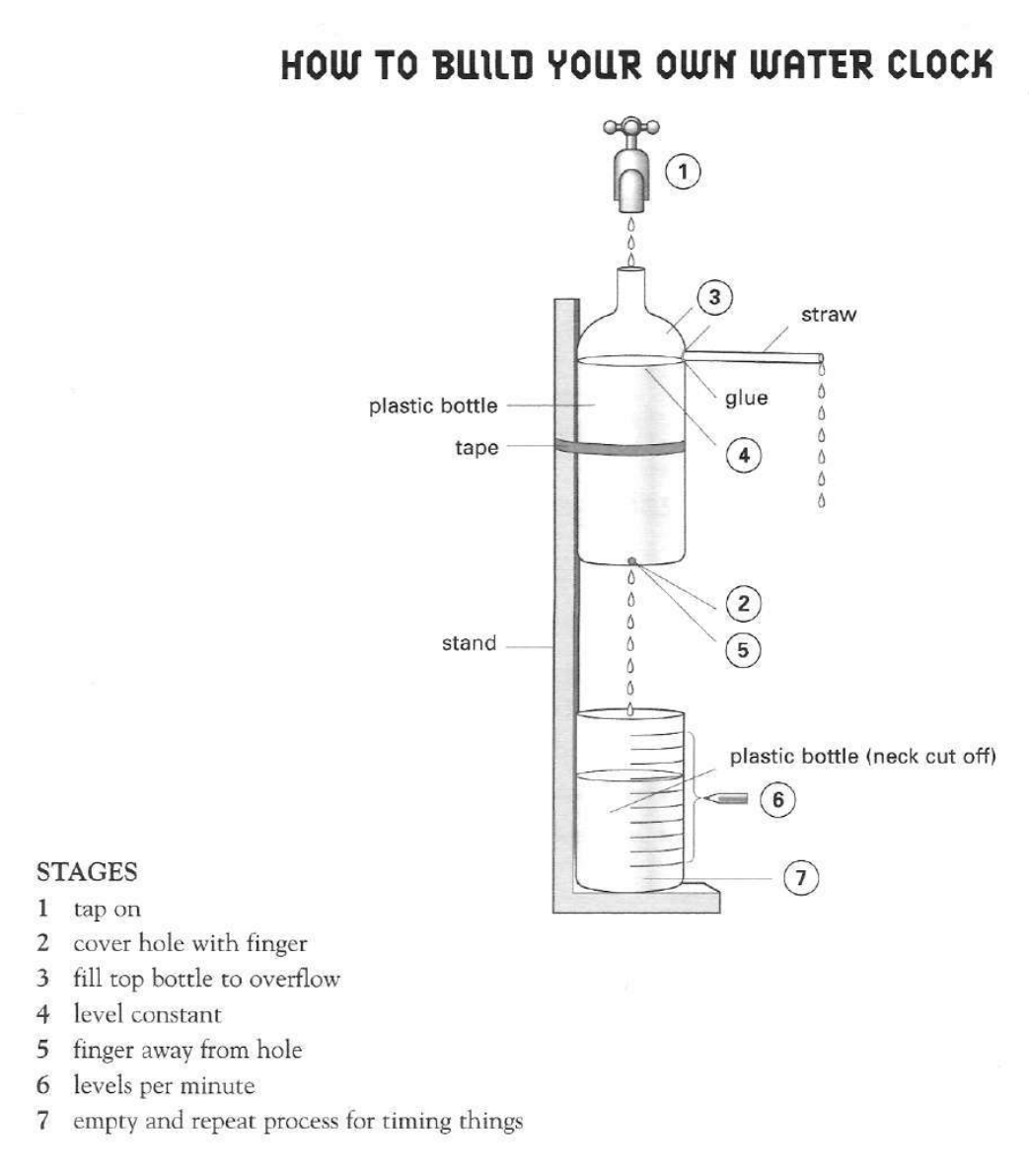
The diagram below shows the process for making a water clock.
Write a report for a university lecturer describing the information below.
HOW TO BUILD YOUR OWN WATER CLOCK
Student answer (Band 5.5)
The design show us the steps on how to successfully build a fully functional water clock.
The general overview shows us the precise steps, while the components seem to be simple and not expensive. Which makes water clock nothard to build.
First of all we need to ensure a source of water streaming such as the tap must be on, as a second step it is necessary to veil the hole on the bottom of the plastic bottle that is hanging on top, we can simply sue our fingers for such step. The goal here is to let the water build up in the uppser plastic bottle until it overflow. Afterwards, maintaining a constant level of water storage in the bottle is necessary, and to ensure that we have a straw on the side of bottle that is glued to ensure that the water is leaking outside, for the sole purpose of keeping the water's level in the equilibrium state. Later on, we can remove the veil off of the hole that is on the bottom of the bottle, which is our finger in this case. On the bottle that is on fixed down, we can see the scales, in which each one of those scales serves as in indication of a minute passing. And finally we can empty and repeat the process for measuring the time for many things.
AI examiner evaluation
| Criterion | Band |
|---|---|
| Task Achievement / Task Response | 6.5 |
| Coherence and Cohesion | 5.5 |
| Lexical Resource | 5.5 |
| Grammatical Range and Accuracy | 5.0 |
| Overall | 5.5 |
Task Achievement / Task Response: Band 6.5
The report covers the main sequence, from turning on the tap and blocking the hole to filling the upper bottle, releasing the water, reading the minute markings, and repeating the process. It also includes relevant construction details, such as the straw glued to the bottle and the lower container’s scales. This gives the reader a generally accurate account of how the clock works. Some details are less fully or precisely described: the upper bottle is attached to a stand, and the lower bottle has its neck cut off, but these features are not clearly explained. The overview mainly says the steps are precise and the parts inexpensive, rather than summarising the key mechanism. A stronger overview would highlight water overflowing to maintain a constant level before draining through the hole into the marked lower bottle.
Coherence and Cohesion: Band 5.5
The stages are presented in a broadly logical order, and sequencing phrases such as “First of all,” “Afterwards,” “Later on,” and “finally” help the reader follow the process. However, the response is arranged as one long paragraph, so the overview and the procedural description are not clearly separated. Some linking is also mechanical, with repeated “we” and “and” constructions. References such as “the bottle that is on fixed down” make it harder to identify the lower container, while “the veil” refers back to the finger in an unclear way. Use a separate overview paragraph followed by a paragraph describing the stages, and make references explicit—for example, “the lower bottle” and “the finger covering the hole.”
Lexical Resource: Band 5.5
The response has enough vocabulary to describe the apparatus and sequence, including “overflow,” “constant level,” “scales,” and “equilibrium state.” However, several choices are inaccurate or unnatural for a process report: “veil the hole” and “remove the veil” do not mean cover and uncover it, while “water storage” and “leaking outside” misrepresent the intended flow. There are also noticeable spelling and word-form errors, including “uppser” and “indication.” These choices sometimes make the description less clear, even though the overall process can be understood. Prefer precise, conventional terms such as “cover the hole,” “release the water,” “overflow outlet,” and “graduation marks,” and check spelling before submitting.
Grammatical Range and Accuracy: Band 5.0
The response attempts a mixture of simple and complex sentences, including clauses introduced by “until” and “while,” and the sequence is generally understandable. However, sentence control is uneven, particularly in longer constructions. For example, “Which makes water clock nothard to build” is a sentence fragment, and “The design show us” has a subject–verb agreement error. Articles and sentence structure are also inconsistent in phrases such as “on fixed down” and “the water's level in the equilibrium state.” Punctuation around the opening overview is awkward, and several sentences combine multiple steps without clear grammatical boundaries. Build accuracy by using complete sentences with a clear subject and verb, and divide long explanations into shorter clauses.
See this exact question answered at other band scores. The same prompt compared across bands.
Browse more IELTS Writing model answers or get your own writing scored by the same AI examiner.