Band 5.5 IELTS Writing Task 1 Model Answer
Overall Band Score: 5.5 · IELTS Complete Catalyst · 2026-11-08
IELTS Writing Task 1 question
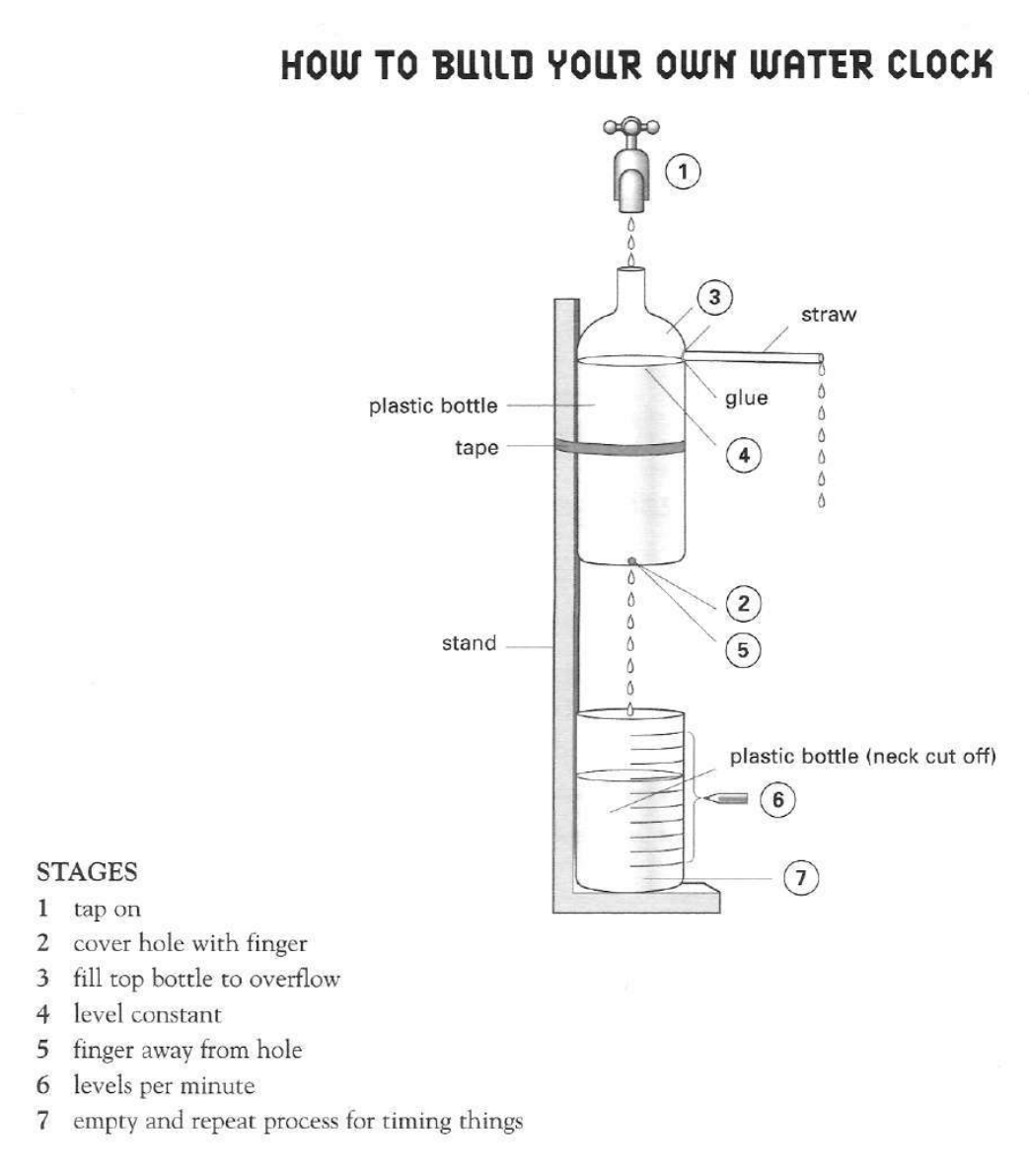
The diagram below shows the process for making a water clock.
Write a report for a university lecturer describing the information below.
HOW TO BUILD YOUR OWN WATER CLOCK
Student answer (Band 5.5)
The diagram depicts the different stages for making a water clock.
Overall, it is evident that there are several steps to make a complete and perfect water clock using different materials. In addition, the main item is water itself that use in entire process. Plastic bottles are placed in their sequence and connected tightly to the stand for ensuring all procedure smoothly.
Looking at the procedure in detail, the first step is to simply open the tap so that piped water flows into a plastic jar. Secondly, a small opening is punctured in the bottom and then covered with a finger the water from escaping. Following this, the next phase is to fill the bottle to the top and wait until the jar overflow.
After that, keep measuring its constant level for accuracy of a time, then put away figure from the bottom, then checking the position of the water per minute . At last, when its empty and then repeat it for measuring the time.
AI examiner evaluation
| Criterion | Band |
|---|---|
| Task Achievement / Task Response | 5.5 |
| Coherence and Cohesion | 6.0 |
| Lexical Resource | 5.5 |
| Grammatical Range and Accuracy | 5.0 |
| Overall | 5.5 |
Task Achievement / Task Response: Band 5.5
The report identifies the process and gives a broad overview, noting that water and plastic bottles are central. It also follows several stages, including opening the tap, filling the upper bottle, allowing water to drain, and repeating the process. However, some important details are inaccurate or unclear: the hole is already at the base of the upper bottle, rather than being punctured during the process, and the water is filled until it overflows through the straw. The explanation of the constant level and the calibration marks on the lower bottle is also difficult to understand. To make the account more complete, describe how the two bottles are arranged and explain that the marked water levels indicate elapsed time.
Coherence and Cohesion: Band 6.0
The response has a clear overall shape, with an introduction, an overview, and a paragraph describing the stages. Sequencing expressions such as “Firstly,” “Secondly,” “Following this,” and “At last” help the reader follow the process. However, the progression becomes less clear in the final stages: “then put away figure from the bottom, then checking the position” does not clearly identify the action or what is being measured. Some linking is also mechanical, with several steps joined by repeated “then” or “after that.” Use a more precise sequence and refer clearly to the upper and lower bottles, so each stage connects unambiguously to the next.
Lexical Resource: Band 5.5
The response uses relevant process vocabulary, including “stages,” “procedure,” “overflow,” and “constant level,” and the reader can generally identify the topic. However, some word choices and collocations are inaccurate or vague, such as “perfect water clock,” “plastic jar,” “put away figure,” and “measuring the time.” “Figure” appears to mean “finger,” while “plastic jar” does not match the diagram’s bottle. These choices sometimes make the instructions difficult to interpret. Aim for precise labels and verbs, for example “upper bottle,” “lower container,” “remove your finger,” and “mark the water level.” This would make the description more natural and technically clear.
Grammatical Range and Accuracy: Band 5.0
The response attempts both simple and more complex sentences, including “Plastic bottles are placed in their sequence and connected tightly to the stand for ensuring all procedure smoothly.” However, errors in verb forms, agreement, articles, and sentence construction are frequent enough to affect clarity. Examples include “water itself that use in entire process,” “covered with a finger the water from escaping,” and “when its empty and then repeat it.” The final sentence also shifts between fragments and clauses, making the sequence hard to follow. Practise forming complete sentences with a clear subject and verb, and check agreement and tense. For example: “The hole is covered with a finger to stop the water escaping.”
See this exact question answered at other band scores. The same prompt compared across bands.
Browse more IELTS Writing model answers or get your own writing scored by the same AI examiner.