Band 5.5 IELTS Writing Task 1 Model Answer
Overall Band Score: 5.5 · IELTS Complete Catalyst · 2026-11-08
IELTS Writing Task 1 question
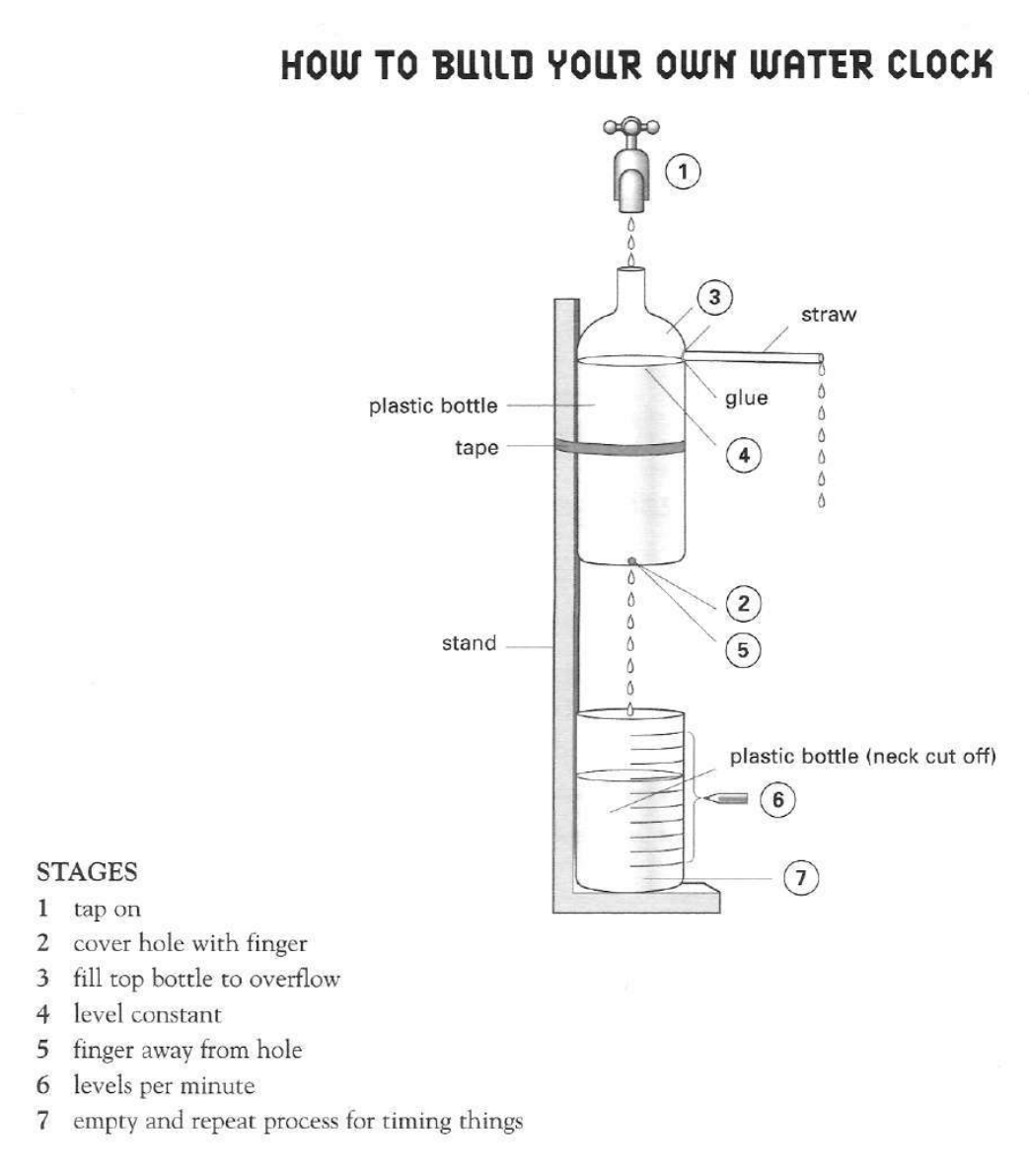
The diagram below shows the process for making a water clock.
Write a report for a university lecturer describing the information below.
HOW TO BUILD YOUR OWN WATER CLOCK
Student answer (Band 5.5)
The process diagram illustrates the stages of making water clock. To made water clock the maker must go through seven different stages.
Overall, it takes six external equipments to describe the process. By using those equipments and following the seven stages one can build their own water clock.
At first,a stand will be needed to attach a plastic bottle on top with the help of tape. In the upper side of the bottle a straw will attach with the help of glue there will be a hole on where the staw was attached agin there will be anotherr hole in the bottom side of the bottle. In stage one the tap will on and to fill the bottle the maker must cover the holw with finger which is in stage two. The filling will continue until it overflow which is stage three and with the help of staw the remaining water will fall and it will stay at constat level which is stage four.
After fill up the bottle take the finger away from whole and let the water fall in the second bottle which is below the first bottle.In stage six measure per minute water flow. At the last stage clear the water and repeatthe process again and again to measure the timing.
AI examiner evaluation
| Criterion | Band |
|---|---|
| Task Achievement / Task Response | 5.5 |
| Coherence and Cohesion | 5.5 |
| Lexical Resource | 5.0 |
| Grammatical Range and Accuracy | 5.0 |
| Overall | 5.5 |
Task Achievement / Task Response: Band 5.5
You identify the diagram as a seven-stage process and describe several key actions, including attaching the upper bottle, filling it until water overflows, removing a finger, and repeating the process. However, the account is only partly accurate and some important features are unclear. For example, the tap is turned on before the bottle is filled, and the lower bottle is used to collect the dripping water; these steps are not explained clearly. The statement that there are “six external equipments” is not a useful overview and does not accurately summarise the apparatus. The calibration marks and the purpose of measuring levels per minute also need clearer explanation. A more precise overview and a complete, accurate account of the stages would strengthen the report.
Coherence and Cohesion: Band 5.5
The response has a basic overall structure: an introduction, an overview, and two paragraphs describing the process. The sequence is generally traceable, particularly through references to stages one to four and then the final stages. However, progression is sometimes difficult to follow because several actions are crowded into long sentences, such as the description of the straw, holes, tap, and filling. Some links are also unclear: “After fill up the bottle” does not clearly connect the filling stage to releasing the water, and “In stage six measure per minute water flow” is abrupt. Use one main step per sentence and connect stages with clear sequencing phrases such as “Once the water reaches the overflow level” and “Finally.”
Lexical Resource: Band 5.0
You use relevant process vocabulary, including “attach,” “overflow,” “remaining water,” and “measure,” so the reader can recognise the general subject. However, the range is limited and several word choices or forms are inaccurate, sometimes making the description harder to understand. “External equipments” is an unsuitable phrase for the materials shown, while “the water will fall” is less precise than describing it as dripping into the lower bottle. There are also noticeable spelling errors, including “staw,” “holw,” “constat,” and “repeatthe.” Aim for accurate, specific terms for the apparatus and actions, and proofread spelling. Replacing repeated general words such as “bottle” and “water” with precise references where appropriate will also improve clarity.
Grammatical Range and Accuracy: Band 5.0
The response attempts both simple and longer sentences, including clauses linked by “which” and “until,” but complex sentences are often faulty and errors occur frequently. Examples include “To made water clock,” “a straw will attach,” and “the tap will on,” where verb forms or required auxiliaries are missing or incorrect. Articles and sentence boundaries also need attention: “making water clock” should include an article, and the long sentence beginning “In the upper side of the bottle” contains several ideas joined without clear punctuation. The final paragraph also shifts between instructions and descriptions without consistent grammatical forms. Practise forming passive process sentences, such as “The bottle is attached to the stand,” and check each sentence for a complete subject and verb.
See this exact question answered at other band scores. The same prompt compared across bands.
Browse more IELTS Writing model answers or get your own writing scored by the same AI examiner.