Band 5.5 IELTS Writing Task 1 Model Answer
Overall Band Score: 5.5 · IELTS Complete Catalyst · 2026-11-09
IELTS Writing Task 1 question
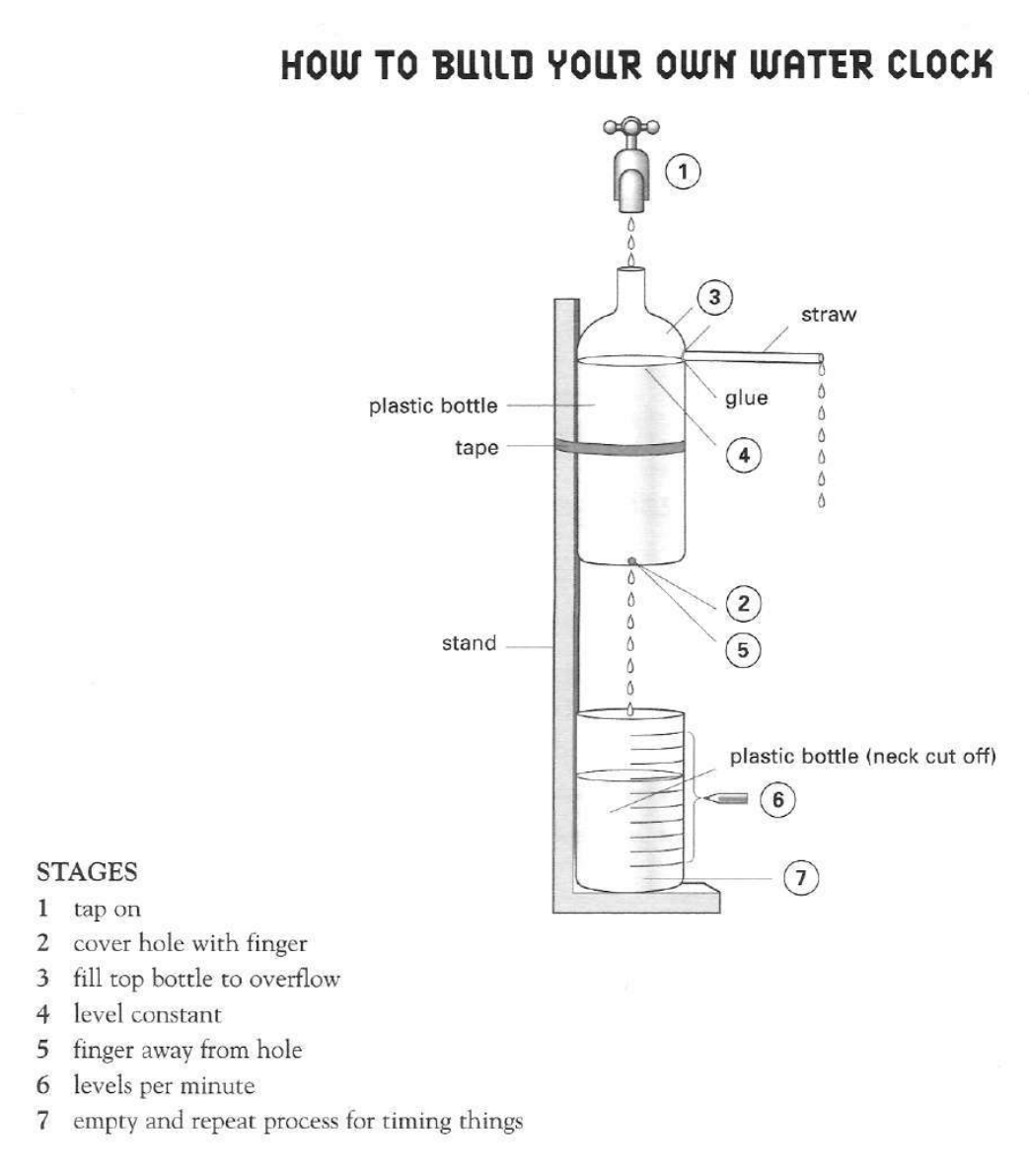
The diagram below shows the process for making a water clock.
Write a report for a university lecturer describing the information below.
HOW TO BUILD YOUR OWN WATER CLOCK
Student answer (Band 5.5)
The diagram demonstrates the procedure for building your own water clock.
Overall, there are several stages that have been mentioned. First is tap on, cover hole with finger, fill top bottle to overflow, level constant, finger away from hole, levels per minute and empty and repeat process for timing things.
The procedure starts from tap that dropped water into a plastic bottle that is tied with a stand with the help of a tape. When water filled top the bottle to overflow, there is a straw connected to it that helps to discharge extra water. There is a hole at the bottom of the bottle which we have to covered with finger or put the finger away when we need water for the next step.
There is another plastic bottle with neck cut off situated at the bottom of the first bottle. In which we measure the level of water in every minute. At last we emptied bottle to repeat the process for timing things.
AI examiner evaluation
| Criterion | Band |
|---|---|
| Task Achievement / Task Response | 6.0 |
| Coherence and Cohesion | 6.0 |
| Lexical Resource | 5.5 |
| Grammatical Range and Accuracy | 5.0 |
| Overall | 5.5 |
Task Achievement / Task Response: Band 6.0
The report identifies the diagram as a water-clock process and includes the main sequence, from turning on the tap to emptying and repeating the process. It also describes key components: the upper bottle, overflow straw, hole, stand and lower bottle. These details show a generally relevant account of the task. However, some stages are listed rather than explained, and the description of the timing function is unclear: “we measure the level of water in every minute” does not explain that the lower bottle’s rising water level is used to mark elapsed time. The account also omits the calibration lines being marked on the lower bottle. Develop the overview and explain how the apparatus works, rather than relying mainly on the stage labels.
Coherence and Cohesion: Band 6.0
The response has a clear overall arrangement: an introduction, an overview of the stages, and paragraphs describing the apparatus and its use. Sequencing expressions such as “Overall,” “The procedure starts” and “At last” help the reader follow the process. However, the overview repeats the stage labels without showing how they relate, and some connections between ideas are awkward or unclear. For example, “There is a hole at the bottom of the bottle which we have to covered with finger or put the finger away” combines two different actions without clearly indicating their order. The reference “In which” also does not connect smoothly to the previous sentence. Use clearer links between each stage and the relevant component.
Lexical Resource: Band 5.5
The response uses enough task-related vocabulary to identify the main equipment and actions, including “overflow,” “straw,” “stand,” and “neck cut off.” This makes the process broadly understandable. However, some word choices and collocations are imprecise or repetitive. “Tap that dropped water” is less natural than a description of water flowing or dripping from the tap, while “tied with a stand” does not accurately express how the bottle is attached. “Discharge extra water” is understandable but less suitable for this simple process description. The repeated use of “bottle” and “water” also limits variety. Aim for precise process vocabulary and natural combinations, such as “secured to the stand” and “drain off excess water.”
Grammatical Range and Accuracy: Band 5.0
The response attempts both simple and more complex sentences, including a relative clause in “a hole at the bottom of the bottle which…” and a time clause beginning “When water filled…”. However, errors in verb forms and sentence construction are frequent enough to make some parts difficult to read. For example, “we have to covered” should use the base form after “to,” and “When water filled top the bottle” has an unclear structure. The fragment “In which we measure…” is not a complete sentence, and “At last we emptied bottle” lacks an article and uses a tense that does not fit a general process description. Practise accurate present-simple process sentences and check that each sentence has a clear subject and verb.
See this exact question answered at other band scores. The same prompt compared across bands.
Browse more IELTS Writing model answers or get your own writing scored by the same AI examiner.