Band 5.5 IELTS Writing Task 1 Model Answer
Overall Band Score: 5.5 · IELTS Complete Catalyst · 2026-11-09
IELTS Writing Task 1 question
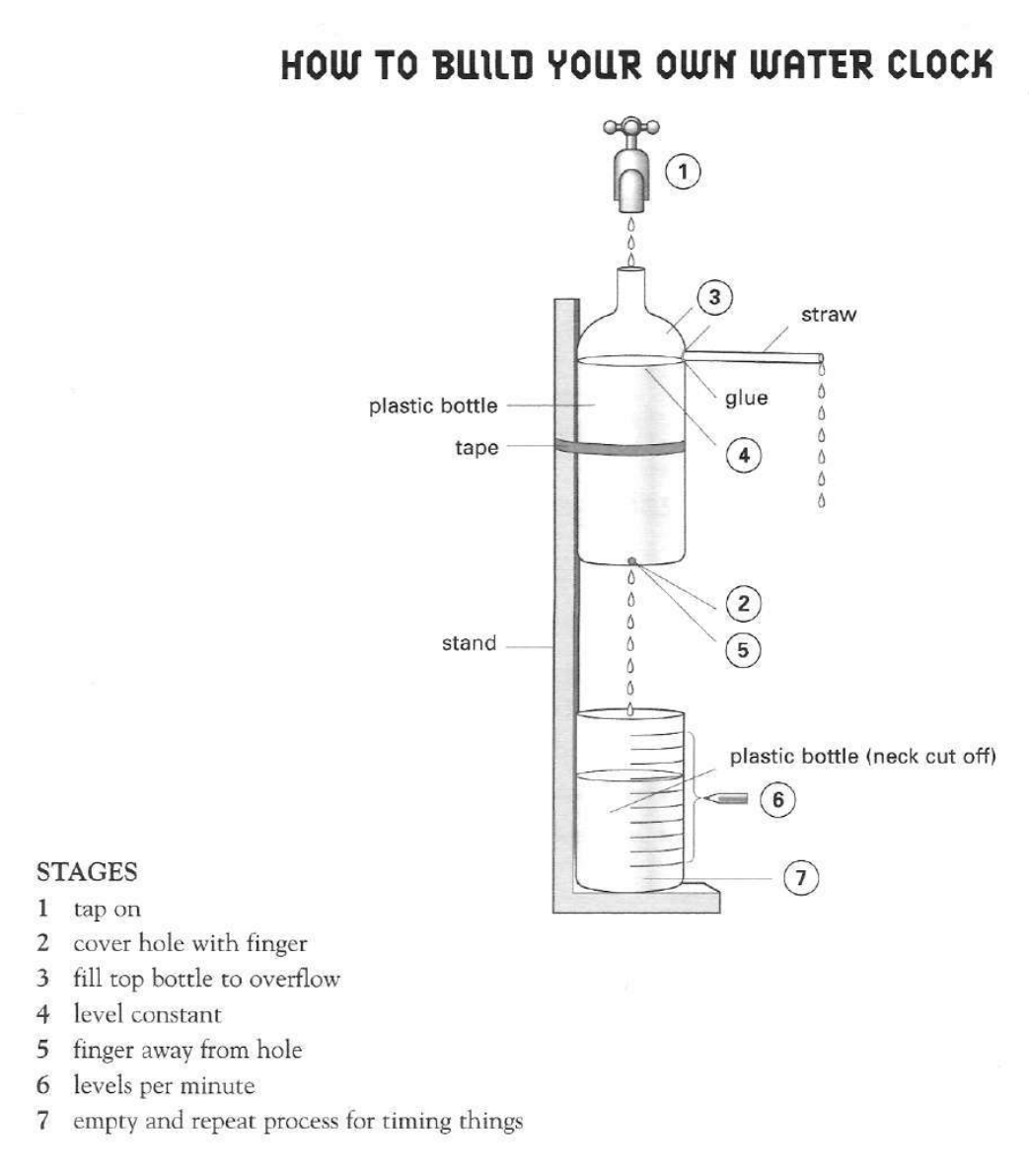
The diagram below shows the process for making a water clock.
Write a report for a university lecturer describing the information below.
HOW TO BUILD YOUR OWN WATER CLOCK
Student answer (Band 5.5)
The figure demonstrates the procedure of forming a water clock following the different stages showing how to develop some one,s personal water clock.
Overall the procedure consists of seven stages starting from the first step of turning on the water tap to fill up the water in the bottle hanging along the provided stand and the bottle is fixed with the help of the tape. The process ends with finally empting the plastic bottle to restart the process for timing the things.
The first stage is to turn on the water tap and cover the hole with finger untill the bottle is completely filled, covering the first three stages.Moreover, fourth stage is tomake sure that the level of the bottle should not be changing and remains contant.A the fifth stage the blockage is removed allowing the water to pour into the next bottle drop by drop.The bottle placed at the bottom shows the measurement lines and level of water per minute could be noted with the help of these lines.Sixth stage shows this calculation.At the last stage we need to empty the bottle and restart the process for the next activity timing calculations.
AI examiner evaluation
| Criterion | Band |
|---|---|
| Task Achievement / Task Response | 5.5 |
| Coherence and Cohesion | 5.5 |
| Lexical Resource | 5.5 |
| Grammatical Range and Accuracy | 5.5 |
| Overall | 5.5 |
Task Achievement / Task Response: Band 5.5
You identify the diagram as a seven-stage process and give a relevant overview, from turning on the tap to emptying the bottle and repeating the timing procedure. Several key stages are included, such as covering the hole, allowing water to flow into the lower bottle, and reading the marked levels. However, some details are unclear or inaccurate: the upper bottle is filled “to overflow” while the hole is covered, and the straw’s overflow function and the stand are not explained. The description also blurs stages three and four, and the meaning of “levels per minute” is not made precise. To develop the report further, explain the apparatus briefly and distinguish each numbered stage more clearly.
Coherence and Cohesion: Band 5.5
The response has a basic overall structure: an introduction, an overview, and a paragraph describing the stages. The sequence is generally understandable, and phrases such as “Overall,” “The first stage,” and “At the last stage” help guide the reader. However, the main process paragraph becomes crowded, with several stages joined together and little punctuation separating the information. For example, the explanation moves from filling the bottle to maintaining a constant level and then releasing the blockage without clearly marking each transition. Some linking is also repetitive or mechanical. Use separate sentences or clearer stage markers for the numbered steps, and ensure each reference such as “this calculation” clearly identifies the information being discussed.
Lexical Resource: Band 5.5
You use relevant process vocabulary, including “procedure,” “stages,” “measurement lines,” “level,” and “restart,” so the reader can follow the general subject. There is also some attempt to vary wording, for example “turn on the water tap” and “allowing the water to pour.” However, several word choices and collocations are inaccurate or awkward, including “forming a water clock,” “develop some one,s personal water clock,” and “the bottle hanging along the provided stand.” Spelling and word-form slips such as “empting,” “untill,” and “contant” are noticeable. Aim for precise, natural process language, such as “construct,” “attached to the stand,” and “empty the lower bottle,” and check spelling carefully.
Grammatical Range and Accuracy: Band 5.5
You attempt both simple and more extended sentence forms, including the overview sentence beginning “Overall” and the clause “allowing the water to pour into the next bottle.” The main sequence remains broadly understandable, but grammatical control is uneven. Some sentences contain faulty or incomplete structures, such as “fourth stage is tomake sure that the level of the bottle should not be changing,” while “A the fifth stage” lacks the correct preposition and article. There are also problems with punctuation and sentence boundaries, particularly where several stages run together. Practise forming clear passive process sentences and checking articles, verb forms, and punctuation; for example, “At the fifth stage, the blockage is removed, allowing water to flow into the lower bottle.”
See this exact question answered at other band scores. The same prompt compared across bands.
Browse more IELTS Writing model answers or get your own writing scored by the same AI examiner.