Band 6.0 IELTS Writing Task 1 Model Answer
Overall Band Score: 6.0 · IELTS Complete Catalyst · 2026-11-10
IELTS Writing Task 1 question
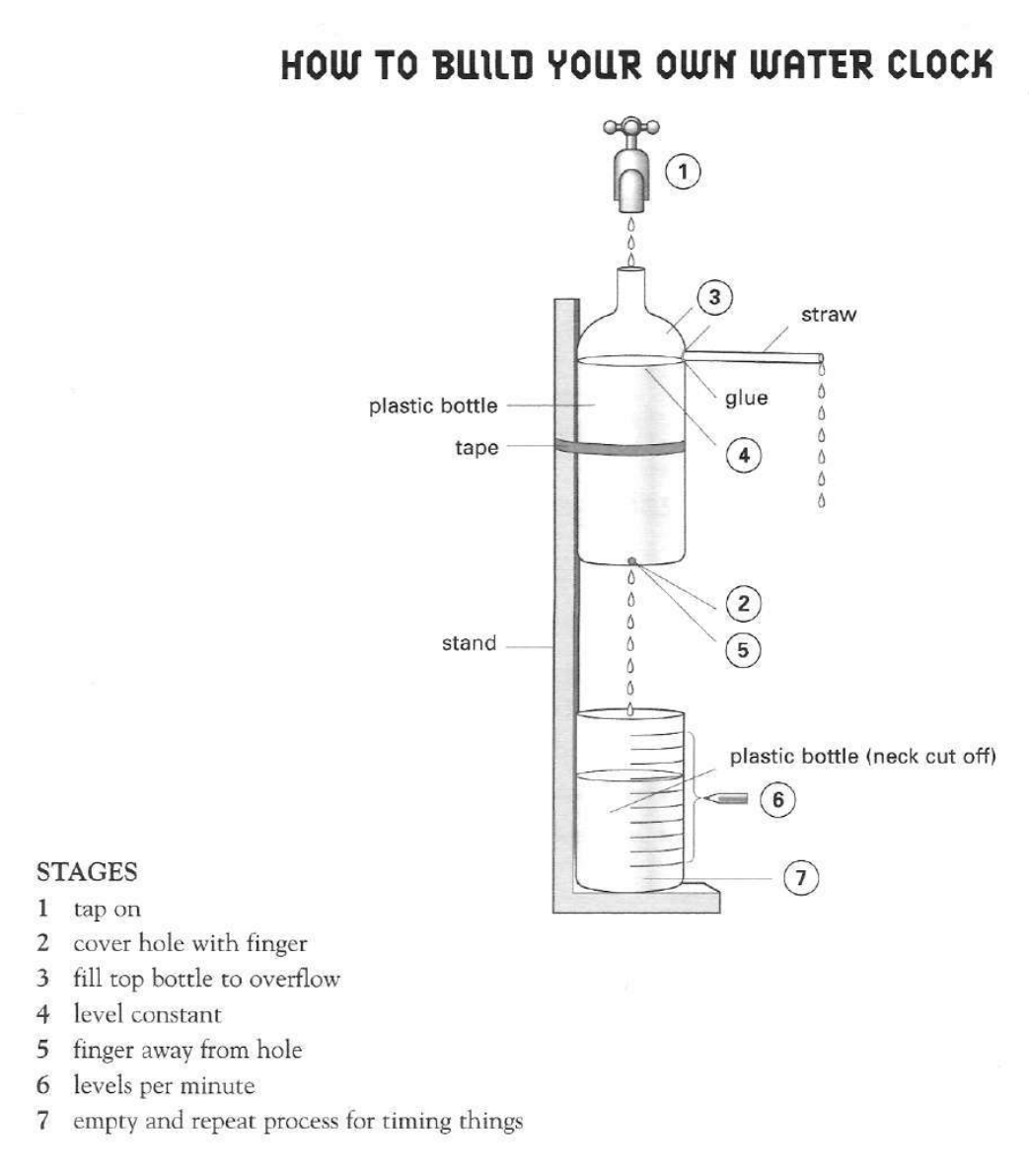
The diagram below shows the process for making a water clock.
Write a report for a university lecturer describing the information below.
HOW TO BUILD YOUR OWN WATER CLOCK
Student answer (Band 6.0)
The diagram illustrates the steps involved in the making of a water clock.
Overall, a water clock is formed by following seven steps, starting with turning the tap on and ending with the water clock.
The process includes opening the tap, and the water is then added to a plastic bottle. The bottle is attached to the stand with tape. There is a hole at the bottom of the bottle which is used for filling up the water in bottle. The hole is covered with a finger in order to stop the water leakage. There is a straw attached to the upper part of the bottle, which is used to maintain the level.
Furthermore, straw is used to restrain the level of water, if water level increased, it will be drained from starw. There is a water bottle at the bottom of the stand with the neck cut off and markings for measurement. The next step includes removing the finger from the hole to count the water dripping level per minute in the bottle. The bottle is emptied, and the process is repeated for timing. These are the steps involved in the process of making a water clock.
AI examiner evaluation
| Criterion | Band |
|---|---|
| Task Achievement / Task Response | 6.0 |
| Coherence and Cohesion | 6.0 |
| Lexical Resource | 5.5 |
| Grammatical Range and Accuracy | 5.5 |
| Overall | 6.0 |
Task Achievement / Task Response: Band 6.0
You cover the main stages and include a useful overview that identifies the seven-step sequence, from turning on the tap to repeating the process for timing. Several construction details are also relevant, including the upper bottle, stand, straw and lower bottle with markings. However, some stages are not described precisely: the hole is covered before the upper bottle is filled to overflowing, and the water level is allowed to become constant before the finger is removed. Your account instead suggests the hole is used for filling and does not clearly explain the constant-level stage. The ending, “ending with the water clock,” is also vague; state that the clock is emptied and the process repeated to time events. More accurate coverage of these less-developed steps would strengthen the report.
Coherence and Cohesion: Band 6.0
The response has a clear overall shape: an introduction, an overview, and a sequence of details that broadly follows the process. Connectors such as “Overall,” “Furthermore,” and “The next step” help signal progression. However, the order is not consistently easy to follow because the construction details and operating stages are mixed together, and the straw’s function is explained twice. Some references are also unclear, particularly “the bottle” when both upper and lower bottles are being discussed. Organise the body into construction and operation, or describe each stage in sequence, and use labels such as “upper bottle” and “lower container” consistently. This would make the progression smoother and reduce repetition.
Lexical Resource: Band 5.5
You use relevant process vocabulary, including “attached,” “markings,” “dripping,” and “repeated,” which helps communicate the diagram’s main features. There is some variety in how you describe the apparatus and actions. However, several choices are imprecise or awkward: “water leakage” does not clearly describe water flowing through the hole, “restrain the level” is not a natural description of the straw’s function, and “starw” is a spelling error. “Water clock is formed” and “count the water dripping level” are also unclear collocations. Choose precise process verbs and standard terms for the water level and overflow. This would make the description more natural and exact while retaining your relevant vocabulary.
Grammatical Range and Accuracy: Band 5.5
You use a mixture of simple sentences and more complex forms, including a relative clause in “a water bottle … with the neck cut off” and a conditional sentence beginning “if water level increased.” Most of the meaning remains understandable, but some grammatical errors and awkward constructions reduce accuracy. For example, “if water level increased, it will be drained” shifts tense and needs an article before “water level”; “There is a water bottle … with the neck cut off and markings” also leaves the relationship between the bottle and markings unclear. The sentence beginning “The process includes opening the tap, and the water is then added” combines actions in a way that obscures their sequence. Use consistent present-tense forms and check articles and clause structure.
See this exact question answered at other band scores. The same prompt compared across bands.
Browse more IELTS Writing model answers or get your own writing scored by the same AI examiner.