Band 5.5 IELTS Writing Task 1 Model Answer
Overall Band Score: 5.5 · IELTS Complete Catalyst · 2026-11-10
IELTS Writing Task 1 question
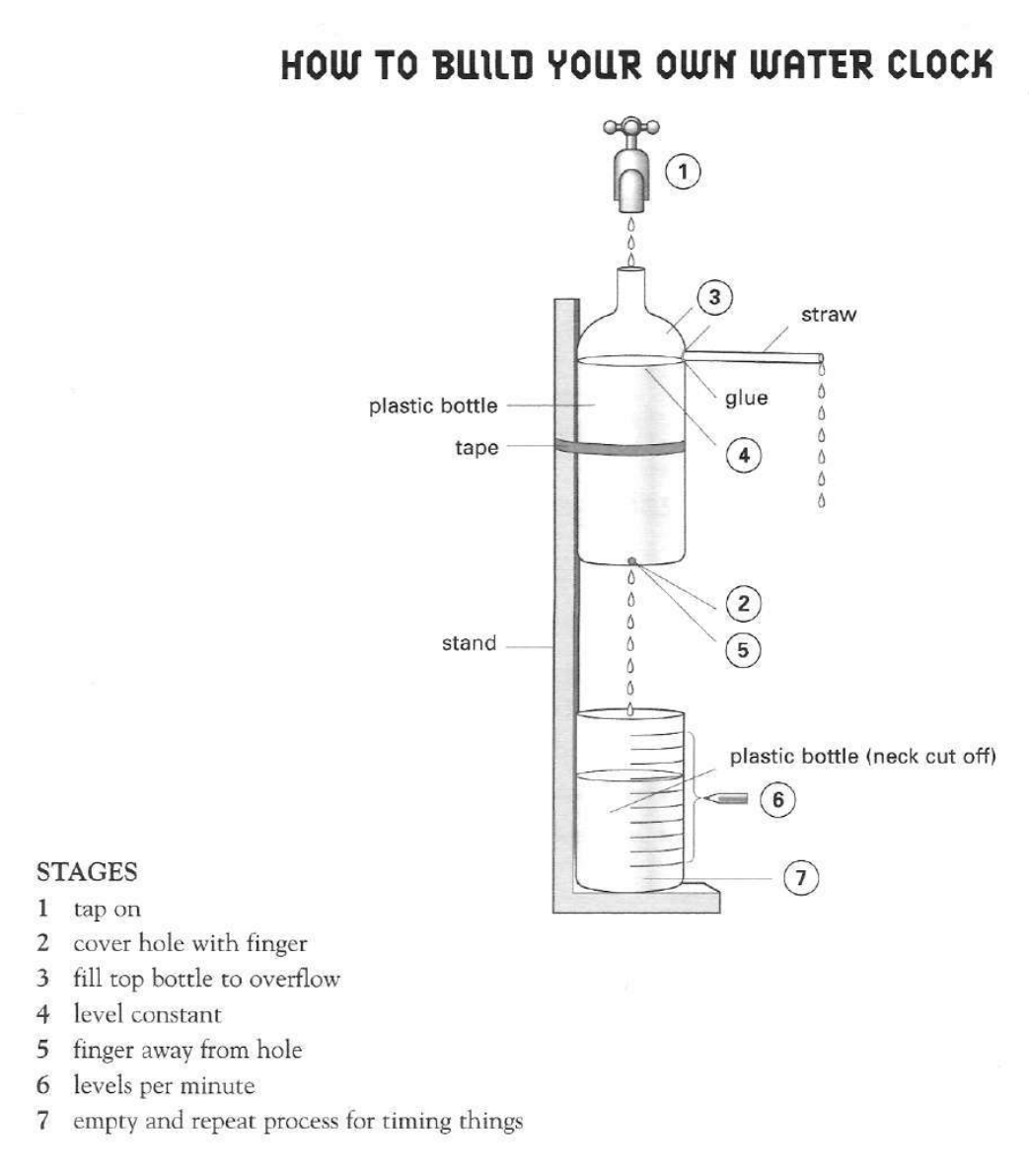
The diagram below shows the process for making a water clock.
Write a report for a university lecturer describing the information below.
HOW TO BUILD YOUR OWN WATER CLOCK
Student answer (Band 5.5)
The diagram illustrates the process of building a water clock following a seven step proccess.Initially a plastic bottle is attached to a stand through a tape and below a plaastic bottle which neck is cut off placed beneath the former bottle on base of the stand and this stand comprising the plastic bottle is leveled below a tap. The bottle above has a straw attaached below the neck to maintain water level and drop extra water and at the base of the bottle is a hole that has to be covered when the tap opens and the bottle is filling.Once water reaches level of straw remove the hand to allow the water flow dropwise into the open plastic bottle placed beneath and watch thoroughly the level of water filled in per minute then empty the plastic bottle and repeat the process of leveling water per minute and keep on redoing the last step.These steps followed throughly enables you making your own water clock.
AI examiner evaluation
| Criterion | Band |
|---|---|
| Task Achievement / Task Response | 5.5 |
| Coherence and Cohesion | 5.0 |
| Lexical Resource | 5.5 |
| Grammatical Range and Accuracy | 5.0 |
| Overall | 5.5 |
Task Achievement / Task Response: Band 5.5
The response identifies the main purpose and describes the basic sequence: water enters the upper bottle, flows into the lower container, and the process is repeated for timing. It also includes relevant construction details, such as the stand, tape, straw and cut-off lower bottle. However, some stages are unclear or inaccurately described. The diagram says to cover the hole before filling the upper bottle to overflow, then remove the finger; your account compresses these actions and says to watch the water level “filled in per minute,” which does not clearly explain that the lower bottle is marked to measure levels per minute. A clearer overview of how the apparatus works, followed by a more precise account of the numbered stages, would make the report more complete.
Coherence and Cohesion: Band 5.0
The response follows a broadly sensible order, moving from the apparatus to filling it and then repeating the timing process. Sequencing expressions such as “Initially,” “Once,” and “then” help the reader follow the general procedure. However, nearly all the information is packed into one long paragraph and several extended sentences, so the stages are difficult to distinguish. Some references are also unclear: “the former bottle” and “this stand comprising the plastic bottle” make it hard to identify which component is meant. Organise the report into a brief overview and a separate sequence of stages, and use clearer references such as “the upper bottle” and “the lower container.”
Lexical Resource: Band 5.5
You use relevant process vocabulary, including “stand,” “straw,” “hole,” “tap,” and “repeat,” which allows the reader to recognise the main components and actions. There are also attempts at more specific wording, such as “dropwise” and “maintain water level.” However, several choices are imprecise or awkward for describing the diagram: “leveling water per minute” does not clearly convey marking the lower bottle, and “keep on redoing the last step” is informal and repetitive. Spelling errors such as “proccess,” “plaastic,” “attaached,” and “throughly” also reduce accuracy. Prefer precise process terms such as “mark,” “measure,” and “calibrate,” and check spelling carefully.
Grammatical Range and Accuracy: Band 5.0
The response attempts to combine several stages using subordinate clauses and time expressions, for example, “Once water reaches level of straw remove the hand…” This shows some effort to use more than simple sentences. However, long, loosely joined sentences contain frequent grammatical problems that sometimes make relationships between actions difficult to follow. Examples include “a plastic bottle is attached to a stand through a tape,” “below a plastic bottle which neck is cut off placed beneath,” and “enables you making.” Articles, relative clauses, verb forms and sentence boundaries need more reliable control. Break the procedure into shorter sentences and check that each has a clear subject and correctly formed verb; for example, “The lower bottle, whose neck has been cut off, rests on the stand’s base.”
See this exact question answered at other band scores. The same prompt compared across bands.
Browse more IELTS Writing model answers or get your own writing scored by the same AI examiner.