Band 5.5 IELTS Writing Task 1 Model Answer
Overall Band Score: 5.5 · IELTS Complete Catalyst · 2026-11-10
IELTS Writing Task 1 question
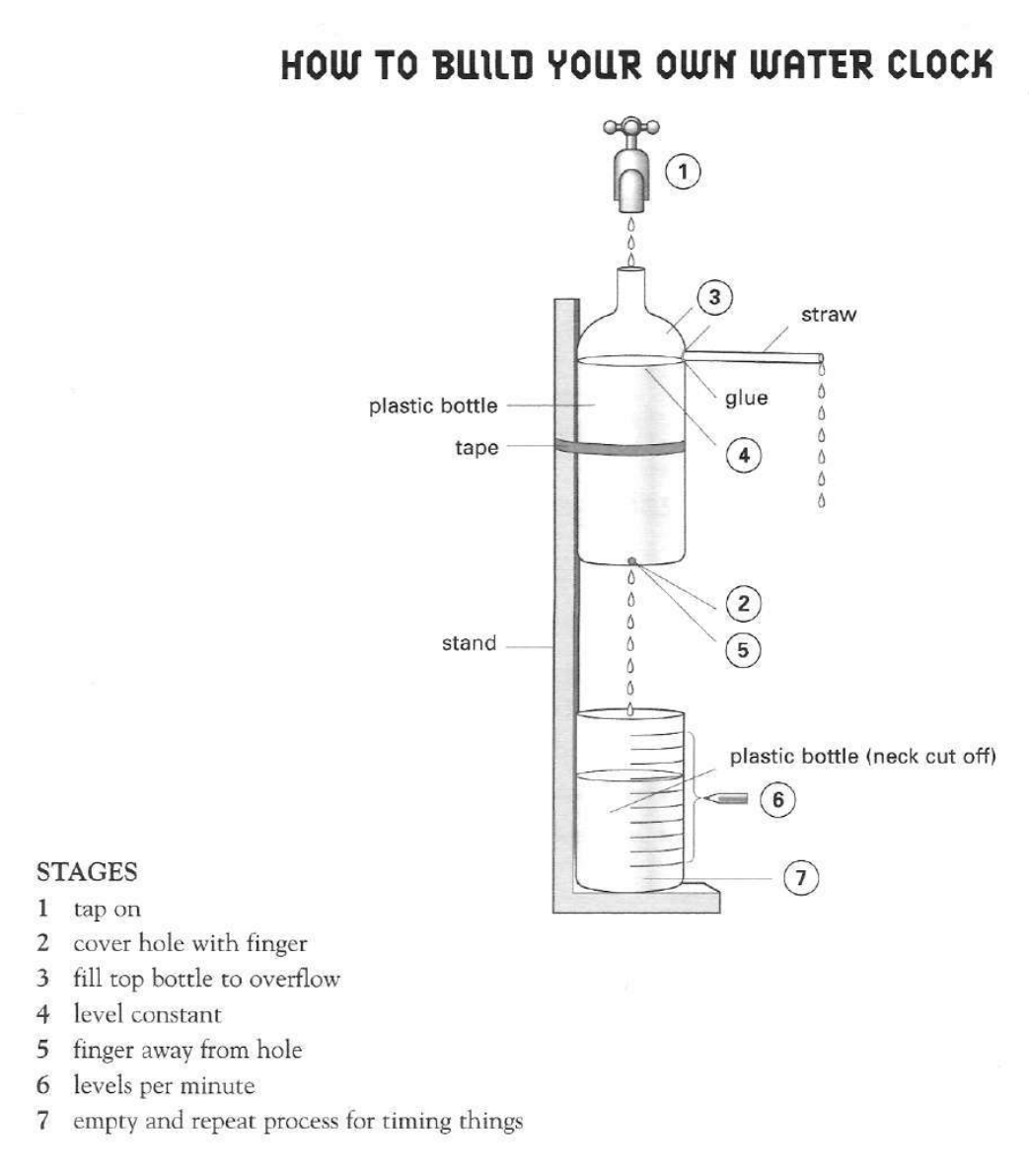
The diagram below shows the process for making a water clock.
Write a report for a university lecturer describing the information below.
HOW TO BUILD YOUR OWN WATER CLOCK
Student answer (Band 5.5)
The given diagram illustrates the process of building a water clock by your own. It requires seven easy steps and you'll need 2 plastic bottle, tape, glue, straw and a stand to make the clock.
You first need to tape a bottle at the top of the stand and place another bottle with neck off at the bottom of the stand. Cut a hole at the bottom of the top bottle. You should mark the top bottle's capacity and stick a straw there so that we can determine the overflow. After finishing the setup the actual process of making the clock starts.
Start the water tap and fill the top bottle untill it overflows. You should cover the hole of that bottle with your finger. Stop the tap and wait till it comes to it's capacity level marked by the straw. Now take your finger away from the hole and measure the levels of the bottom bottle per minute. After getting an average number you're good to go. Now empty all the bottles and you got your water clock.
AI examiner evaluation
| Criterion | Band |
|---|---|
| Task Achievement / Task Response | 5.5 |
| Coherence and Cohesion | 6.0 |
| Lexical Resource | 5.5 |
| Grammatical Range and Accuracy | 5.5 |
| Overall | 5.5 |
Task Achievement / Task Response: Band 5.5
The response identifies the main purpose and gives a sequence of construction and operating steps, including the two bottles, stand, straw, overflow and timing. However, some details are inaccurate or unclear: the diagram shows the upper bottle attached with tape, but does not say to mark its capacity; the straw sets the overflow level. The operating sequence is also partly misreported: the hole is covered before filling, and the tap remains on until water overflows; the response instead says to stop the tap and wait for the level to reach the straw. The final stages—reading the lower bottle’s level per minute, then emptying and repeating the process—are not fully conveyed. A clearer overview and more faithful account of the stages would strengthen coverage.
Coherence and Cohesion: Band 6.0
The information is arranged in a generally logical order: materials and setup come first, followed by the operating procedure. Paragraphing helps distinguish these phases, and sequencing expressions such as “You first,” “After finishing the setup,” and “Now” guide the reader. However, the transition from construction to operation is somewhat abrupt, and the sequence of actions is not always easy to follow because the instructions about covering the hole, filling the bottle and stopping the tap do not match the diagram’s order. Some references, such as “that bottle” and “it,” could also be more precise. Use numbered stages or clearer linking phrases to make the process progression more reliable.
Lexical Resource: Band 5.5
The response uses a relevant range of process vocabulary, including “tape,” “stand,” “overflow,” “capacity,” and “measure,” so the main procedure is understandable. However, several choices are informal or imprecise for an academic process report: “by your own,” “easy steps,” “good to go,” and “you got your water clock” sound conversational. Some wording also mislabels the apparatus: the straw indicates the overflow level rather than helping “determine the overflow,” and “levels … per minute” is not a precise description of the readings. Spelling and word-form slips such as “untill” and “neck off” are noticeable. Prefer neutral, exact terms such as “construct,” “stages,” and “water level.”
Grammatical Range and Accuracy: Band 5.5
The response includes both simple instructions and some longer structures, for example, “After finishing the setup the actual process … starts,” and the sequence is generally understandable. However, grammatical control is uneven, particularly in articles, plurals, possessives and verb forms. Examples include “2 plastic bottle” instead of a plural form, “by your own” instead of a reflexive construction, and “it’s capacity” where a possessive is needed. The sentence “Now empty all the bottles and you got your water clock” shifts awkwardly between an imperative and past tense. There are also some run-on or loosely joined instructions. Check agreement and tense consistency, and use complete, clearly punctuated sentences while retaining a mix of sentence patterns.
See this exact question answered at other band scores. The same prompt compared across bands.
Browse more IELTS Writing model answers or get your own writing scored by the same AI examiner.