Band 5.0 IELTS Writing Task 1 Model Answer
Overall Band Score: 5.0 · IELTS Complete Catalyst · 2026-11-10
IELTS Writing Task 1 question
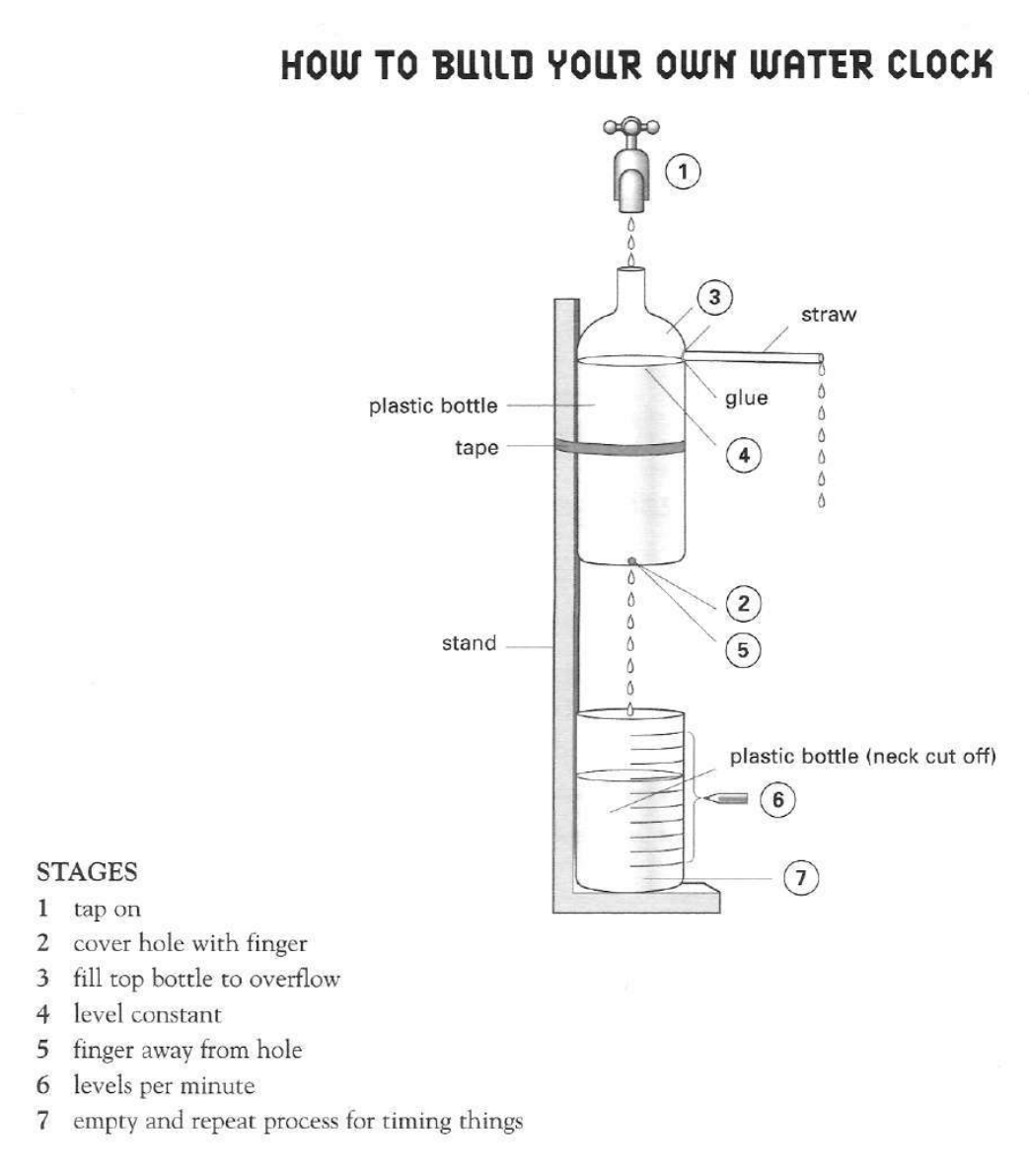
The diagram below shows the process for making a water clock.
Write a report for a university lecturer describing the information below.
HOW TO BUILD YOUR OWN WATER CLOCK
Student answer (Band 5.0)
The process diagram illustrates that how to make water clock.
Overall, the process consist of seven main stages, beginning with put some water to plastic bottle from tap water, and ending with how clock is accounted. The water clock includes plastic bottle which is sticked with stand by tape and has a small hole on the bottom, straw which is glued to plastic bottle, and another plastic bottle with measurement lines.
First, tap on and put some water to plastic bottle until water reaches straw, while covering hole with finger. After that, take finger away from hole.
Next, lines on the second plastic bottle is levels per minute. After second bottle overflowed people can repeat the process for timing things.
AI examiner evaluation
| Criterion | Band |
|---|---|
| Task Achievement / Task Response | 5.0 |
| Coherence and Cohesion | 5.5 |
| Lexical Resource | 5.0 |
| Grammatical Range and Accuracy | 5.0 |
| Overall | 5.0 |
Task Achievement / Task Response: Band 5.0
You identify the diagram as a water-clock process and give a broad start-to-finish account, including the bottles, stand, tape, straw and calibration lines. However, the report only partially covers the stages: it omits the instruction to fill the upper bottle until it overflows, the constant water level, and the meaning of the markings as levels per minute is unclear. The claim that the second bottle overflows is not shown; the diagram says to empty it and repeat the process. The overview phrase “ending with how clock is accounted” does not clearly describe the final stage. The response is also below the required 150 words. Add the missing steps and explain the apparatus and timing method accurately.
Coherence and Cohesion: Band 5.5
The response has a basic sequence, using “First,” “After that,” and “Next,” and it separates the overview from the procedural details. These features help the reader follow the general direction of the process. However, the progression is incomplete and some links between ideas are unclear: “After that, take finger away from hole” is followed by a statement about the second bottle’s lines without explaining how water collects there or how the markings are made. The final sentence combines overflow and repetition in a way that obscures the sequence. Use one paragraph for the apparatus and overview, then a clearly ordered account of the stages, with accurate references such as “the upper bottle” and “the lower bottle.”
Lexical Resource: Band 5.0
You use some relevant process vocabulary, including “plastic bottle,” “stand,” “tape,” “straw,” “hole,” and “measurement lines,” so the reader can identify the main equipment. However, the range is limited and several word choices or collocations make the description unclear. “How clock is accounted” does not express the idea of timing, while “lines … is levels per minute” is not a natural way to describe calibration marks. “Sticked” is also an inaccurate form. Choose precise process terms and use them consistently, for example, “attached,” “overflow,” “calibration marks,” and “measure elapsed time.” This would make the account more concise and easier to understand.
Grammatical Range and Accuracy: Band 5.0
The response attempts a few longer structures, such as “beginning with … and ending with …” and “until water reaches straw, while covering hole with finger,” but control is inconsistent. Errors occur in basic sentence patterns and agreement: “illustrates that how” uses an unnecessary conjunction, “the process consist” lacks subject–verb agreement, and “lines … is” has a plural subject with a singular verb. Articles are also frequently missing, as in “from tap water,” “to plastic bottle,” and “with finger.” The final sentence is difficult to parse because its clauses are not clearly connected. Practise accurate simple sentences first, then combine steps with controlled clauses and check articles, agreement and punctuation.
See this exact question answered at other band scores. The same prompt compared across bands.
Browse more IELTS Writing model answers or get your own writing scored by the same AI examiner.