Band 5.0 IELTS Writing Task 1 Model Answer
Overall Band Score: 5.0 · IELTS Complete Catalyst · 2026-11-11
IELTS Writing Task 1 question
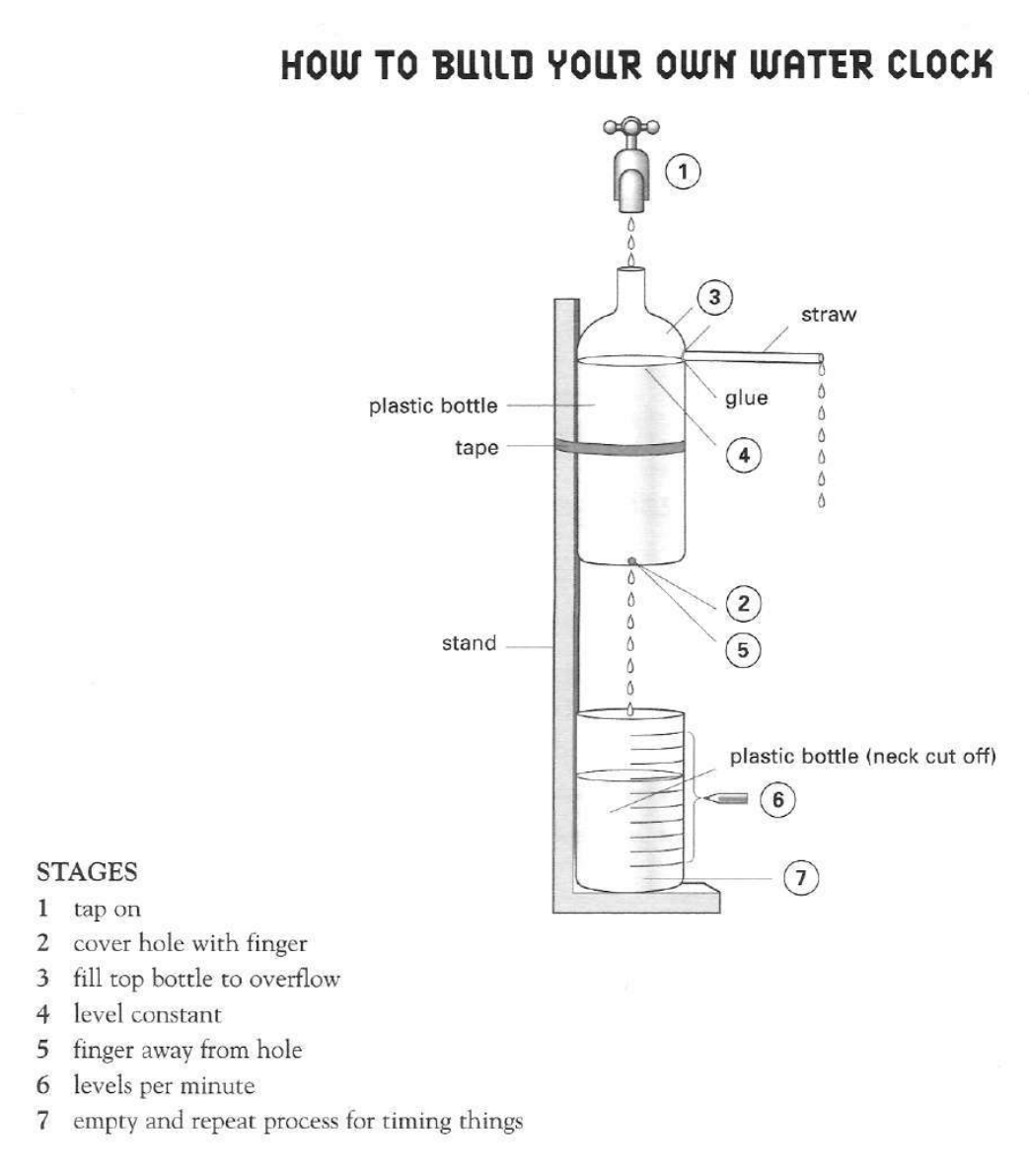
The diagram below shows the process for making a water clock.
Write a report for a university lecturer describing the information below.
HOW TO BUILD YOUR OWN WATER CLOCK
Student answer (Band 5.0)
Here, this diagram showing a process for making water clock.This showing how to build your own water clock.There are different stages in diagram to build a water clock.
In this water clock the first satge is tap on, we have tap when we turn on then it will drop water in plastic bottle and plastic bottel bend with stand through tape and in bottom of bottle we have small whole which also droop water to another plastic bottle which name neck cut off which is basically for measuring time.But in top bottle we also have glue and straw at top right of bottle for overflow water.So it mean when fill top bottle with water then it will over flow through straw, thats why here water level be always constan because of straw.Also in bottom plastic bottle we have in most bottom a space when it empty it mean the process will be repeat for timing things. Also we have in bottom bottle right side small horizontal lines which shows level of water per minute.
AI examiner evaluation
| Criterion | Band |
|---|---|
| Task Achievement / Task Response | 5.5 |
| Coherence and Cohesion | 5.0 |
| Lexical Resource | 5.0 |
| Grammatical Range and Accuracy | 5.0 |
| Overall | 5.0 |
Task Achievement / Task Response: Band 5.5
The response identifies the main purpose and several relevant components, including the tap, two bottles, stand, straw, overflow, and the lower bottle’s timing marks. It also explains the broad sequence from filling the upper bottle to repeating the process. However, some stages are not reported accurately or clearly: the instruction to cover the hole with a finger and then remove the finger is omitted, and “level of water per minute” does not clearly explain that the marks indicate levels at one-minute intervals. The claim that the lower bottle has “a space when it empty” is also unclear. A more complete, step-by-step account of the numbered stages, with a concise overview of how the clock measures time, would make the description more fully developed.
Coherence and Cohesion: Band 5.0
The response has a basic overall order: it introduces the diagram, describes the apparatus, and then explains how water moves through it. This gives the reader some sense of the process. However, the information is largely presented in two long paragraphs, and the second combines construction details, operation, and the purpose of the markings without clear progression. Linking phrases such as “So it mean” and repeated uses of “also” do not always show the relationship between steps precisely. Organise the report into a brief overview followed by a clearly sequenced description, using references such as “first,” “once the bottle is full,” and “finally” to guide the reader through the stages.
Lexical Resource: Band 5.0
The response uses some relevant task vocabulary, including “overflow,” “stand,” “straw,” and “measuring time,” so the basic subject is understandable. However, the range is limited and several word choices or spellings make details difficult to interpret, such as “small whole” for the hole, “bottel bend with stand,” and “water level be always constan.” Repetition of “plastic bottle” and “water” also limits precision. Use accurate process verbs and component names, for example, “is attached to the stand,” “drains through the straw,” and “calibration marks,” while checking spelling. This would make the description clearer and more appropriate to a formal report.
Grammatical Range and Accuracy: Band 5.0
The response attempts to connect ideas in longer sentences, for example, “when fill top bottle with water then it will over flow through straw,” but these structures are often faulty. Missing subjects and articles, incorrect verb forms, and agreement problems occur throughout: “This diagram showing,” “when we turn on then it will drop,” and “water level be always constan.” Sentence boundaries and punctuation are also inconsistent, with several ideas joined into long strings. These errors sometimes make the sequence or meaning difficult to follow. Practise accurate simple present forms for process descriptions, such as “Water flows into the upper bottle,” and build longer sentences with correctly formed clauses and clear punctuation.
See this exact question answered at other band scores. The same prompt compared across bands.
Browse more IELTS Writing model answers or get your own writing scored by the same AI examiner.