Band 5.5 IELTS Writing Task 1 Model Answer
Overall Band Score: 5.5 · IELTS Complete Catalyst · 2026-11-12
IELTS Writing Task 1 question
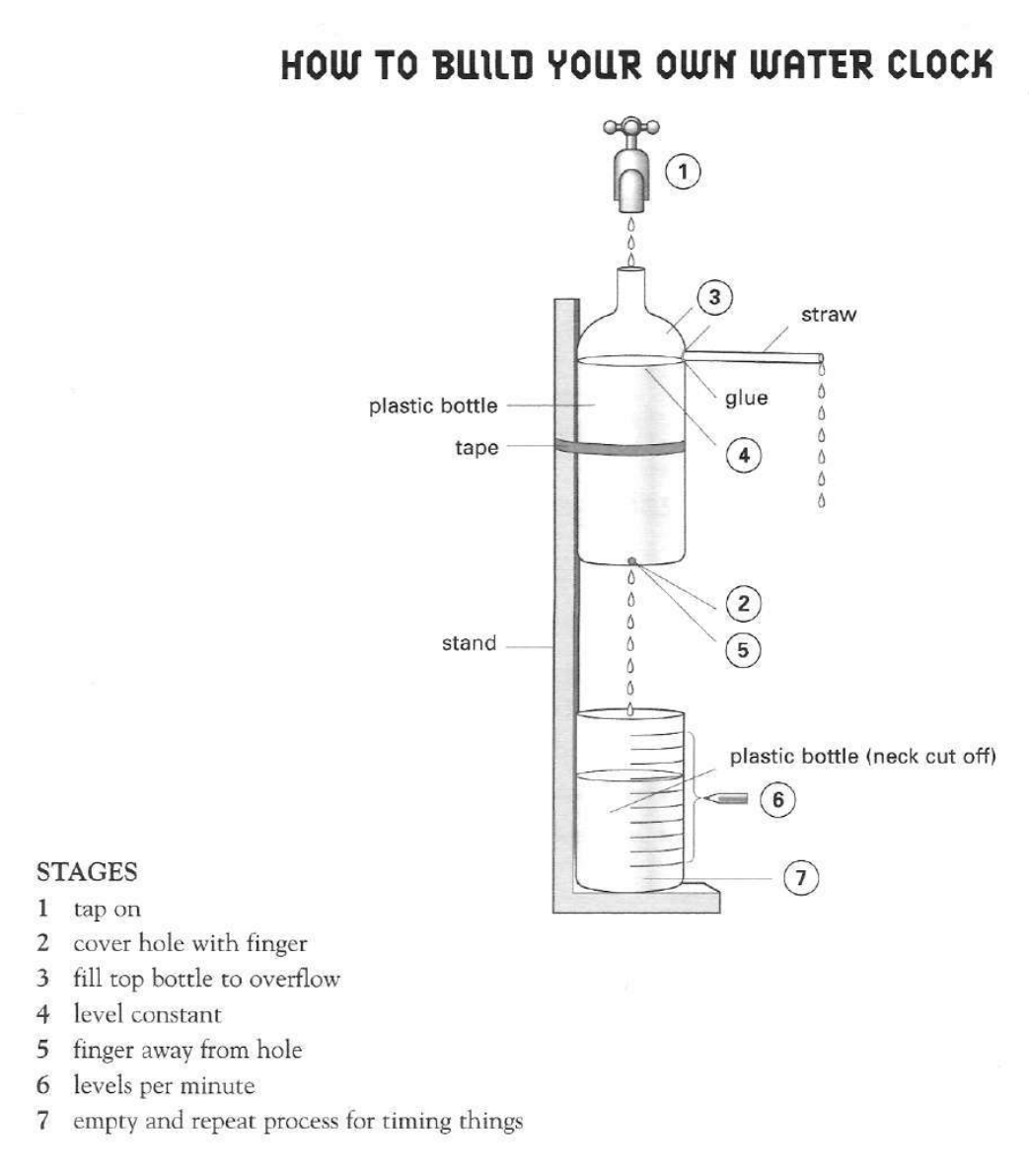
The diagram below shows the process for making a water clock.
Write a report for a university lecturer describing the information below.
HOW TO BUILD YOUR OWN WATER CLOCK
Student answer (Band 5.5)
The diagram illustrates the various stages invovled in creating a water clock.
Overall, constructing a water clock consists different stages which starts from on the water tap and goes through fill upper bottle to overflow and put finger away from the whole in upper bottle. The process ends at measure level of water per minte and repeat process again for measure time.
Turning to the details, process is begin with the on water tap to fill the plastic bottle which connect with stand with tape. After that put finger on the hole in the botton of the bottle and wait to fill the upper bottle for overflow from the straw which paste with plastic bottle with glue. when plastic bottle overflow their level should be constant.
Next step is put back finger from the hole in the bottom of the plastic bottle and by this what dripped in the lower plastic bottle that set on the stand. When drops dripped in the lower bottle their level is measured by the measurement create on the plastic bottle. By this water clock measure the time. It is a repeat process so when lower bottle filled and overflow then empty the lower bottle and start the same process again to measure the timing things.
AI examiner evaluation
| Criterion | Band |
|---|---|
| Task Achievement / Task Response | 6.0 |
| Coherence and Cohesion | 6.0 |
| Lexical Resource | 5.0 |
| Grammatical Range and Accuracy | 5.0 |
| Overall | 5.5 |
Task Achievement / Task Response: Band 6.0
You cover the main sequence from turning on the tap and filling the upper bottle to measuring the water level and repeating the process. You also include relevant construction details, such as the stand, tape, glue, straw and lower bottle, and your opening overview identifies the process as a series of stages. Some details, however, are unclear or not fully accurate: the diagram says to cover the hole while the upper bottle fills to overflow, then remove the finger; your account says “put finger on” and later “put back finger,” which makes the sequence difficult to follow. The final step is to empty and repeat for timing things, not to wait for the lower bottle to overflow. Clarifying these stages and explaining how the marked levels indicate time would make the report more complete.
Coherence and Cohesion: Band 6.0
The response has a recognisable structure: an introduction and overview are followed by two paragraphs describing the process. Sequencing expressions such as “After that,” “Next step,” and “when” help the reader follow the general order. However, some links are mechanical or unclear, and the progression becomes difficult to track in sentences such as “Next step is put back finger from the hole” and “By this water clock measure the time.” The overview also combines several stages in one long sentence rather than summarising the process clearly. Use more precise stage transitions and refer consistently to the upper and lower bottles; this would improve cohesion and make the sequence easier to follow.
Lexical Resource: Band 5.0
You use relevant process vocabulary, including “overflow,” “stand,” “glue,” “hole,” and “lower plastic bottle,” so the reader can identify much of the equipment and action. However, the range is limited and several word choices or collocations are inaccurate, including “creating a water clock,” “on the water tap,” “measurement create,” and “measure the timing things.” Spelling slips such as “invovled,” “botton,” and “minte” also reduce precision. Aim for standard process-report expressions and accurate forms, for example “constructing,” “turn on the tap,” “markings,” and “measure time.” More precise vocabulary would help distinguish the water level, calibration marks and repeated timing procedure.
Grammatical Range and Accuracy: Band 5.0
You attempt both simple and longer sentences, and the overall meaning is usually recoverable. Some grammatical errors nevertheless make parts of the process difficult to understand. For example, “constructing a water clock consists different stages” is missing a necessary preposition, while “which starts from on the water tap” has an unclear clause structure. There are also errors in verb forms and agreement, as in “process is begin” and “their level should be constant,” as well as missing articles in phrases such as “fill the upper bottle.” Sentence boundaries and capitalisation are inconsistent, particularly after “overflow.” Practise forming clear passive instructions or descriptions, such as “The hole is covered while the bottle fills,” and check articles, verb forms and sentence punctuation.
See this exact question answered at other band scores. The same prompt compared across bands.
Browse more IELTS Writing model answers or get your own writing scored by the same AI examiner.