Band 5.0 IELTS Writing Task 1 Model Answer
Overall Band Score: 5.0 · IELTS Complete Catalyst · 2026-11-13
IELTS Writing Task 1 question
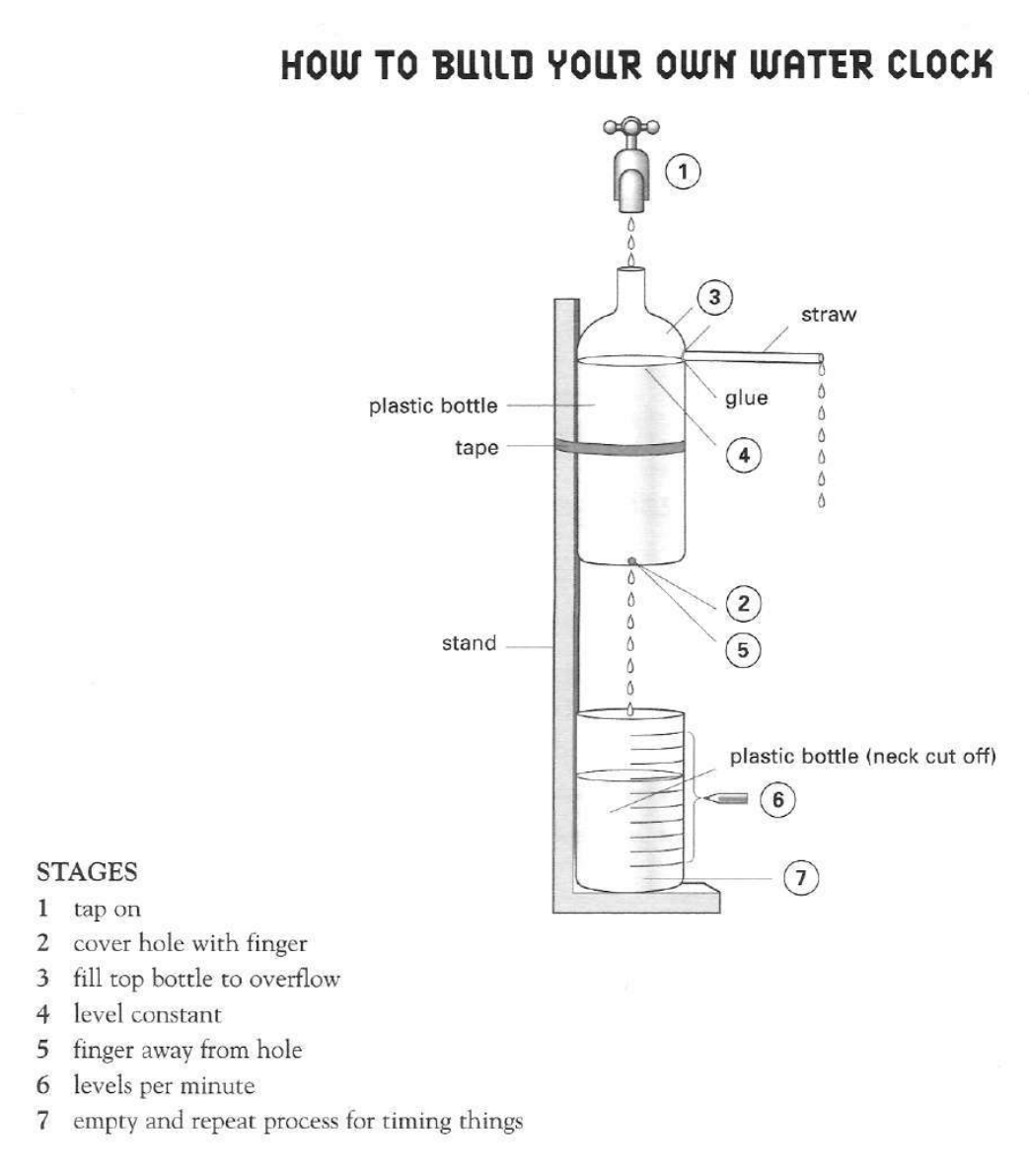
The diagram below shows the process for making a water clock.
Write a report for a university lecturer describing the information below.
HOW TO BUILD YOUR OWN WATER CLOCK
Student answer (Band 5.0)
The dia gram shows the process of making a water clock. In this process we use plastic bottle, tap, stand, plastic bottle (neck cut off), straw and glue. At the first stage, water drops are dropped into a bottle and in the second step make a little hole at the lower side of bottle and put a finger. Moreover, in the third step we attach a straw with glue and bottle attach with stand with the help of tape.
In addition to this, the cut off bottle place in the stand at beneath the first bottle. In the fourth step, the first bottle fill water and finger from hole water overflow through the straw and we see water dropped to the lower cut bottle through the tiny hole. Further more, in the sixth step we mark a cut bottle with pencil and measure levels per minute. At the end, repeat this process for timing things.
AI examiner evaluation
| Criterion | Band |
|---|---|
| Task Achievement / Task Response | 5.0 |
| Coherence and Cohesion | 5.5 |
| Lexical Resource | 5.0 |
| Grammatical Range and Accuracy | 5.0 |
| Overall | 5.0 |
Task Achievement / Task Response: Band 5.0
The response identifies the diagram as a water-clock process and mentions several relevant components, including the bottles, tap, stand, straw and glue. It also recognises the final purpose of repeating the process to time things. However, the stages are not reported accurately or in a clear, complete sequence. For example, the first stage is turning on the tap, not water already dropping into a bottle; making a hole is not listed as a stage; and the straw and stand are construction details rather than the third step. The key sequence of covering the hole, filling the upper bottle until it overflows, keeping the water level constant, then releasing the finger is confused. A clearer overview and a more faithful account of the numbered stages would make the report more complete.
Coherence and Cohesion: Band 5.5
The response has two paragraphs and uses sequencing expressions such as “At the first stage,” “In addition to this,” and “At the end,” so the reader can recognise that it is describing a process. However, the progression is difficult to follow because the numbered stages are mixed with construction details and some steps are misplaced. For instance, the straw and stand are described as part of the third step, while the filling and overflow actions appear later under the fourth step. Linking phrases such as “Moreover” and “Further more” do not always clarify how one action relates to the next. Organise the report into an introduction and a chronological description, and use stage numbers consistently to guide the reader.
Lexical Resource: Band 5.0
The response uses a basic set of relevant process words, including “attach,” “overflow,” “measure,” and “repeat,” and names several materials shown in the diagram. However, the vocabulary is limited and some word choices or combinations make the meaning unclear, such as “water drops are dropped” and “cut bottle.” “Levels per minute” is taken from the diagram, but the report would be clearer if it explained that the marks show the water level at one-minute intervals. Spelling and word formation also need attention: “dia gram” should be “diagram,” and “Further more” should be “Furthermore.” Aim for precise process vocabulary and natural collocations rather than repeating general words such as “bottle” and “step.”
Grammatical Range and Accuracy: Band 5.0
The response attempts to describe actions using both simple sentences and sequencing clauses, but the range is limited and errors occur frequently enough to make some sentences difficult to interpret. Examples include “the cut off bottle place in the stand” and “the first bottle fill water,” where the verb forms are incomplete. In “finger from hole water overflow through the straw,” the relationships between the actions are not expressed grammatically. Articles and prepositions are also often missing or inaccurate, as in “attach a straw with glue and bottle attach with stand.” Use complete subject–verb structures and check tense and passive forms when describing the process, for example, “The straw is attached to the bottle with glue.”
See this exact question answered at other band scores. The same prompt compared across bands.
Browse more IELTS Writing model answers or get your own writing scored by the same AI examiner.