Band 6.0 IELTS Writing Task 1 Model Answer
Overall Band Score: 6.0 · IELTS Complete Catalyst · 2026-11-13
IELTS Writing Task 1 question
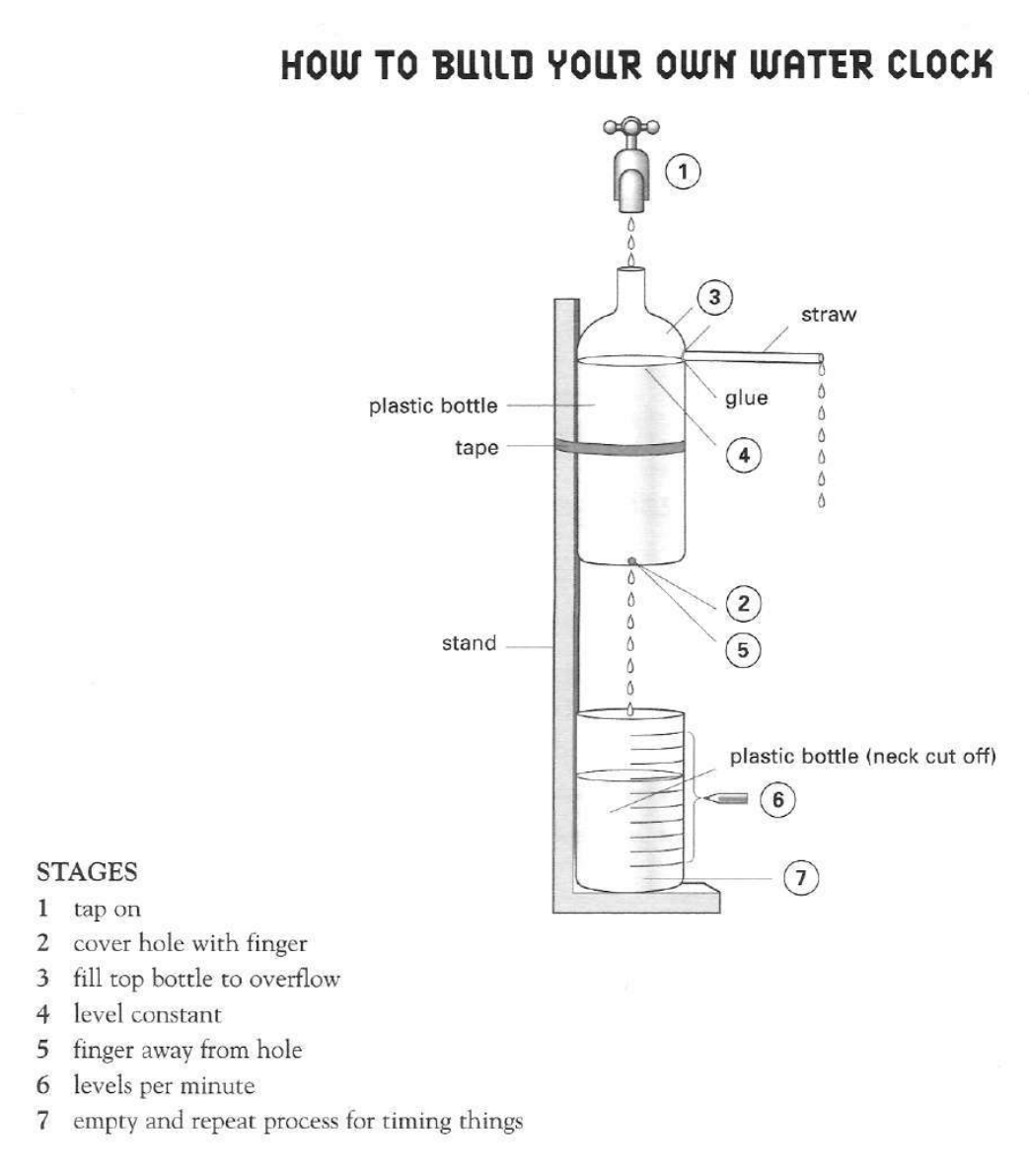
The diagram below shows the process for making a water clock.
Write a report for a university lecturer describing the information below.
HOW TO BUILD YOUR OWN WATER CLOCK
Student answer (Band 6.0)
The illustated diagram presents the process of making a water clock.
Overall, the diagram shows the step by step process of how to build your own water clock. Beginning from turning on the water from the faucet until repeating the whole process until you get the right timing.
The things that you need to build a water clock are the following: water, two plastic bottles (one bottle should have a small hole at the bottom and the other one, the neck should be cut off), straw, glue, tape and a stand.
The first step is to turn on the faucet, the watercatched by a plastic bottle with a hole on the bottom, second step, cover the hole with a finger, to fill the top bottle to overflow, when the level constant is reached, remove the finger on the hole, and let the water drop to the next container, record the levels per minute. And the last step is to empty the whole thing and repeat the process until getting the exact timing.
AI examiner evaluation
| Criterion | Band |
|---|---|
| Task Achievement / Task Response | 6.0 |
| Coherence and Cohesion | 6.5 |
| Lexical Resource | 5.5 |
| Grammatical Range and Accuracy | 5.0 |
| Overall | 6.0 |
Task Achievement / Task Response: Band 6.0
The report identifies the diagram as a water-clock process and covers the main sequence, from turning on the tap and filling the upper bottle to removing the finger, recording levels, and repeating the procedure. It also names the key materials and distinguishes the bottle with a hole from the lower bottle with its neck cut off. However, some details are unclear or not fully grounded in the diagram: “until you get the right timing” and “until getting the exact timing” suggest a target outcome that is not stated. The explanation of the constant level and the marked levels per minute is also brief. A more precise account of how the upper bottle overflows and water drips into the lower container would make the description more complete.
Coherence and Cohesion: Band 6.5
The response has a clear overall arrangement: an introduction and overview are followed by the materials and then the stages. The sequence is generally easy to follow, and phrases such as “The first step” and “the last step” help guide the reader. This logical organisation is a strength. However, the overview sentence beginning “Beginning from…” is a fragment, and the long final paragraph compresses several stages into one sentence, making the order harder to track. The transition from the materials list to the process could also be smoother. To strengthen progression further, give each stage or closely related pair of stages a clear sentence and use linking expressions consistently without relying mainly on ordinal labels.
Lexical Resource: Band 5.5
The response uses relevant task vocabulary, including “faucet,” “overflow,” “plastic bottles,” “stand,” and “levels per minute,” so the reader can understand the general process. However, the range is somewhat limited and several expressions are imprecise or awkward for a process report. “The watercatched by a plastic bottle” is difficult to interpret, while “the whole thing” is informal and vague. “Exact timing” also adds an unsupported implication rather than describing the diagram neutrally. There is a spelling error in “illustated,” and “watercatched” is not an appropriate form. Aim for precise process verbs and standard collocations, such as describing water as flowing or dripping into a container and referring to repeating the procedure.
Grammatical Range and Accuracy: Band 5.0
There is an attempt to use both simple statements and more complex sequencing, but control is uneven. The overview fragment, “Beginning from turning on the water … until repeating the whole process,” lacks a main clause. The process sentence beginning “The first step is to turn on the faucet” then runs through several stages with comma splices and unclear clause boundaries. Some grammatical patterns are also inaccurate, as in “when the level constant is reached” and “remove the finger on the hole.” These errors sometimes make relationships between actions less clear, although the main sequence remains understandable. Use complete sentences with a clear subject and verb, and separate the stages with full stops; for example, state that the water level becomes constant before the finger is removed.
See this exact question answered at other band scores. The same prompt compared across bands.
Browse more IELTS Writing model answers or get your own writing scored by the same AI examiner.