Band 5.5 IELTS Writing Task 1 Model Answer
Overall Band Score: 5.5 · IELTS Complete Catalyst · 2026-11-14
IELTS Writing Task 1 question
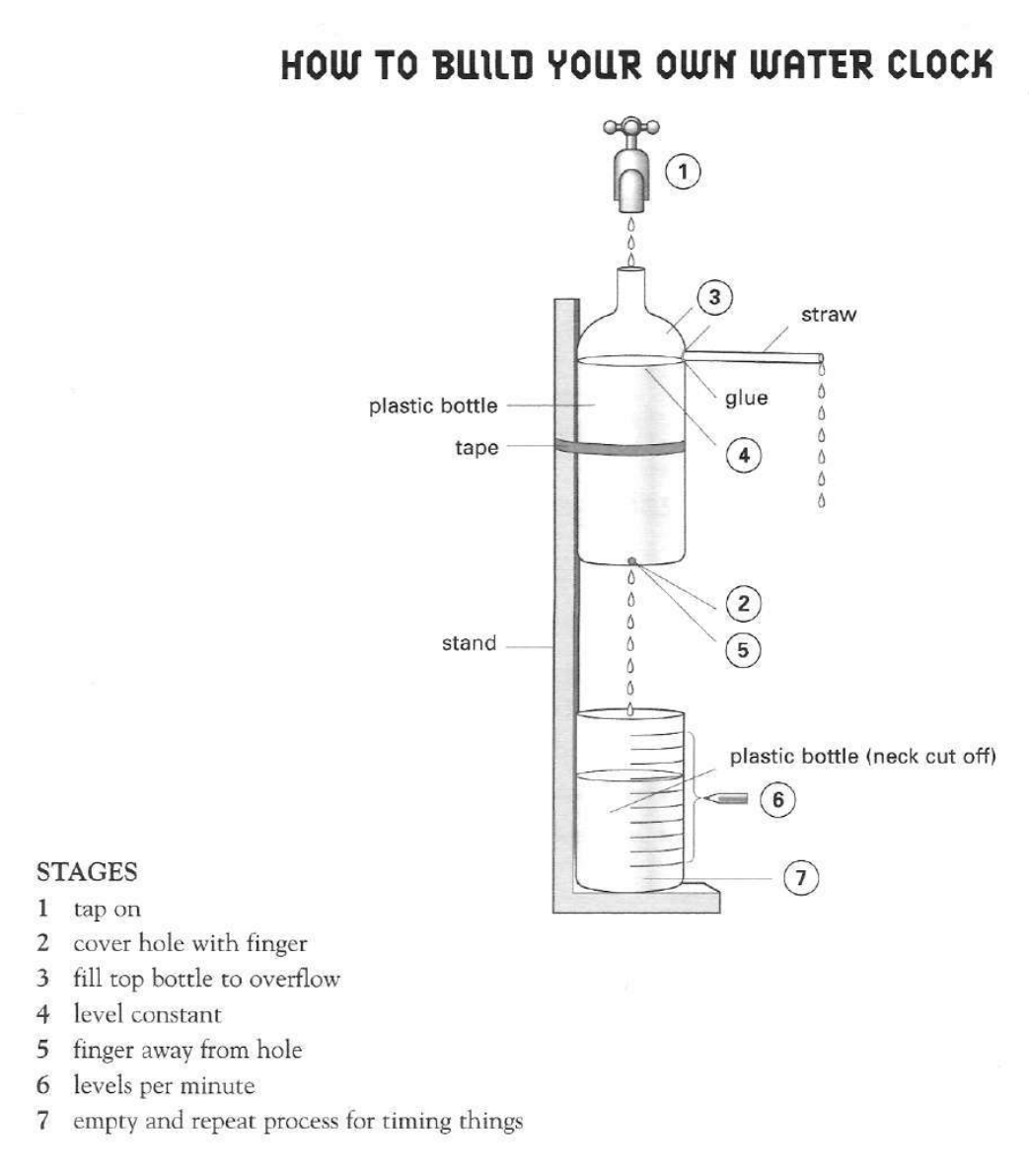
The diagram below shows the process for making a water clock.
Write a report for a university lecturer describing the information below.
HOW TO BUILD YOUR OWN WATER CLOCK
Student answer (Band 5.5)
Here is the diagram of a water clock, The principal of this water clock is to predict the accurate time using simple water drop. This was often used by old generation for measuring the accurate time.
The design of this water clock is very simple, first you have a simple tape which generate a drop within an accurate time period. This drop go in the plastic bottle which joint with a stand using a tape. Upperside of plastic bottle has a straw whivh is connected to a bottle with glew. A small holl is also there at the bottom side of the bottle where a drop of the liquid dripped into plastic container.
Where drop which is dripped in plastic container is show time, when plastic container fulled with water means a slot of time (1 or 2 hours according to the setting) is gone which was measured by designer.
Allover, diagram describe the working principle and process of making the water clock within a six stages.
AI examiner evaluation
| Criterion | Band |
|---|---|
| Task Achievement / Task Response | 5.0 |
| Coherence and Cohesion | 6.0 |
| Lexical Resource | 5.0 |
| Grammatical Range and Accuracy | 5.0 |
| Overall | 5.5 |
Task Achievement / Task Response: Band 5.0
You identify the apparatus and describe several relevant parts, including the tap, upper bottle, straw, stand and lower container. However, the report only partially covers the process shown: it does not explain the numbered stages, such as covering the hole, filling the upper bottle until water overflows, then removing a finger and marking the lower bottle’s water levels. The claim that the clock measures “1 or 2 hours” is not supported by the diagram, and the overview says there are six stages when seven are listed. The purpose is broadly recognised, but the explanation of how the stages produce a timing device remains limited. To improve, give a clear overview and describe the sequence accurately, without adding unsupported timing details.
Coherence and Cohesion: Band 6.0
The response has a generally understandable order: it introduces the clock, describes its components, explains what the collected water indicates, and ends with a summary. Paragraph breaks also help separate these points. However, progression is not consistently clear because the report moves from construction details to an unsupported claim about a one- or two-hour period, then returns to a general conclusion. Linking is sometimes awkward, as in “Where drop which is dripped in plastic container is show time,” and the final sentence does not accurately summarise the sequence. Organise the report around an overview followed by the numbered stages, using clear transitions such as “First,” “Next,” and “Finally.” This would make the relationships between steps easier to follow.
Lexical Resource: Band 5.0
You use some relevant vocabulary for describing the diagram, including “plastic bottle,” “stand,” “straw,” “bottom,” and “dripped.” This gives the reader a basic sense of the equipment and its function. However, the range is limited, and several word choices or spellings make parts difficult to understand: “principal” is used where “principle” is intended, “whivh” and “glew” are misspelled, and “a slot of time” is not a natural expression here. Phrases such as “simple water drop” and “accurate time” are also imprecise. Build a more specific process vocabulary, for example “water flows,” “overflow outlet,” “calibration marks,” and “measure elapsed time,” and check spelling and collocations carefully.
Grammatical Range and Accuracy: Band 5.0
The response attempts both simple and longer sentence forms, and the reader can usually identify the main meaning. However, control is uneven, particularly in longer clauses. For example, “This drop go in the plastic bottle which joint with a stand” has errors in verb agreement and clause structure, while “Where drop which is dripped in plastic container is show time” is difficult to parse. Articles and plurals are also inconsistent, as in “a small holl” and “plastic container fulled with water.” The final sentence, “diagram describe … within a six stages,” contains agreement and number errors. Use shorter, complete sentences to describe each stage, and check subject–verb agreement, articles, and past participles before combining clauses.
See this exact question answered at other band scores. The same prompt compared across bands.
Browse more IELTS Writing model answers or get your own writing scored by the same AI examiner.