Band 5.5 IELTS Writing Task 1 Model Answer
Overall Band Score: 5.5 · IELTS Complete Catalyst · 2026-11-14
IELTS Writing Task 1 question
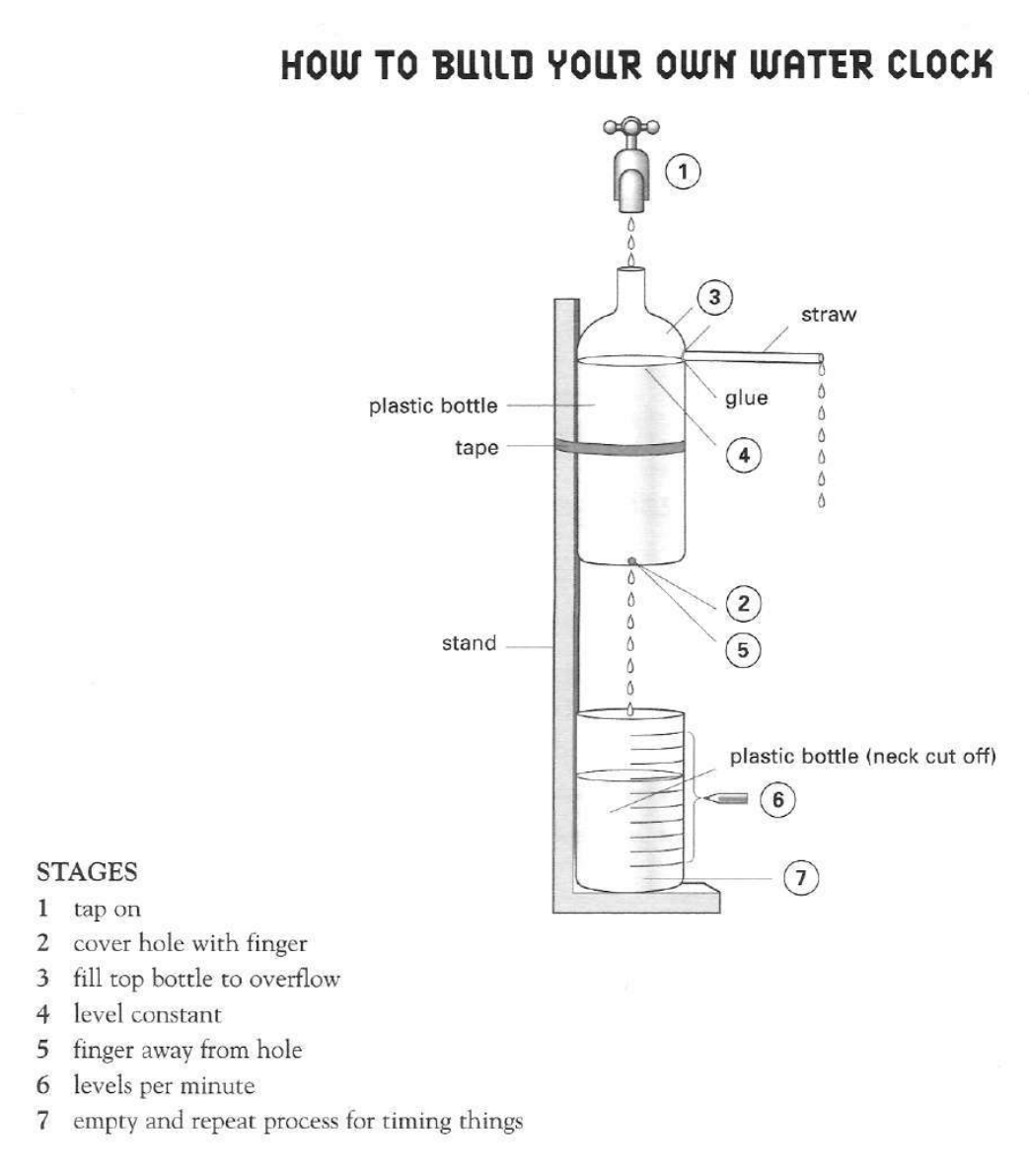
The diagram below shows the process for making a water clock.
Write a report for a university lecturer describing the information below.
HOW TO BUILD YOUR OWN WATER CLOCK
Student answer (Band 5.5)
the procees diargramme illustrates the tips needed to build water clock at home involved in seven stages.
overall, it is clear that we have to started with opining the tap on and we should used a several things like glue , tape , straw to get into the next stage and as its shown we finished with an empty bottel and repeat process for timing things.
first of all , we start with the first stage which is opening the tap on , then we cover the bottle hole with a finger to make sure the water dosnt leak after that we fill the top of the bottle to overflow , next we take the constant level of water
now , we take off the finger away from the hole we coverd before, following this step we need to take a note of the water levels per minute , finally for the final step we have to pour the water out of the bottle and repeat the process for timing things.
AI examiner evaluation
| Criterion | Band |
|---|---|
| Task Achievement / Task Response | 5.0 |
| Coherence and Cohesion | 6.0 |
| Lexical Resource | 5.0 |
| Grammatical Range and Accuracy | 5.0 |
| Overall | 5.5 |
Task Achievement / Task Response: Band 5.0
You identify the diagram as a seven-stage process and describe its main sequence, from turning on the tap to repeating the process for timing. This gives the report a relevant foundation. However, some important details are omitted or unclear: the apparatus is not described, including the upper and lower bottles, the stand, and the straw used as an overflow drain. The step “we take the constant level of water” does not clearly explain that the upper bottle is filled until the water level remains constant before the finger is removed. The account also says to note water levels per minute, but does not explain that the lower bottle is marked to measure them. Include these features and clarify the stages to address the diagram more fully.
Coherence and Cohesion: Band 6.0
The response has a clear overall arrangement: an introduction, an overview, and a chronological account of the stages. Sequencing expressions such as “first of all,” “then,” “after that,” “following this step,” and “finally” help the reader follow the process. The progression is generally coherent, although the overview repeats the final stage and the body could group the construction details separately from the operating instructions. Some links are mechanical, and references such as “the bottle hole” and “the constant level” are not always clear. Use more precise references and organise the report into a concise overview followed by clearly grouped details.
Lexical Resource: Band 5.0
You use relevant process vocabulary, including “stages,” “overflow,” “levels per minute,” and “repeat the process,” so the basic meaning can be followed. However, the range is limited and several noticeable spelling and word-choice errors reduce clarity, for example “procees diargramme,” “opining,” “bottel,” and “dosnt.” Some phrases are also unnatural for a diagram report, such as “take the constant level of water” and “take a note of the water levels.” Choose precise terms for the equipment and actions, and check spelling carefully. For example, describe the water level as remaining constant and say that the lower bottle is marked at intervals.
Grammatical Range and Accuracy: Band 5.0
You attempt both simple and longer sentences, and the sequence is usually understandable. However, the range is limited, and errors in verb forms, articles, and sentence construction occur frequently enough to make some parts difficult to read. Examples include “we have to started,” “we should used,” and “we cover the bottle hole with a finger,” where the verb forms or phrasing are not controlled. The long sentence beginning “now, we take off the finger” also joins several actions without clear punctuation. Practise accurate present-simple descriptions of processes, such as “The finger is removed, allowing water to flow into the lower bottle,” and divide complex sequences into shorter, correctly punctuated sentences.
See this exact question answered at other band scores. The same prompt compared across bands.
Browse more IELTS Writing model answers or get your own writing scored by the same AI examiner.