Band 5.5 IELTS Writing Task 1 Model Answer
Overall Band Score: 5.5 · IELTS Complete Catalyst · 2026-11-15
IELTS Writing Task 1 question
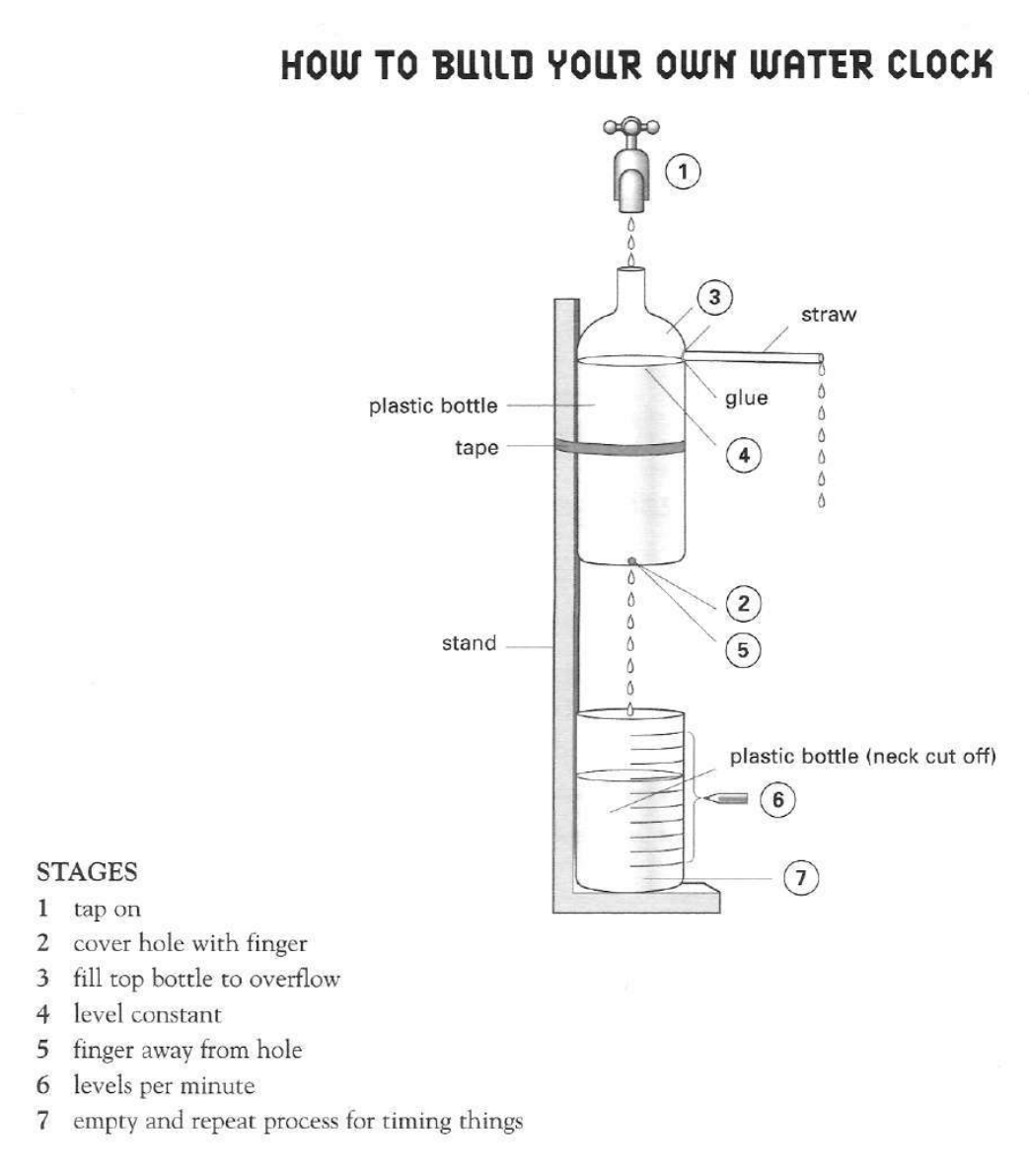
The diagram below shows the process for making a water clock.
Write a report for a university lecturer describing the information below.
HOW TO BUILD YOUR OWN WATER CLOCK
Student answer (Band 5.5)
The diagram illustrates the steps including in the process of building your own water clock.
Overall, water clock is made by using materials such as plastic bottle, tape, stand, straw and a glue. The process consist of seven stages, initiates from stage one which is turn on the tap.
Water clock can be build by tapeing two plastic bottles with the stand, tape first bottle on the top and second one on the bottom and cut its neck. Make two holes in the first bottle one is at the bottom and second is below the neck and glued a straw with it .
Now put water clock under the tap, stage one is turn on the tap, next stage is cover the bottom hole of first bottle with your finger, in third stage fill the bottle to overflow from the straw and remove the finger in stage five. In stage six marked the second bottle as level per minute now it is ready to use. In stage seven empty the second bottle and repeat the process and use it for timing the things.
AI examiner evaluation
| Criterion | Band |
|---|---|
| Task Achievement / Task Response | 6.0 |
| Coherence and Cohesion | 5.5 |
| Lexical Resource | 5.5 |
| Grammatical Range and Accuracy | 5.0 |
| Overall | 5.5 |
Task Achievement / Task Response: Band 6.0
You cover the main purpose and sequence, including the tap, covering and uncovering the hole, filling the upper bottle until water overflows, marking levels, and repeating the process. The overview also identifies the seven stages and the main materials. However, some construction details are unclear or inaccurate: the diagram shows the upper bottle attached to a stand with tape and the lower bottle resting on its base, rather than both bottles being taped to the stand. It also shows a hole at the upper bottle’s base and a straw near the top; saying to make “two holes” is not supported. The calibration step is only briefly described, so explain that the lower bottle is marked as water levels change over time.
Coherence and Cohesion: Band 5.5
The response has a recognisable overall structure: an introduction and overview are followed by construction details and then the operating stages. Sequencing words such as “Overall,” “Now,” “next,” and “In stage six” help the reader follow the process. However, the progression is not consistently clear because construction and operation are compressed together, and the stages are not always presented in order: stage five is mentioned before stage four. Some links are mechanical or awkward, and “it” in “glued a straw with it” has an unclear reference. Separate the apparatus-building steps from the numbered operating sequence, and use clearer transitions and references to make the progression easier to follow.
Lexical Resource: Band 5.5
You use relevant task vocabulary, including “overflow,” “stand,” “straw,” and “level per minute,” so the reader can understand the general process. There is also some attempt to describe construction and operation rather than relying only on basic labels. However, several word choices and forms are inaccurate or unnatural, such as “steps including in the process,” “tapeing,” and “marked the second bottle as level per minute.” “Water clock” and “bottle” are repeated frequently, while some descriptions lack precision. Choose standard process language and more exact terms—for example, describe attaching the upper bottle to the stand and marking the lower bottle at regular intervals as the water level changes. Check spelling and collocations carefully.
Grammatical Range and Accuracy: Band 5.0
You attempt both simple sentences and longer sentences with sequencing clauses, as in “In third stage fill the bottle to overflow from the straw and remove the finger in stage five.” This shows some range, and the main meaning is generally recoverable. However, errors in verb forms, agreement, articles, and sentence construction occur across the response. Examples include “The process consist,” “Water clock can be build,” and “Make two holes … and glued a straw,” where the verb forms do not fit the sentence. Articles are also often missing, as in “under the tap” versus “turn on the tap” and “on the top.” Use consistent present simple or passive forms for process descriptions, and check subject–verb agreement and sentence boundaries.
See this exact question answered at other band scores. The same prompt compared across bands.
Browse more IELTS Writing model answers or get your own writing scored by the same AI examiner.