Band 5.5 IELTS Writing Task 1 Model Answer
Overall Band Score: 5.5 · IELTS Complete Catalyst · 2026-11-15
IELTS Writing Task 1 question
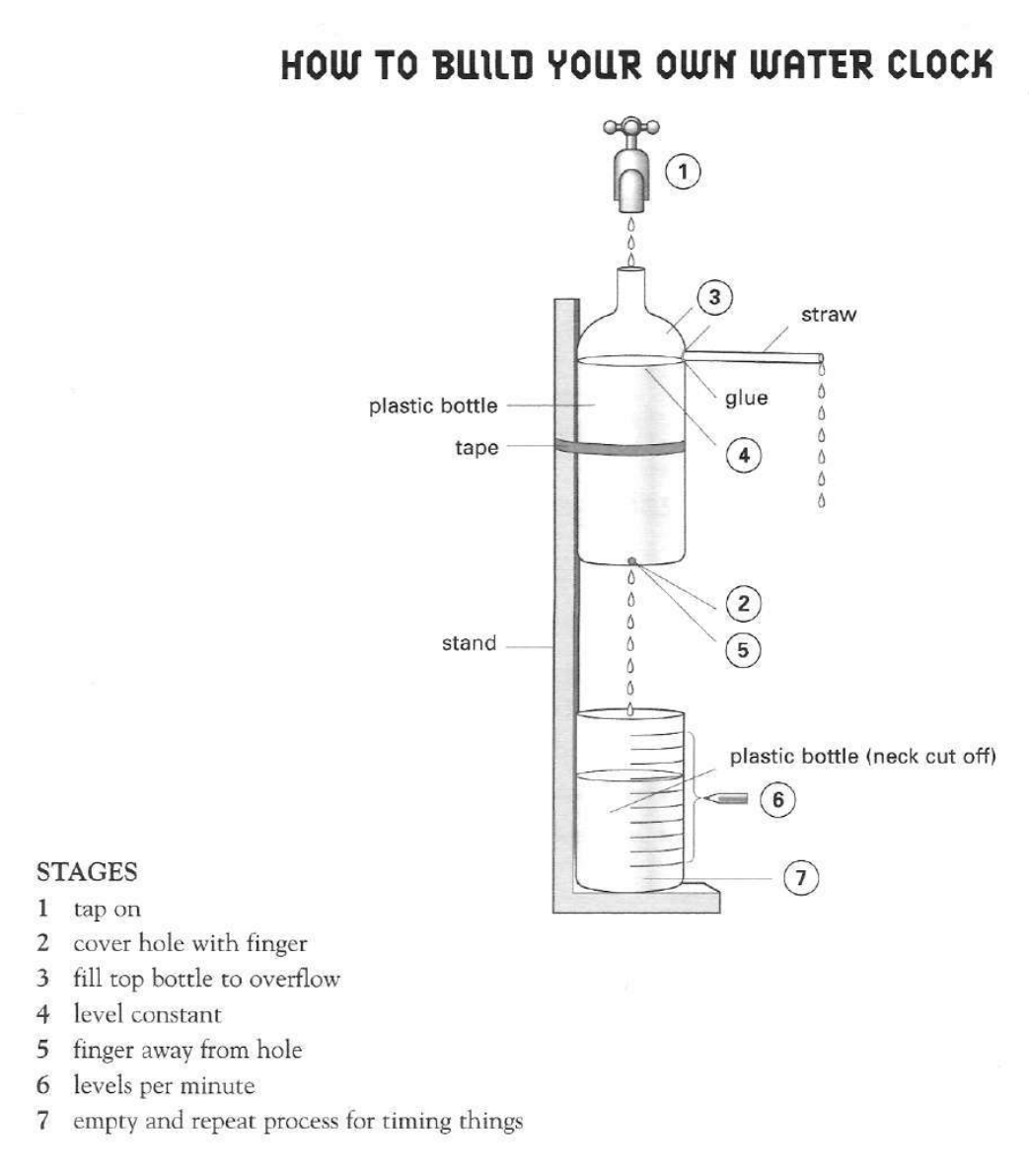
The diagram below shows the process for making a water clock.
Write a report for a university lecturer describing the information below.
HOW TO BUILD YOUR OWN WATER CLOCK
Student answer (Band 5.5)
The sketch diagram represents the method of building your own water clock.
Overall, the diagram illustrate, there are seven important step in the process of making own water clock. The main features includs, the tap on top, bottle made of plastic (close nick) with straw in the middle of structure and the plastic bottle (open nick) in the bottom.
The process started, when the water starts flow from the tap on the top. In the next step the water is collected in the plastic bottle (close mouth) that are taped with the stand, on the right side of the stand a straw is attached through glue that retains the level of the water in the bottle constant.A smal hole in the bottom of the bottle which is closed or open through finger.
when the hole is open for the flow of the water, the water is collected in another plastic bottle with open nick then empety and repeat process foer timing things.
AI examiner evaluation
| Criterion | Band |
|---|---|
| Task Achievement / Task Response | 5.5 |
| Coherence and Cohesion | 6.0 |
| Lexical Resource | 5.0 |
| Grammatical Range and Accuracy | 5.0 |
| Overall | 5.5 |
Task Achievement / Task Response: Band 5.5
You identify the diagram as a water-clock process and give a basic overview of its seven stages, including the tap, the upper bottle, the straw and the lower container. You also mention that the water is allowed to flow and that the process is repeated for timing. However, several important details are missing or unclear: the upper bottle is filled until it overflows, the straw keeps the water level constant by draining excess water, and the lower bottle is marked with calibration lines to show levels per minute. The description of the hole is also confusing, since it says it is “closed or open through finger” without clearly explaining when the finger is removed. Covering these stages more accurately and fully would strengthen the report.
Coherence and Cohesion: Band 6.0
The response has a recognisable overall order: it begins with an introduction and overview, then moves from the tap and upper bottle to the water flowing into the lower container. This gives the reader a basic sense of the process. However, the stages are compressed into a few long paragraphs, and the final sequence is difficult to follow because the hole, water collection and repetition are joined together without clear transitions. Some linking phrases, such as “In the next step,” help, but the report would be clearer if each main phase were separated and connected with precise sequencing language such as “Once the bottle is full” and “After the finger is removed.” References such as “another plastic bottle” could also be made more explicit.
Lexical Resource: Band 5.0
You use relevant task vocabulary, including “tap,” “stand,” “straw,” “glue” and “water clock,” so the reader can identify the main apparatus. However, the range is limited and several word choices or spellings make details unclear. “Close nick” and “open nick” appear to mean bottles with closed and cut-off necks, while “retains the level … constant” is an awkward way to describe the straw’s function. There are also noticeable spelling errors, including “includs,” “smal” and “empety.” Aim for accurate, specific process vocabulary and check spelling; for example, describe the lower container as a “bottle with its neck cut off” and the straw as an “overflow outlet.”
Grammatical Range and Accuracy: Band 5.0
The response attempts both simple and more extended sentences, but control is inconsistent, and errors sometimes make the sequence harder to understand. For example, “the diagram illustrate” has subject–verb disagreement, while “there are seven important step” has an incorrect plural form. The opening overview also contains a sentence fragment-like construction: “Overall, the diagram illustrate, there are…” In “the water is collected in the plastic bottle … that are taped,” the relative clause does not agree clearly with its noun. Punctuation is also weak, particularly where “constant.A smal hole” runs two sentences together. Use shorter, complete sentences first, then add subordinate clauses with careful agreement and punctuation.
See this exact question answered at other band scores. The same prompt compared across bands.
Browse more IELTS Writing model answers or get your own writing scored by the same AI examiner.