Band 6.0 IELTS Writing Task 1 Model Answer
Overall Band Score: 6.0 · IELTS Complete Catalyst · 2026-11-15
IELTS Writing Task 1 question
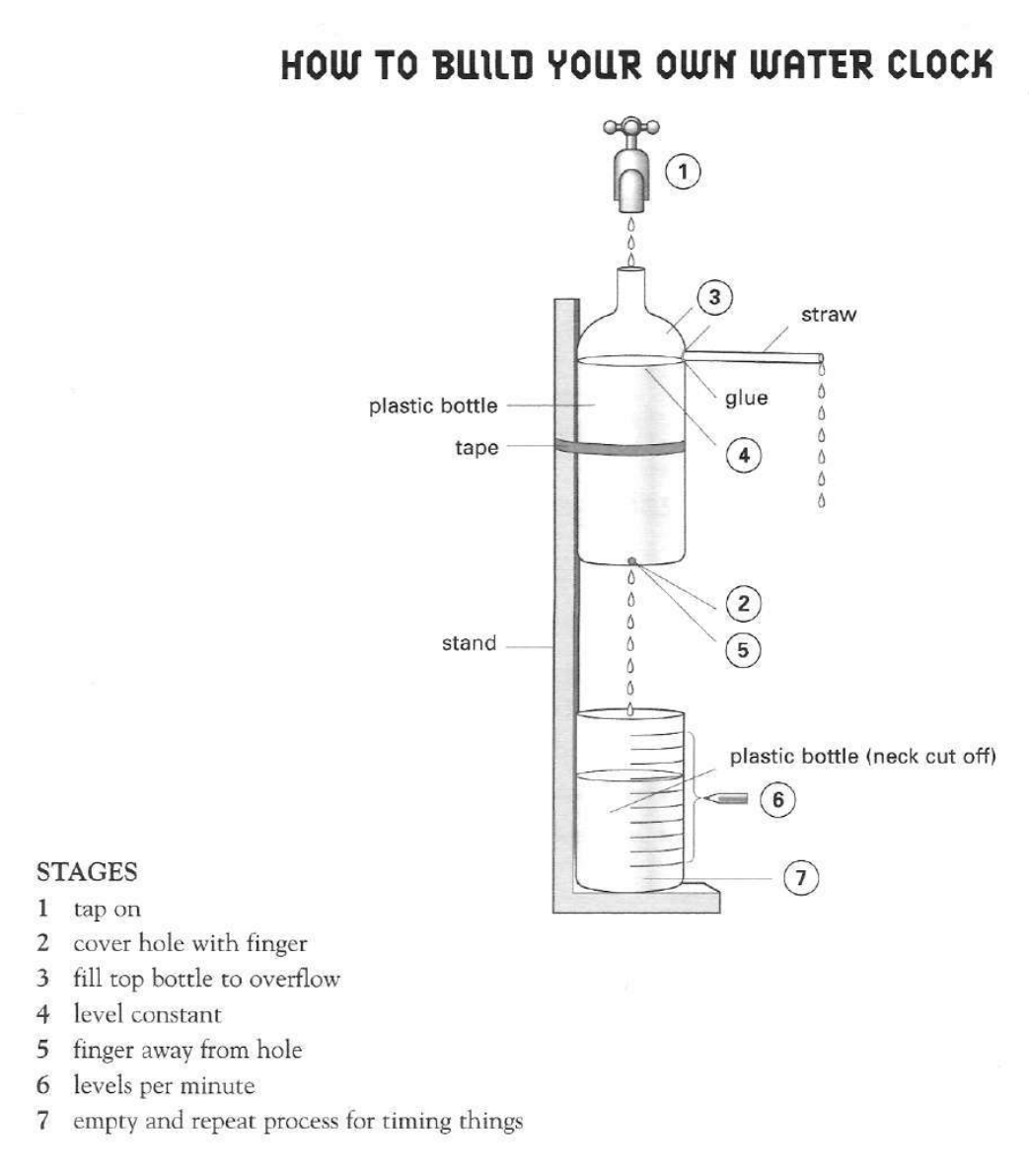
The diagram below shows the process for making a water clock.
Write a report for a university lecturer describing the information below.
HOW TO BUILD YOUR OWN WATER CLOCK
Student answer (Band 6.0)
The diagram gives information about the procedures to build your own water clock using two plastic bottles, stand and straw.
First, the tap is turned on to allow the water to flow into the upper plastic bottle, while a hole is covered with a finger at the bottom of the bottle. Second, upper bottle is filled until the water reaches the overflow level, and it maintains constant using a straw . After that, a finger is removed away to allow the water to flow from the upper bottle into the lower bottle.
Third, the lower bottle is scaled into levels; therefore, time can be measure corresponding to how many levels. Finally, once the lower bottle reaches its full capacity, it is emptied and the process is repeated for another time to be measured.
AI examiner evaluation
| Criterion | Band |
|---|---|
| Task Achievement / Task Response | 6.0 |
| Coherence and Cohesion | 6.5 |
| Lexical Resource | 5.5 |
| Grammatical Range and Accuracy | 5.5 |
| Overall | 6.0 |
Task Achievement / Task Response: Band 6.0
You cover the main sequence, from turning on the tap and filling the upper bottle to releasing the water, reading the levels and repeating the process. The description of the overflow level and the lower bottle’s markings is relevant, and the final purpose of timing is clear. However, some stages are compressed or unclear: “it maintains constant using a straw” does not clearly explain that the straw keeps the water level constant by draining excess water, and the calibration marks are described only briefly. The response also falls 17 words short of the required minimum, limiting the detail available. Add a concise overview and explain the apparatus and stages more fully to make the account more complete.
Coherence and Cohesion: Band 6.5
The information follows a generally logical order, and sequencing expressions such as “First,” “Second,” “After that” and “Finally” help the reader follow the process. The progression from preparing the bottles to using the clock is easy to recognise. This is a coherent overall arrangement, though the linking is somewhat mechanical and the paragraphing is limited to a short introduction followed by one long process paragraph. “Third” also appears after “After that,” making the sequence markers slightly inconsistent. Grouping the construction and operating stages into separate paragraphs, and using clearer links between them, would make the progression more flexible and polished.
Lexical Resource: Band 5.5
You use relevant vocabulary for the topic, including “upper plastic bottle,” “overflow level,” “lower bottle” and “capacity,” so the process is mostly understandable. There is some useful variation in how you describe the stages. However, several word choices or collocations are imprecise: “the procedures to build” is less natural than “the process of building,” and “the lower bottle is scaled into levels” does not clearly convey that it is marked with calibration lines. “Time can be measure” also contains an incorrect word form, while “another time to be measured” is vague. Choose precise process vocabulary such as “mark,” “calibrate” and “measure intervals” to describe the apparatus and its use more accurately.
Grammatical Range and Accuracy: Band 5.5
You attempt a mix of sentence forms, including a complex opening sentence with “while” and a result clause introduced by “therefore.” Most of the process remains understandable, and the sequence is expressed using appropriate present-tense forms. Some grammatical errors persist, however. Articles are missing in “stand and straw” and “upper bottle is filled,” and “it maintains constant” lacks a clear grammatical construction. The phrase “time can be measure” has an incorrect verb form, and the spacing before the full stop in “straw .” is a punctuation slip. Review articles, passive constructions and modal verb patterns; for example, “time can be measured” and “the water level is kept constant” would be clearer.
See this exact question answered at other band scores. The same prompt compared across bands.
Browse more IELTS Writing model answers or get your own writing scored by the same AI examiner.