Band 6.5 IELTS Writing Task 1 Model Answer
Overall Band Score: 6.5 · IELTS Complete Catalyst · 2026-11-15
IELTS Writing Task 1 question
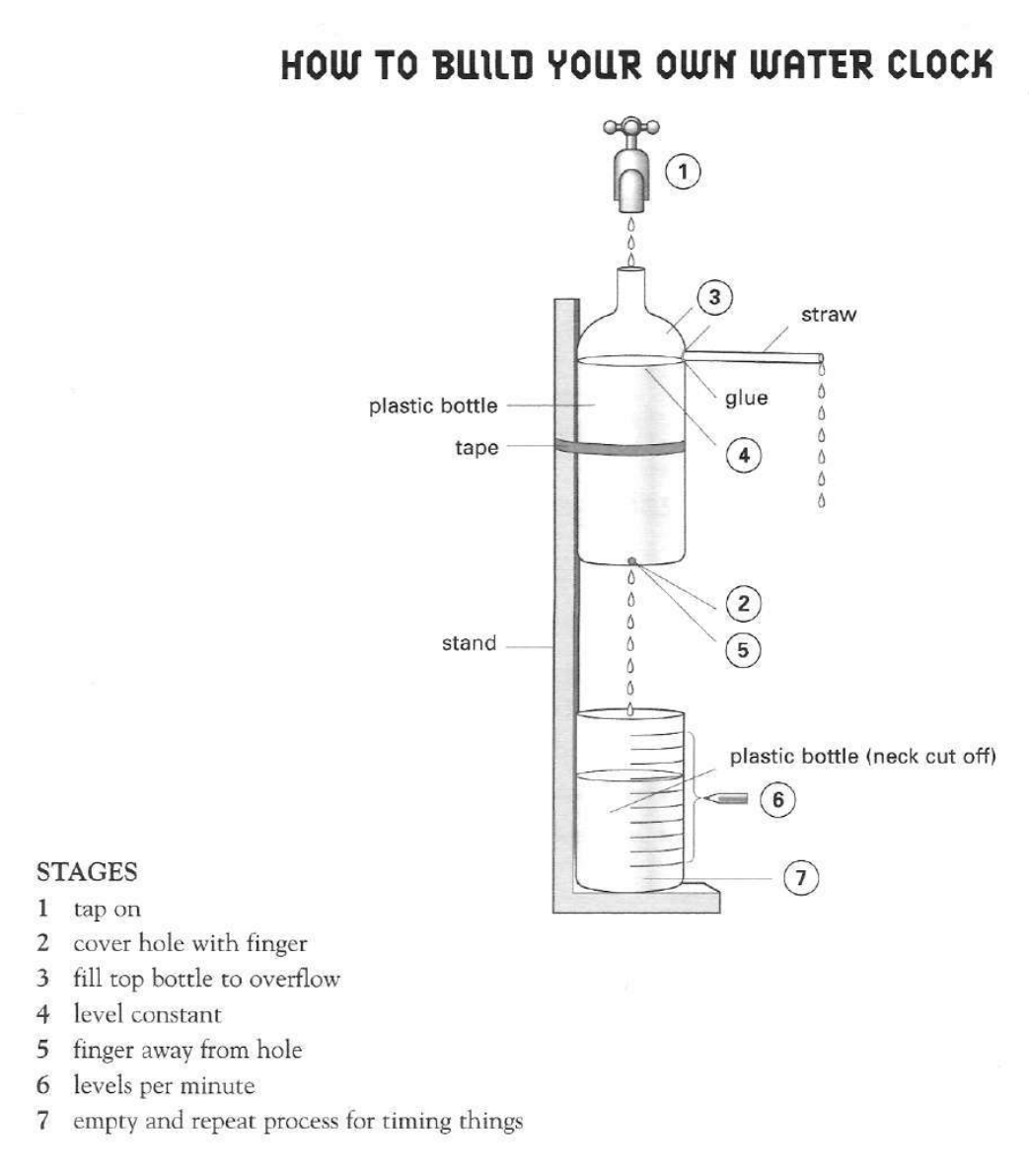
The diagram below shows the process for making a water clock.
Write a report for a university lecturer describing the information below.
HOW TO BUILD YOUR OWN WATER CLOCK
Student answer (Band 6.5)
The diagram illustrates the process for making a clock using water.
Overall, it is clear that the process consists of 7 stages, beginning with turning the tap on and ending with checking levels per minute and repeating the process for timing things. The process includes several other stages like covering the hole of a plastic bottle, levelling the water and so on.
To begin with, the first step involves turning the tap on. After turning the tap on the water is stored in a plastic bottle which has a hole in the bottom and the bottle is attached to a stand using a tape. The second step includes to covering the hole with a finger. In the third stage, the water should be filled to the top until the water overflows. Following this, the water level should be at accurate level.
Furthermore, in the fifth step remove the finger from the hole so the water starts dripping. In the sixth step, the flowing water is stored in a plastic bottle with a neck cut off and water levels are calculated there per minute and finally in the last stage, empty the plastic bottle and repeat the process to time things.
AI examiner evaluation
| Criterion | Band |
|---|---|
| Task Achievement / Task Response | 6.5 |
| Coherence and Cohesion | 7.0 |
| Lexical Resource | 6.0 |
| Grammatical Range and Accuracy | 6.0 |
| Overall | 6.5 |
Task Achievement / Task Response: Band 6.5
The report covers the main sequence and gives a clear overview, identifying the seven stages and the process’s beginning and end. It also includes relevant construction details, such as the upper bottle being attached to a stand and the lower bottle having its neck cut off. This meets the task well, but some stages are less fully or precisely described. In particular, “the water level should be at accurate level” does not explain that the upper bottle’s level becomes constant after overflowing, and the straw used as an overflow drain is omitted. The account also blurs the distinction between measuring levels per minute and checking them. Clarifying these details would make the description more complete and precise.
Coherence and Cohesion: Band 7.0
The response is organised into an overview followed by a chronological account, and the progression from “To begin with” through “in the last stage” is easy to follow. Paragraphing supports this structure, while phrases such as “Following this” and “Furthermore” help connect steps. The sequence is generally clear, although some linking is mechanical and the overview partly repeats the final stages rather than summarising the process’s key mechanism. The transition from the upper bottle to the lower one could also be made more explicit, so readers can follow how water passes between them. Overall, the organisation is logical; more precise referencing and less repetitive stage-by-stage linking would make cohesion more flexible.
Lexical Resource: Band 6.0
The vocabulary is adequate for describing the apparatus and sequence, with relevant terms such as “plastic bottle,” “stand,” “overflows,” and “dripping.” The writer also uses process language like “stage” and “repeat the process,” so the meaning is generally clear. However, some choices are imprecise or awkward: “checking levels per minute” is less exact than describing the marked levels as a measure of time, and “water is stored” does not clearly convey that it flows into the upper bottle. “Accurate level” is also an unnatural phrase in this context. A wider range of precise process verbs and technical nouns, including “overflow straw,” “calibration marks,” and “drain,” would improve clarity and flexibility.
Grammatical Range and Accuracy: Band 6.0
The response uses a mix of simple and more complex forms, including a relative clause in “a plastic bottle which has a hole in the bottom” and time clauses such as “After turning the tap on.” Most sentences communicate the intended sequence, but some grammatical errors remain. For example, “The second step includes to covering” combines incompatible verb patterns; use “involves covering” or “includes covering.” The instruction-like phrase “in the fifth step remove the finger” also shifts away from the report’s otherwise consistent passive or descriptive style. Articles and sentence construction need attention in “at accurate level.” Practising consistent passive forms, such as “the finger is removed,” would improve control while retaining the range already attempted.
See this exact question answered at other band scores. The same prompt compared across bands.
Browse more IELTS Writing model answers or get your own writing scored by the same AI examiner.