Band 5.5 IELTS Writing Task 1 Model Answer
Overall Band Score: 5.5 · IELTS Complete Catalyst · 2026-11-16
IELTS Writing Task 1 question
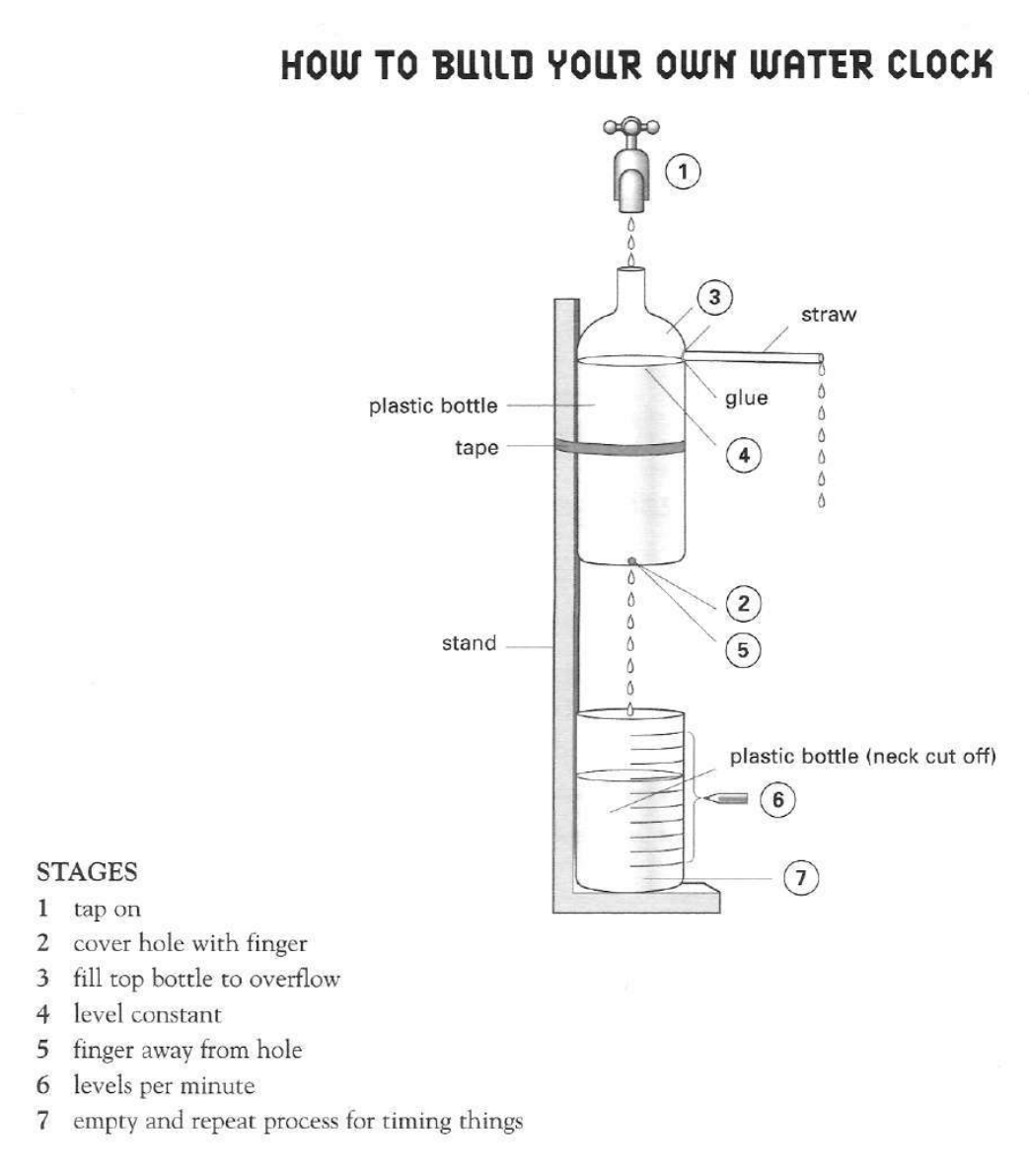
The diagram below shows the process for making a water clock.
Write a report for a university lecturer describing the information below.
HOW TO BUILD YOUR OWN WATER CLOCK
Student answer (Band 5.5)
The digram illustrates the process of formation of a water clock.
Overall, the seven different stages start with the tapping on for water supply and end with the levels per minute and repeat the process. Set the process as shown.
Firstly, tap on and cover the hole with finger at the bottom of the top plastic bottle which is attached with stand . Then, fill top plastic bottle with water and allow it to overflowthwough the straw until the level of water become constant.
Afterwards, remove the finger away from hole and water starts to pour to the another plastic bottle which has neck cut
off. Then, levels the water per minute in the bottle and empty the bottle . Repeat the process for timing things .
AI examiner evaluation
| Criterion | Band |
|---|---|
| Task Achievement / Task Response | 5.5 |
| Coherence and Cohesion | 5.5 |
| Lexical Resource | 5.0 |
| Grammatical Range and Accuracy | 5.0 |
| Overall | 5.5 |
Task Achievement / Task Response: Band 5.5
The report identifies the process as having seven stages and gives its broad sequence, from turning on the tap to using the clock repeatedly for timing. It also includes relevant details such as the upper bottle, straw, overflow and lower bottle. However, several stages are compressed or unclear: “levels per minute” does not explain that the water level is marked at one-minute intervals, and the description omits the calibration marks being made on the lower bottle. The overview’s phrase “end with the levels per minute and repeat the process” also blurs the final stages. The response is below the required 150 words, so it has limited space to describe the apparatus and stages fully. Develop the overview and explain each key action more precisely.
Coherence and Cohesion: Band 5.5
The response has a basic structure: an introduction, an overview and a sequence of steps. Time markers such as “Firstly” and “Afterwards” help the reader follow the process, and the stages are mostly presented in the correct order. However, progression is not always clear. “Set the process as shown” does not add meaningful information, while the overview combines the ending stages in a confusing way. Some actions are crowded into long sentences, particularly the sentence beginning “Then, fill top plastic bottle,” and the final instructions are separated by inconsistent spacing and punctuation. Use one paragraph for the overview and a clearly ordered paragraph for the stages, with accurate links such as “Once the water reaches the overflow straw” and “After the lower bottle is marked.”
Lexical Resource: Band 5.0
The vocabulary is sufficient to identify the main equipment and actions, including “plastic bottle,” “stand,” “straw,” “overflow” and “repeat the process.” However, the range is limited, and several word choices or forms make the description imprecise. “Formation of a water clock” is not a natural description of assembling or making one, and “levels the water per minute” does not clearly convey marking the water level at one-minute intervals. There are also noticeable spelling and word-form errors, including “digram” and “overflowthwough.” Use precise process vocabulary and check spelling; terms such as “attach,” “calibrate” and “mark” would help describe the construction and measurement steps more accurately.
Grammatical Range and Accuracy: Band 5.0
The response attempts both simple and more complex sentences, including a sequence with “until” and a relative clause in “which is attached with stand.” However, errors are frequent and sometimes make the instructions difficult to interpret. Examples include missing articles in “cover the hole with finger” and “attached with stand,” the awkward construction “allow it to overflow … until the level of water become constant,” and the incorrect form “Then, levels the water.” Sentence boundaries and spacing are also inconsistent, as in “bottle . Then” and “bottle . Repeat.” Aim for accurate, complete clauses: for example, “Cover the hole at the base with a finger,” followed by “Fill the upper bottle until the water reaches the straw.” Check subject–verb agreement, articles and punctuation.
See this exact question answered at other band scores. The same prompt compared across bands.
Browse more IELTS Writing model answers or get your own writing scored by the same AI examiner.