Band 5.5 IELTS Writing Task 1 Model Answer
Overall Band Score: 5.5 · IELTS Complete Catalyst · 2026-11-17
IELTS Writing Task 1 question
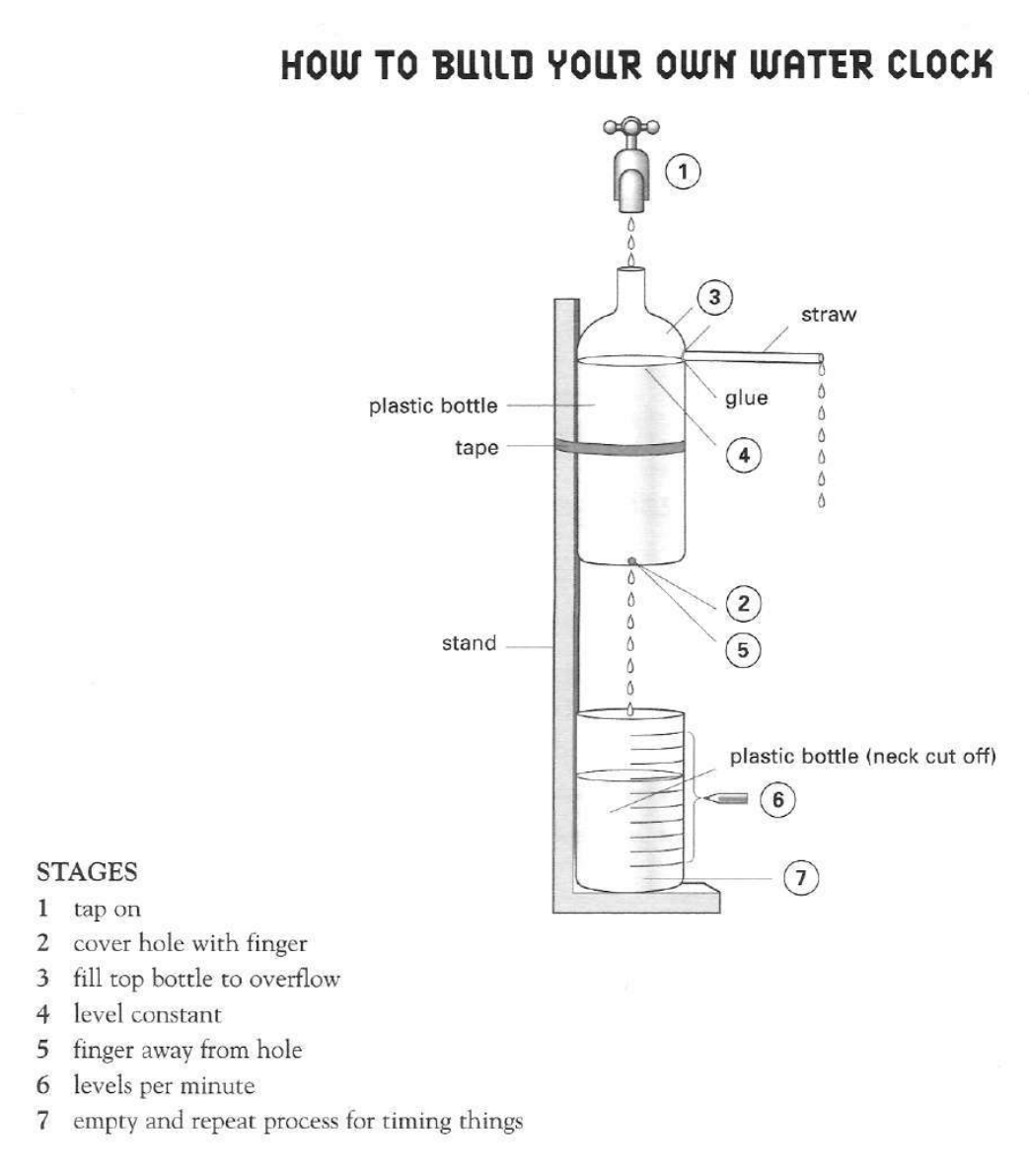
The diagram below shows the process for making a water clock.
Write a report for a university lecturer describing the information below.
HOW TO BUILD YOUR OWN WATER CLOCK
Student answer (Band 5.5)
The diagram illustrates the process of making a water clock, requiring a tap water, two plastic bottles, a straw, and a tape.
The first step is to arrange all these equipments in a order to create time clock, first a stand is used to hold two water bottles one above the other, then make two holes in the plastic bottle.First hole on the bottom of bottle just above the second plastic bottole and second hole at the neck of the first bottle to insert a straw in it, the straw is only inserted at the tip.
Now moving onto the next step, one should keep the tap on, while cover the bottom hole with finger to avoid leakage of water from the bottom of plastic bottle, wait till water fill to overflow.Now bottom bottle has a marking on it calculate its level per minute. These level will be used as a reference for timing things.
Conclusion, water bottles are used to calculate the time of water dripping and used it to calcutae time for different things.
AI examiner evaluation
| Criterion | Band |
|---|---|
| Task Achievement / Task Response | 5.5 |
| Coherence and Cohesion | 6.0 |
| Lexical Resource | 5.0 |
| Grammatical Range and Accuracy | 5.0 |
| Overall | 5.5 |
Task Achievement / Task Response: Band 5.5
You identify the diagram as a water-clock process and mention several relevant components, including the bottles, stand, straw and tap. You also describe filling the upper bottle and using markings to time activities. However, some important stages and construction details are inaccurate or unclear: the diagram shows a straw fixed near the top as an overflow drain, not inserted into a hole at the bottle’s neck, and the lower bottle is the one with calibration marks. The sequence of covering the hole, allowing the water to drip, marking levels per minute, and emptying and repeating the process is not fully explained. A clearer overview and a more accurate account of the stages would make the report more complete.
Coherence and Cohesion: Band 6.0
The response has a recognisable progression, moving from an introduction to construction, operation and a concluding statement. Sequencing phrases such as “The first step” and “Now moving onto the next step” help the reader follow the process. However, the stages are grouped in a way that makes some relationships difficult to follow, and the construction paragraph combines several actions in a long sentence. The transition to “Conclusion” is also not especially useful for a process report, where a final operational stage would be more informative. Organise the report into a brief overview followed by clearly ordered construction and operating stages, using references such as “the upper bottle” and “the lower bottle” consistently.
Lexical Resource: Band 5.0
You use some task-related vocabulary, including “stand,” “overflow,” “marking” and “reference,” which helps communicate the general purpose of the apparatus. However, the range is limited and several word choices or collocations are inaccurate, sometimes making the instructions hard to interpret. For example, “tap water” is not the same as the tap shown in the diagram, and “calculate its level per minute” does not clearly describe marking the water level at one-minute intervals. There are also spelling errors such as “bottole” and “calcutae,” alongside awkward phrases such as “create time clock.” Use precise process vocabulary and check spelling; terms such as “attach,” “drip,” “calibrate” and “interval” would suit this description.
Grammatical Range and Accuracy: Band 5.0
You attempt both simple and more extended sentence forms, including the sequence beginning “first a stand is used” and the clause “while cover the bottom hole.” However, complex constructions are often faulty, and errors in articles, verb forms, agreement and punctuation can make the instructions difficult to read. Examples include “requiring a tap water,” “while cover,” and “These level will be used.” The sentence beginning “First hole on the bottom…” is also a fragment, while “plastic bottle.First hole” needs sentence separation and punctuation. Aim for complete sentences with a clear subject and verb, and check agreement and article use. For example: “While the tap is running, cover the hole at the base of the upper bottle with a finger.”
See this exact question answered at other band scores. The same prompt compared across bands.
Browse more IELTS Writing model answers or get your own writing scored by the same AI examiner.