Band 5.5 IELTS Writing Task 1 Model Answer
Overall Band Score: 5.5 · IELTS Complete Catalyst · 2026-11-17
IELTS Writing Task 1 question
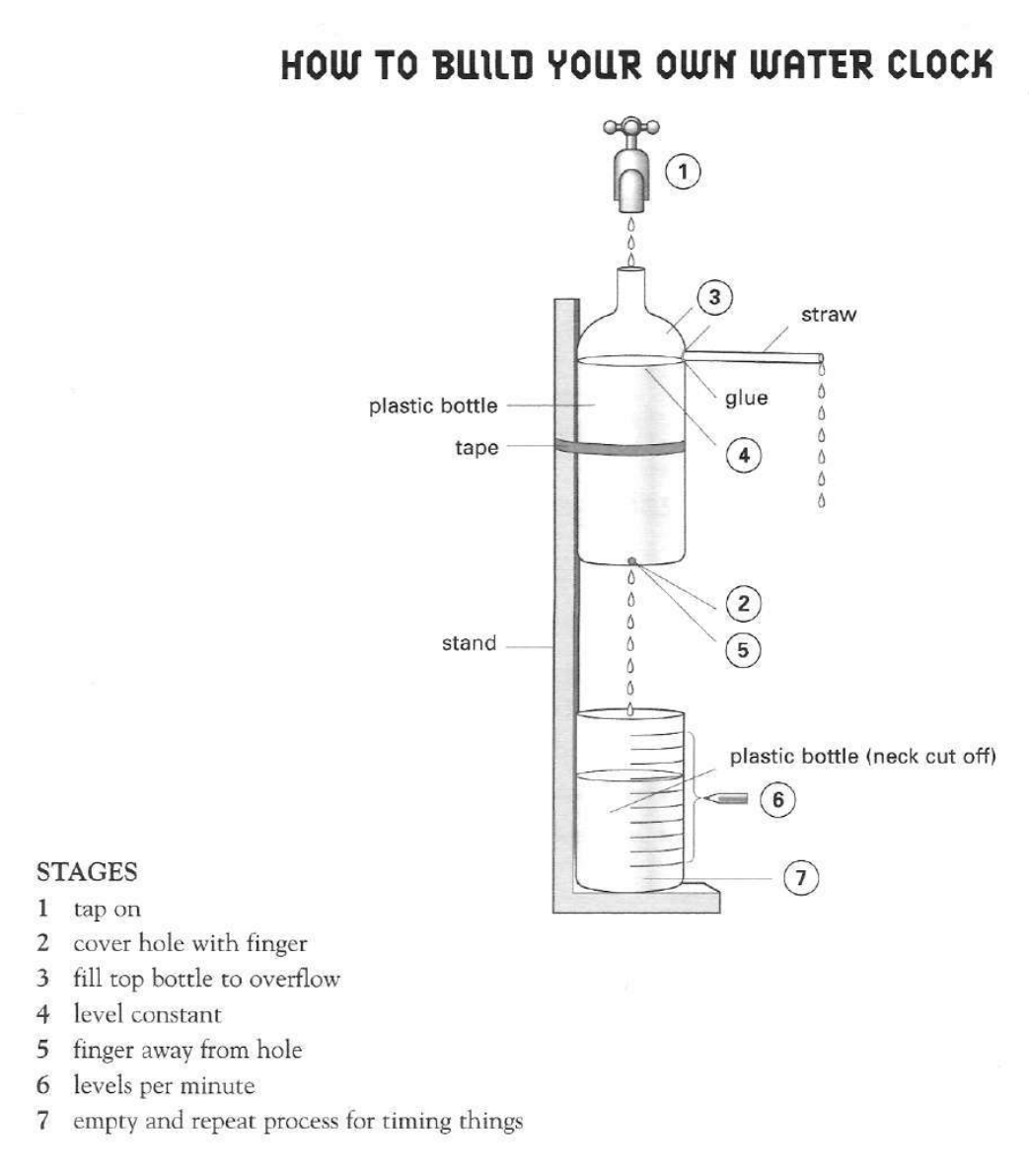
The diagram below shows the process for making a water clock.
Write a report for a university lecturer describing the information below.
HOW TO BUILD YOUR OWN WATER CLOCK
Student answer (Band 5.5)
The procedure diagram illustrates, the process of building a water clock. Overall, the process is consist of a series of seven steps starting from dripping of water drops end with the emptying and repeatitions of the process for other timing things.
Initially, the process start by the drops of water from the tap into the plastic bottle and covering the hole with finger in second step and further filling the bottle to overflow in the third step, wait until the level remain constant.
Additionally, in the fifth step move your finger away from the hole in the bottom the water will start dripping in the second plastic bottle with different leveling on it. In te sixth step count the levels per minute for a procedure and empty the bottle and can repeat the process for other timming things in the final step of the procedure.
AI examiner evaluation
| Criterion | Band |
|---|---|
| Task Achievement / Task Response | 5.0 |
| Coherence and Cohesion | 5.5 |
| Lexical Resource | 5.5 |
| Grammatical Range and Accuracy | 5.0 |
| Overall | 5.5 |
Task Achievement / Task Response: Band 5.0
You identify the diagram as a seven-step process and include several central stages, such as covering the hole, filling the upper bottle until it overflows, removing the finger, and counting levels per minute. However, the account is only partial: it does not explain how the apparatus is assembled, including the stand, attached upper bottle, overflow straw, and lower bottle with calibration marks. The opening also says the process starts with water dripping from the tap, whereas the listed first stage is turning the tap on; the overview’s “starting from dripping” therefore misrepresents the sequence. The final use is mentioned, but the explanation remains brief and unclear. The response is five words below the required minimum, and fuller coverage of the construction and stages would make the report more complete.
Coherence and Cohesion: Band 5.5
The response follows the general order of the process, and the paragraph beginning “Initially” moves through the early stages before “Additionally” introduces the later ones. This gives the reader a basic sense of sequence. However, the organisation is compressed into three paragraphs, with several stages crowded into long sentences, so the progression is not consistently easy to follow. “Additionally” does not clearly signal a new stage in a sequence, and the final sentence combines counting, emptying, and repeating without a clear boundary between them. Use one paragraph for the apparatus and overview, then group the numbered stages into clearly sequenced steps, using transitions such as “Next” and “Finally” accurately.
Lexical Resource: Band 5.5
You use relevant process vocabulary, including “overflow,” “hole,” “levels per minute,” and “procedure,” which helps communicate the basic subject. However, the range is limited and some word choices or forms are inaccurate or awkward: “repeatitions,” “timming,” “different leveling,” and “other timing things” are not natural descriptions. “Drops of water from the tap” is also imprecise for the first stage, which is turning the tap on. More specific terms from the diagram would improve precision, such as “upper bottle,” “lower container,” “calibration marks,” and “overflow straw.” Check spelling and choose standard collocations, for example “repeat the process to time other activities.”
Grammatical Range and Accuracy: Band 5.0
The response attempts some longer sentences and uses sequencing clauses, but grammatical errors are frequent enough to make parts difficult to read. Examples include “the process is consist,” “the process start,” and “wait until the level remain constant,” where verb forms and agreement are incorrect. The opening comma after “illustrates” is unnecessary, and the sentence beginning “Additionally” lacks a clear subject and structure: “in the fifth step move your finger away…” The final sentence also joins several actions without clear grammatical boundaries. Practise forming complete sentences with an explicit subject and consistent present tense, such as “In the fifth step, the user removes a finger from the hole, allowing water to drip into the lower bottle.” This would make the sequence clearer while retaining some complex structures.
See this exact question answered at other band scores. The same prompt compared across bands.
Browse more IELTS Writing model answers or get your own writing scored by the same AI examiner.