Band 5.0 IELTS Writing Task 1 Model Answer
Overall Band Score: 5.0 · IELTS Complete Catalyst · 2026-11-18
IELTS Writing Task 1 question
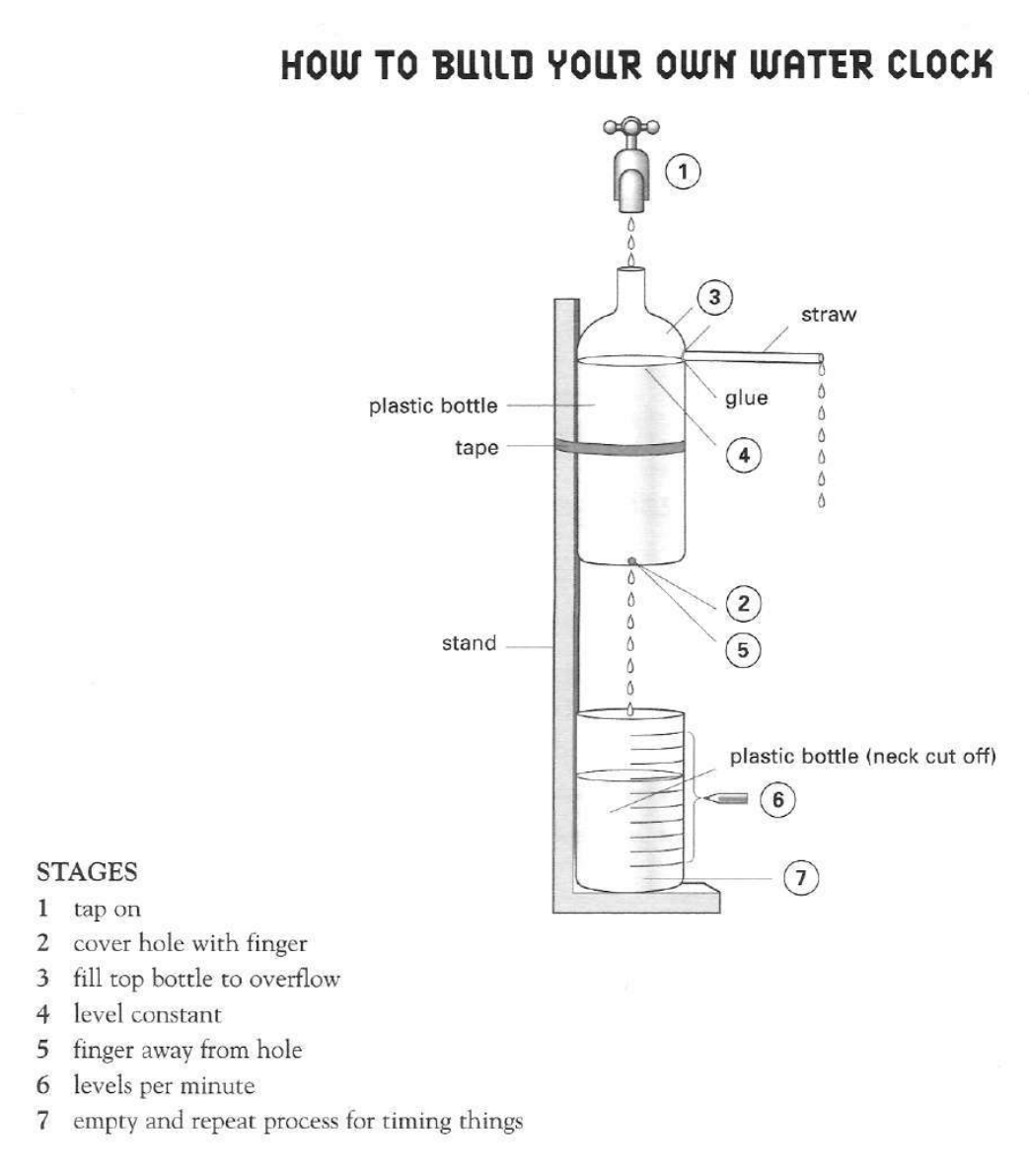
The diagram below shows the process for making a water clock.
Write a report for a university lecturer describing the information below.
HOW TO BUILD YOUR OWN WATER CLOCK
Student answer (Band 5.0)
The diagram below illustrates the process for making a water clock and this process divided into 7 steps.
Overall, this report shows that how we can make a water clock within seven steps. To begin with we should need two plastic bottles for this purpose first we can make tape on bottle with iron stand and we can tap on moreover, in the second stage we can inter a straw into the plastic bottle and make full fit in bottle with glue to drew water.
We can make a hole at the lower level of the bottle and cover hole with finger and step three we can fill rop bottle to overflow in the 4th stage we can check the level of the water.
In addition, in 5th stage we can finger away from the whole to make sure the water droplets. Furthermore, we cut off the neck of second bottle and we can check the water levels per minute in sixth step. We can notify the empty and repeat process for timing things in seven stage.
AI examiner evaluation
| Criterion | Band |
|---|---|
| Task Achievement / Task Response | 5.5 |
| Coherence and Cohesion | 5.5 |
| Lexical Resource | 4.5 |
| Grammatical Range and Accuracy | 4.5 |
| Overall | 5.0 |
Task Achievement / Task Response: Band 5.5
You identify the diagram as a seven-stage process and include several relevant actions, such as covering the hole, filling the upper bottle to overflow, and repeating the process for timing. However, the account does not consistently describe the stages accurately or clearly. For example, the straw is described as being inserted into the bottle, whereas it is fixed to the side as an overflow drain; the stand is called an “iron stand,” and the order of preparing the apparatus and operating it is confused. The overview also repeats that there are seven steps rather than summarising how the clock works. To strengthen the report, give a concise overview of the setup and water-flow principle, then describe the stages in their correct order using the diagram’s labels.
Coherence and Cohesion: Band 5.5
The response has a basic sequence, with references to stages such as “second stage,” “sixth step,” and “seven stage,” and it is divided into paragraphs. These features give the reader some sense of progression. However, the order is not consistently logical: the account moves between assembling the apparatus and operating it, and some actions are placed under the wrong stage. Linking phrases such as “moreover,” “in addition,” and “furthermore” are used, but they do not always clarify the relationship between ideas. Several sentences also combine multiple instructions, making the sequence difficult to follow. Organise the report into an overview and a clearly ordered description, using stage numbers consistently and linking each action to the next.
Lexical Resource: Band 4.5
Your vocabulary includes relevant process terms such as “overflow,” “plastic bottles,” “water levels,” and “repeat process,” so the topic is generally recognisable. However, the range is limited and several word choices or combinations make the meaning difficult to understand. For instance, “make tape on bottle with iron stand,” “inter a straw,” and “make full fit in bottle with glue to drew water” do not describe the apparatus clearly. “Rop bottle” and “whole” also appear to be inaccurate forms or choices. Use precise nouns and verbs for the components and actions, such as attaching, fixing, draining, and measuring. Learning common process-description phrases will help you explain the diagram more accurately and reduce repetition.
Grammatical Range and Accuracy: Band 4.5
You attempt to connect ideas in longer sentences, but sentence structures are often faulty, and errors can make the instructions hard to follow. For example, “this process divided into 7 steps” is missing a verb, while “we should need two plastic bottles” combines incompatible verb forms. There are also problems with articles, agreement, and sentence boundaries, as in “we can make a hole at the lower level of the bottle and cover hole with finger.” The repeated use of “we can” limits the range of structures. Practise accurate passive forms suited to process reports, such as “The upper bottle is attached to a stand,” alongside clear sequencing clauses. Check each sentence for a complete verb pattern, articles, and punctuation.
See this exact question answered at other band scores. The same prompt compared across bands.
Browse more IELTS Writing model answers or get your own writing scored by the same AI examiner.