Band 5.5 IELTS Writing Task 1 Model Answer
Overall Band Score: 5.5 · IELTS Complete Catalyst · 2026-11-18
IELTS Writing Task 1 question
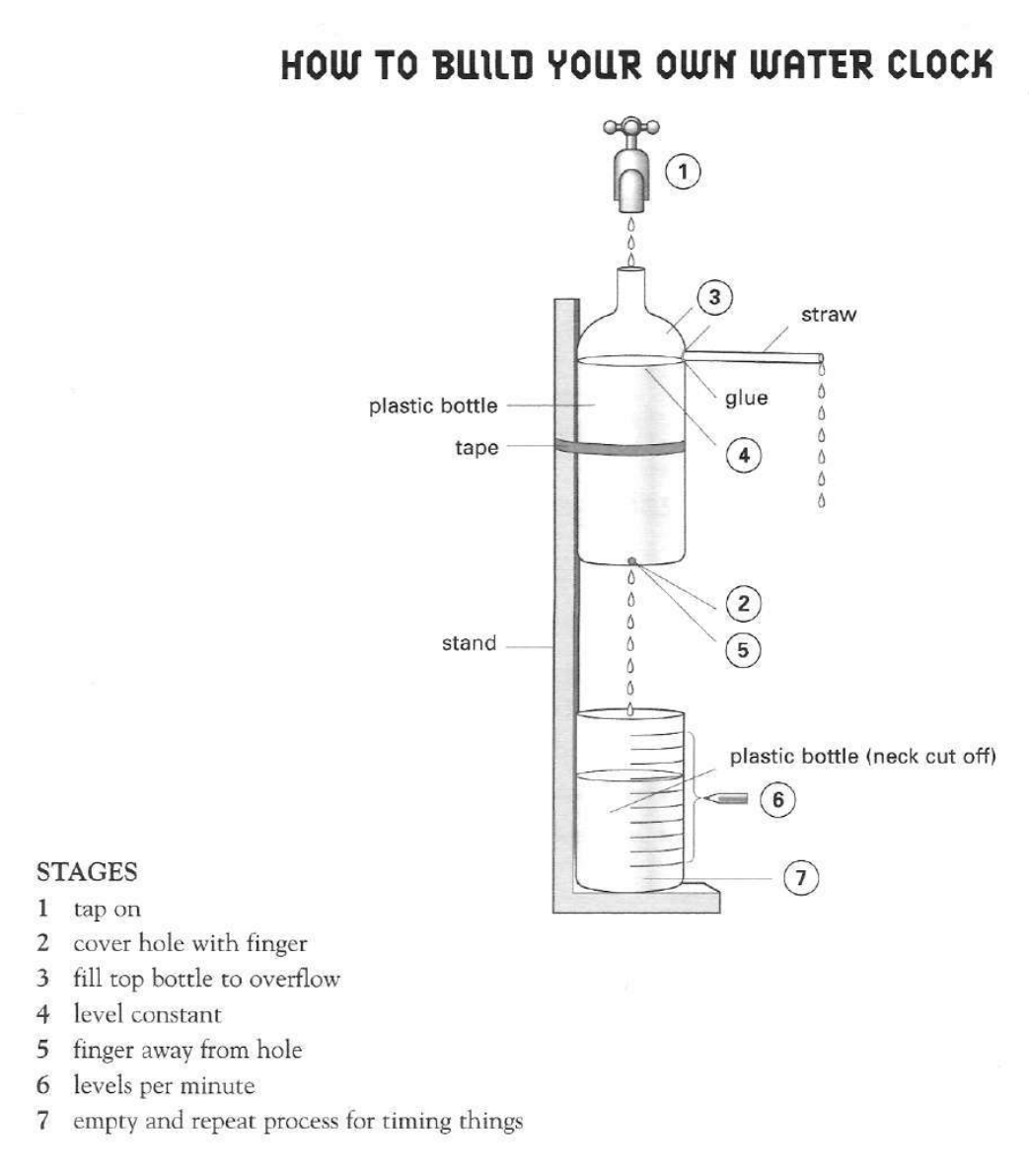
The diagram below shows the process for making a water clock.
Write a report for a university lecturer describing the information below.
HOW TO BUILD YOUR OWN WATER CLOCK
Student answer (Band 5.5)
The given digram illustrates the step-by-step process of constructing and operating a simple homemad water clock.
Overall, it is a stright forward process that consist of two main stages: assembling the equipment using basic household materials, and then using water flow to measure time in minutes.
To begin with, several materials, two plastic bottles, one straw, tape, l-shaped stand, and one tap. One bottle neck cut off and fixed at the end up of stand. The other bottle hang-up with pipe and whole at the bottom.
Now working of the water clock, First on the tap and poured water in one bottel that attched to l-shapped stand and fixed with tape, the straw is fixed at uper end and the extra water from water-level go to waste through straw, and whole at the end of bottle, cover the whole before the countainer fill. when water level reaches to constant. Now move finger away from hole and the water filled into other bottle. And now empty and repeat process for note timing.
AI examiner evaluation
| Criterion | Band |
|---|---|
| Task Achievement / Task Response | 6.0 |
| Coherence and Cohesion | 6.0 |
| Lexical Resource | 5.0 |
| Grammatical Range and Accuracy | 5.0 |
| Overall | 5.5 |
Task Achievement / Task Response: Band 6.0
The report covers both construction and operation, and the overview identifies the two broad stages: assembling the equipment and using water flow to measure time. It also includes relevant details such as the stand, bottles, straw, tape, overflow and releasing the hole. However, some important steps are unclear or inaccurately described. The upper bottle is said to be “fixed at the end up of stand,” while the lower bottle’s position and role are not clearly explained. The sequence of covering the hole, filling the upper bottle until water overflows, and then allowing it to drain is also difficult to follow. Explain the numbered stages in order and distinguish clearly between the upper and lower bottles to make the process more complete and precise.
Coherence and Cohesion: Band 6.0
The response has an overall progression from an introduction and overview to materials, construction and operation. Sequencing expressions such as “To begin with,” “Now” and “And now” help signal movement through the process. However, the paragraphing and links between ideas are not consistently effective: the materials list leads into incomplete construction details, and the shift to operation is abrupt. Several actions are crowded into one long final section, making the order of filling, covering and releasing the hole hard to track. Use separate paragraphs for the equipment and the operating sequence, and connect each numbered stage with clear, consistent transitions. This would make the organisation easier to follow without changing the relevant content.
Lexical Resource: Band 5.0
The response uses some task-relevant vocabulary, including “water clock,” “stand,” “straw,” “water level” and “overflow,” and attempts phrases such as “step-by-step process” and “measure time.” However, the range and control are limited, with noticeable spelling and word-choice problems: “digram,” “homemad,” “stright,” “bottel” and “whole” (apparently intended to mean “hole”) can distract or confuse the reader. Some expressions are also imprecise, such as “hang-up with pipe” and “go to waste through straw.” Choose accurate process vocabulary—for example, “attached,” “drains” and “overflow outlet”—and check spelling carefully. More precise wording would help communicate the apparatus and its function.
Grammatical Range and Accuracy: Band 5.0
The response attempts both simple and longer sentences, and the overall meaning can usually be understood. However, there are recurring problems with sentence formation, verb forms, articles and agreement. For example, “To begin with, several materials, two plastic bottles…” is a fragment, while “One bottle neck cut off and fixed…” lacks a clear subject and auxiliary verb. In “the water filled into other bottle,” the verb form and sentence structure are not controlled. The final section also joins several actions with commas and full stops in ways that obscure their sequence. Practise writing complete sentences with a clear subject and verb, and use consistent present-tense passive forms for the construction stages, such as “The bottle is attached to the stand.”
See this exact question answered at other band scores. The same prompt compared across bands.
Browse more IELTS Writing model answers or get your own writing scored by the same AI examiner.