Band 6.0 IELTS Writing Task 1 Model Answer
Overall Band Score: 6.0 · IELTS Complete Catalyst · 2026-11-19
IELTS Writing Task 1 question
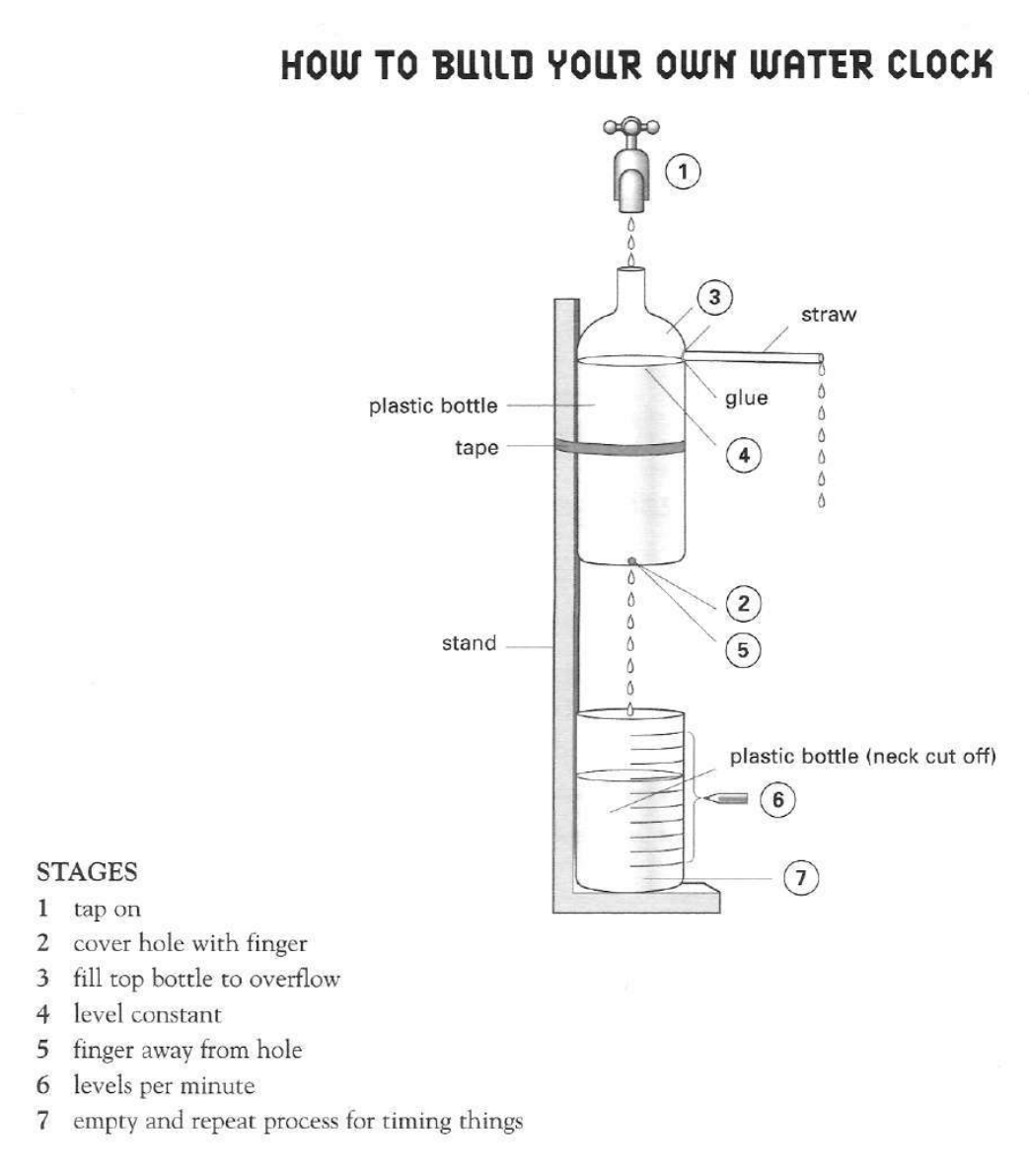
The diagram below shows the process for making a water clock.
Write a report for a university lecturer describing the information below.
HOW TO BUILD YOUR OWN WATER CLOCK
Student answer (Band 6.0)
The given diagram represents the process of making a water clock. There are 7 stages for making the clock.
Place a plastic bottle below the tap and tie it with stand using a tape. Keep the tap on and cover the hole which lies at the bottom of the bottle so that the bottle gets filled with water. Make a hole at the top of the bottle and add straw with a glue. The level of the water should be constant to that of the straw. Later, take your finger away from the hole to start the flow. The water goes into the plastic bottle which lies on the stand represents levels per minute. Per minute is defined by the lines given on the bottle. Water gets stored in the bottle and it clearly shows how many minutes have gone by.
The process can be repeated for timing different things by emptying the bottle that lies in the bottom.
AI examiner evaluation
| Criterion | Band |
|---|---|
| Task Achievement / Task Response | 6.0 |
| Coherence and Cohesion | 6.0 |
| Lexical Resource | 5.5 |
| Grammatical Range and Accuracy | 5.5 |
| Overall | 6.0 |
Task Achievement / Task Response: Band 6.0
You cover the main purpose and sequence, including filling the upper bottle, allowing water to flow into the lower container, reading the levels, and repeating the process. The final sentence correctly reports that the clock can be reused for timing different activities. However, some construction details are inaccurate or unclear: the diagram shows the upper bottle attached to a stand with tape, while the lower bottle rests on the stand; it does not say to tie the bottle. You also say to make a hole at the top, although the water outlet is at the base, and the tap is turned on before the upper bottle is filled to overflow. A clearer overview and more precise account of these stages would make the description more complete.
Coherence and Cohesion: Band 6.0
The response follows a broadly logical order, moving from setting up the apparatus to filling it, starting the flow, reading the markings, and repeating the process. This makes the procedure understandable overall. The sequence is also supported by time markers such as “Later” and “The process can be repeated.” However, the opening only announces that there are seven stages rather than summarising the overall mechanism, and the main paragraph combines several distinct actions without clear grouping. Some references are difficult to follow, particularly “the plastic bottle which lies on the stand represents levels per minute,” where the relationship between the container and its markings is unclear. Organising the setup and operation into separate stages and using clearer references would improve progression.
Lexical Resource: Band 5.5
You use relevant vocabulary for describing a process, including “stages,” “constant,” “flow,” and “repeated,” and the reader can generally understand the equipment and actions. However, some word choices and collocations are imprecise for this diagram. “Tie it with stand” does not accurately describe attaching the upper bottle to the stand with tape, while “make a hole at the top” misidentifies the outlet. The phrase “represents levels per minute” is also unclear; the markings indicate elapsed time rather than representing levels. There is some repetition of “bottle” and “water,” which could be reduced by using precise labels such as “upper container,” “lower container,” and “water level.” More accurate process vocabulary would make the report clearer.
Grammatical Range and Accuracy: Band 5.5
You use a mixture of short instructions and longer sentences, and most of the sequence remains understandable. The sentence “The process can be repeated for timing different things by emptying the bottle that lies in the bottom” shows an attempt to combine purpose and method. Some grammatical errors and awkward constructions remain, however. In “Place a plastic bottle below the tap and tie it with stand,” the article and sentence structure around “stand” are incomplete. “The water goes into the plastic bottle which lies on the stand represents levels per minute” lacks a clear grammatical connection between the clauses. The report also shifts between imperative instructions and present-tense description. Use consistent present simple forms and check clause boundaries, articles, and agreement to improve accuracy.
See this exact question answered at other band scores. The same prompt compared across bands.
Browse more IELTS Writing model answers or get your own writing scored by the same AI examiner.