Band 5.5 IELTS Writing Task 1 Model Answer
Overall Band Score: 5.5 · IELTS Complete Catalyst · 2026-11-19
IELTS Writing Task 1 question
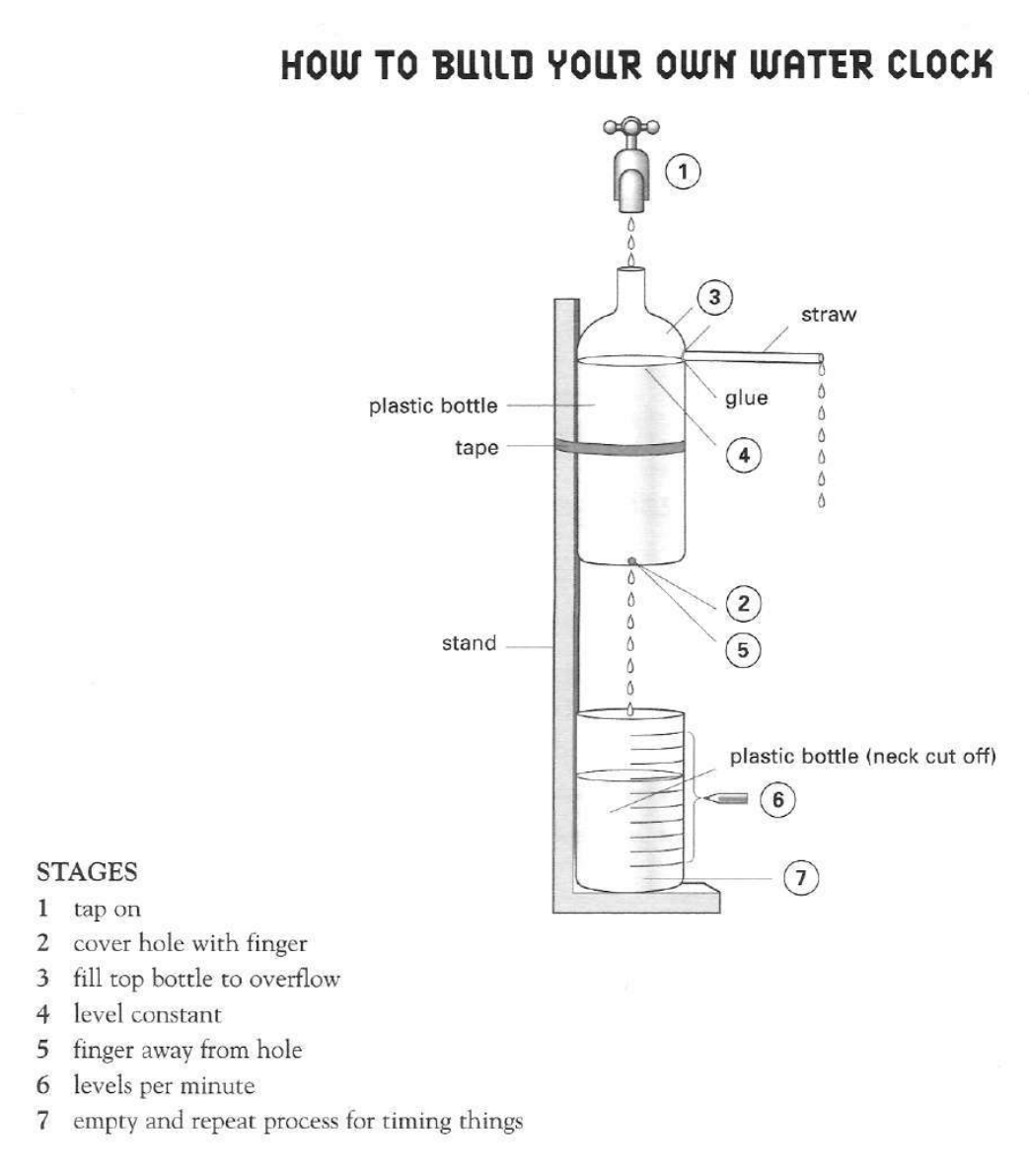
The diagram below shows the process for making a water clock.
Write a report for a university lecturer describing the information below.
HOW TO BUILD YOUR OWN WATER CLOCK
Student answer (Band 5.5)
The figure illustrate the method for makina a water clock.
Overall, it requires seven stages, such as tap on, cover hole with finger, fill top bottle to overflow, level constant, finger away from hole, levels per minute and empty and repeat process for timming things.
To begin with, in the first process, we have to open the tap and fill the plastic bottle with the help of tape we need to support the plastic bottle with the help of stand.furthermore, by applying glue with straw so that the water will poure automatically throught small opening in the second process we need to cover hole with finger moving on to the remaning information fill top bottle to overflow, basicall, we have to make water level constant.
Then we must remove finger away from hole, so that the water will flow downward. Moreover in the help of plastic bottle we can collect all the water consequently we can caliberate levels per minute. Thus, in the last process we must empty the plastic bottle and repeat process for timing things.
AI examiner evaluation
| Criterion | Band |
|---|---|
| Task Achievement / Task Response | 6.0 |
| Coherence and Cohesion | 6.0 |
| Lexical Resource | 5.0 |
| Grammatical Range and Accuracy | 5.0 |
| Overall | 5.5 |
Task Achievement / Task Response: Band 6.0
You cover the main sequence and give an overview that identifies seven stages, from turning on the tap to repeating the process for timing. You also include relevant construction details, such as attaching the upper bottle to a stand and using a straw for overflow. However, some stages are compressed or unclear: “fill top bottle to overflow” and “level constant” are not explained as distinct actions, and the diagram’s lower bottle with its neck cut off and the water dripping through a hole at the upper bottle’s base are not clearly described. Develop these key features more precisely and keep the report focused on what the diagram shows, rather than adding uncertain details such as water flowing “automatically.”
Coherence and Cohesion: Band 6.0
The response has a recognisable overall structure: an introduction, an overview, and a description of the process in sequence. Time and sequence markers such as “To begin with,” “Then,” and “in the last process” help the reader follow the stages. However, the middle section becomes difficult to track because several steps are joined in one long sentence, and “moving on to the remaining information” does not clearly signal which stage comes next. Some linking phrases, including “furthermore,” “Moreover,” and “consequently,” feel mechanical or do not show the exact relationship between ideas. Use separate sentences or paragraphs for construction and operation, and connect each stage explicitly to the next.
Lexical Resource: Band 5.0
You use some task-related vocabulary, including “overflow,” “stand,” “straw,” and “calibrate,” which helps communicate the process. However, the range is limited and several word choices or spellings reduce precision: “makina,” “timming,” “poure,” and “caliberate” are inaccurate, while “open the tap” and “collect all the water” are less precise descriptions in this context. Phrases such as “with the help of” are repeated and make the report sound less concise. Aim for accurate process vocabulary and natural collocations, for example, describe water as dripping into the lower bottle and the straw as an overflow outlet. Proofreading spelling would also make your meaning clearer.
Grammatical Range and Accuracy: Band 5.0
You attempt both simple and more extended sentence forms, including clauses beginning with “so that” and “while,” and the overall meaning is generally recoverable. However, errors in sentence structure and control are noticeable. The opening “The figure illustrate” has subject–verb disagreement, and “stand.furthermore” shows faulty sentence punctuation and capitalisation. The long sentence beginning “To begin with” joins several actions without clear grammatical boundaries, while “by applying glue with straw” lacks a clear subject and article. There are also inconsistent forms such as “we have to” alongside passive descriptions. Use shorter, complete sentences, check agreement and articles, and punctuate each stage clearly.
See this exact question answered at other band scores. The same prompt compared across bands.
Browse more IELTS Writing model answers or get your own writing scored by the same AI examiner.