Band 5.5 IELTS Writing Task 1 Model Answer
Overall Band Score: 5.5 · IELTS Complete Catalyst · 2026-11-19
IELTS Writing Task 1 question
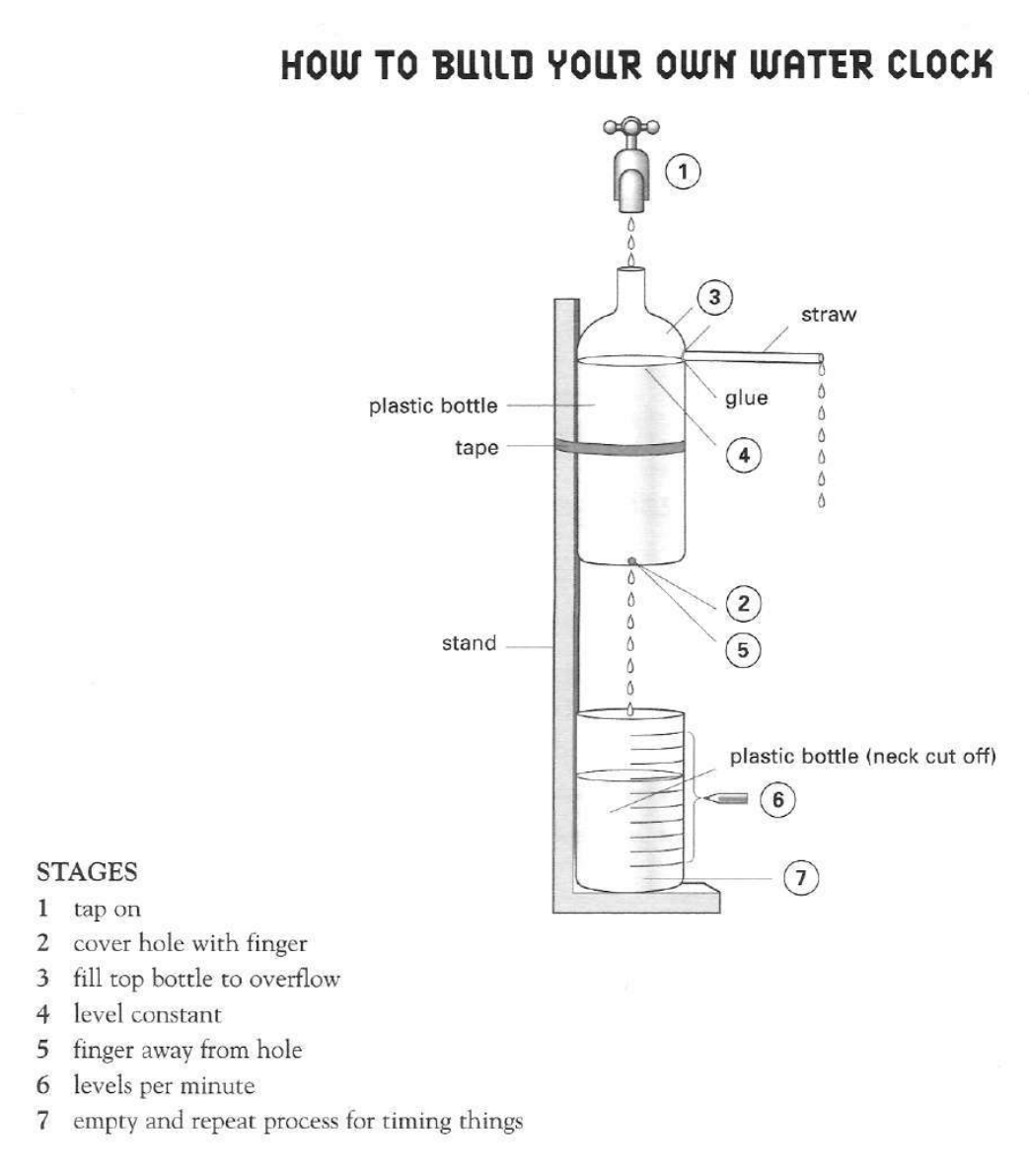
The diagram below shows the process for making a water clock.
Write a report for a university lecturer describing the information below.
HOW TO BUILD YOUR OWN WATER CLOCK
Student answer (Band 5.5)
The diagram presents the stages of creating a water clock .
Overall, it incorporates seven stages. Starting from the tap water putting into the plastic bottle with dropping the water into another plastic bottle. This process needs to be repeated in order to build a water clock.
First, a faucet drop water into a plastic bottle, filling the bottle with water. There is a hole in the back of the plastic bottle. In the second stage that hole is needed to cover with finger. For this reason, the water slowly increases in the bottle and at a point the bottle is filled with water and start to overflow from the straw. Due to that the water level remains constant at a particular level. This incorporates stage four.
In the fifth stage, that hole is opened by removing finger and water droplets are started to fill the second plastic bottle. In the next step, that bottle is marked by a pencil in one minute after filling. In the last stage, that plastic bottle is released its water and repeat this process for timing things.
AI examiner evaluation
| Criterion | Band |
|---|---|
| Task Achievement / Task Response | 6.0 |
| Coherence and Cohesion | 5.5 |
| Lexical Resource | 5.5 |
| Grammatical Range and Accuracy | 5.5 |
| Overall | 5.5 |
Task Achievement / Task Response: Band 6.0
The report covers the main sequence and gives a general overview that the process has seven stages and is repeated for timing. It also correctly describes the tap, the upper bottle, the overflow straw, the hole being released, and water collecting in the lower bottle. However, some details are unclear or inaccurate: the hole is at the base of the upper bottle, not “in the back,” and the lower bottle is marked with calibration lines to show the water level per minute, rather than simply being marked “in one minute after filling.” The construction details—such as attaching the upper bottle to a stand and cutting the neck off the lower bottle—are also omitted. More precise coverage of these features would make the account more complete.
Coherence and Cohesion: Band 5.5
The response has a recognisable overall structure: an introduction and overview are followed by stages in sequence, with “First,” “In the second stage,” “In the fifth stage,” and “In the last stage” helping the reader follow the process. However, progression is not consistently clear. The overview sentence beginning “Starting from the tap water…” is difficult to interpret, and “For this reason” does not clearly express the relationship between covering the hole and filling the bottle. The reference “that bottle” is also ambiguous because two bottles have been mentioned. Use clearer stage-by-stage paragraphs and more precise links, such as “Once the upper bottle is full, water overflows through the straw; this keeps its level constant.”
Lexical Resource: Band 5.5
The response uses relevant vocabulary for describing a process, including “stages,” “overflow,” “water level,” and “repeated,” so the main subject is generally understandable. However, several word choices and collocations are imprecise or unnatural, such as “faucet drop water,” “hole in the back,” “water droplets are started to fill,” and “released its water.” “Plastic bottle” is repeated frequently, and “incorporates” is not a natural choice for describing a process or stage. Aim for more precise process language, for example “water flows from the tap,” “a hole at the base,” and “the lower bottle is emptied.” This would improve clarity and reduce repetition while retaining an appropriate academic tone.
Grammatical Range and Accuracy: Band 5.5
There is an attempt to use both simple and more complex sentences, including “For this reason…” and “Due to that…,” and the sequence is usually understandable. Some grammatical errors remain, however. For example, “a faucet drop water” has incorrect subject–verb agreement, while “the bottle is filled with water and start to overflow” shifts incorrectly between verb forms. The construction “that hole is needed to cover with finger” is also incomplete and lacks an article; a clearer form would be “the hole is covered with a finger.” In the final sentence, “that plastic bottle is released its water and repeat” has faulty verb structure and an unclear subject. Check agreement, articles, and consistent verb forms, especially when describing each stage.
See this exact question answered at other band scores. The same prompt compared across bands.
Browse more IELTS Writing model answers or get your own writing scored by the same AI examiner.