Band 5.5 IELTS Writing Task 1 Model Answer
Overall Band Score: 5.5 · IELTS Complete Catalyst · 2026-11-19
IELTS Writing Task 1 question
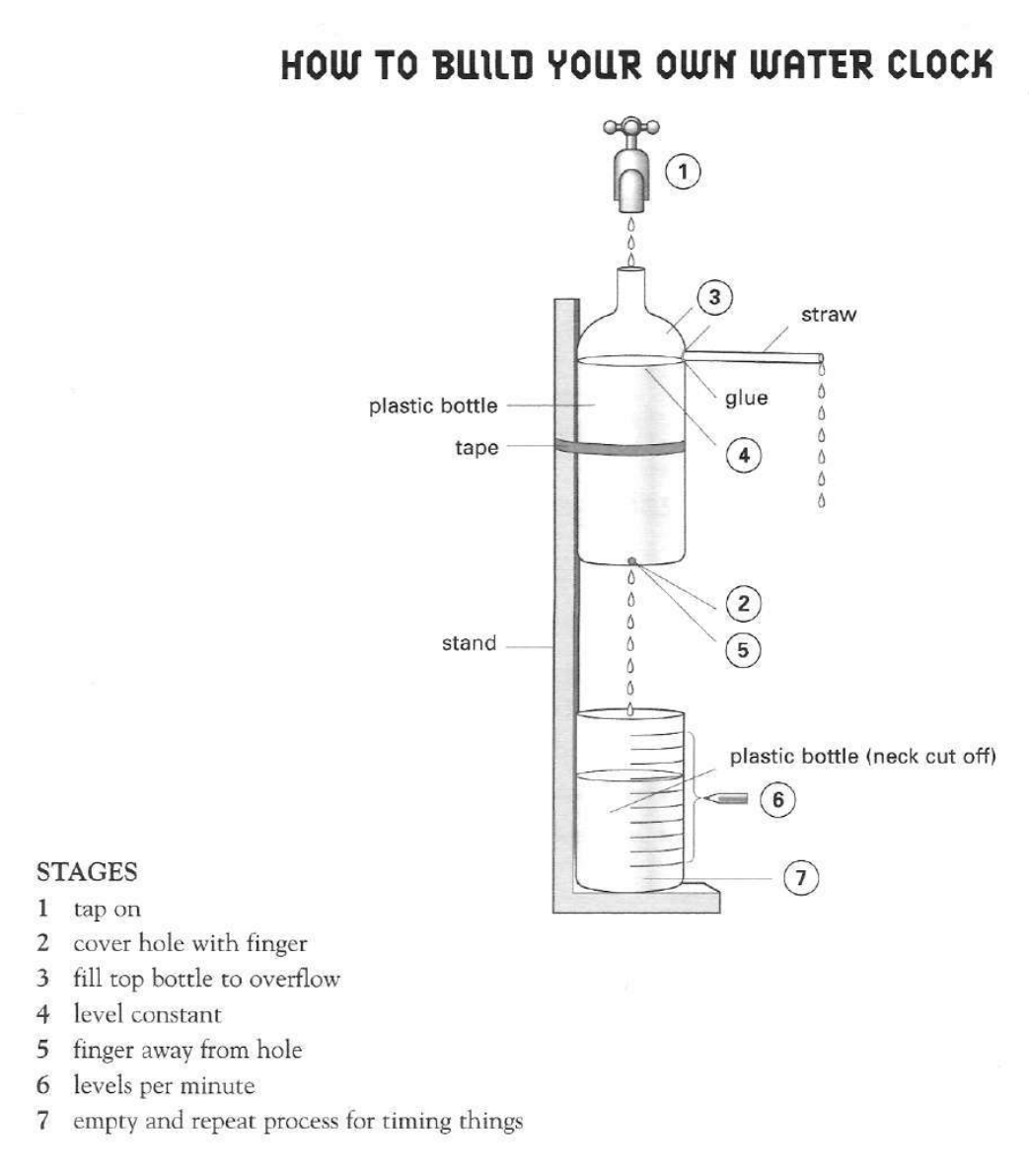
The diagram below shows the process for making a water clock.
Write a report for a university lecturer describing the information below.
HOW TO BUILD YOUR OWN WATER CLOCK
Student answer (Band 5.5)
The diagram provides key information about the process for making a water clock
Overall it is clear for the graph that there are 7 stages to count the timing for a certain activity or thing using water, And the equipement needed involves a straw, plastic bottle, glue, tape, stand and a plastic botlle
According to what is shown the water starts dripping after we tap on the source of it, Then we need to cover the hole of the bottle with our fingers, After that once the liquid starts getting of straw, we take off our finger from the bottom hole to let the water get into the second plastic bottle which is just under the first one
After all that when the the thing we want to count minutes for is accompliched or done we should cover the first bottle hole and simply take a look at the levels on the second one to see how much time it took
AI examiner evaluation
| Criterion | Band |
|---|---|
| Task Achievement / Task Response | 5.0 |
| Coherence and Cohesion | 6.0 |
| Lexical Resource | 5.0 |
| Grammatical Range and Accuracy | 5.0 |
| Overall | 5.5 |
Task Achievement / Task Response: Band 5.0
You identify the diagram as a water-clock process and mention that it has seven stages, the equipment, and the use of water levels to measure time. However, the account only partially describes the procedure and includes important inaccuracies. The diagram shows the upper bottle being filled until water overflows through the straw, then the finger is removed from the hole so water drips into the lower bottle; your wording that liquid “starts getting of straw” is unclear, and you do not explain the constant water level or the calibration marks being made. The final instruction is also misreported: the diagram says to empty the apparatus and repeat the process, not to cover the hole and read the lower bottle when an activity ends. A clearer, accurate overview and fuller stage-by-stage description would strengthen the report.
Coherence and Cohesion: Band 6.0
The response has a recognisable overall arrangement: an introduction, an overview, and two paragraphs describing the process and its use. Sequencing phrases such as “According to what is shown” and “After that” help the reader follow the general order. However, progression becomes less clear in the long third paragraph, where several actions are joined together, and the final paragraph introduces a timing procedure that is not clearly connected to the diagram’s stated instruction to empty and repeat. Some references, including “the source of it” and “the thing we want to count minutes for,” are vague. Use shorter, more clearly separated stages and refer consistently to the upper and lower bottles to make the sequence easier to follow.
Lexical Resource: Band 5.0
You use some relevant process vocabulary, including “straw,” “plastic bottle,” “hole,” “dripping,” and “levels,” so the reader can identify the main subject. However, the range is limited and several word choices or forms are inaccurate or unclear, such as “getting of straw,” “accompliched,” and “equipement.” Phrases like “the source of it” and “the thing we want to count minutes for” are also imprecise for a formal report. Aim for accurate process terms and more natural collocations, for example, “water flows through the straw” and “measure the duration of an activity.” Check spelling carefully and avoid repeating general words such as “thing” when a precise noun is available.
Grammatical Range and Accuracy: Band 5.0
You attempt to connect ideas using subordinate clauses and time expressions, as in “after we tap on the source of it” and “once the liquid starts…,” but complex sentences are often difficult to control. There are errors in sentence boundaries and punctuation: the opening is not punctuated as a complete sentence, and “And” and “Then” are capitalised after commas. The phrase “when the the thing we want to count minutes for is…” contains a repeated article and an awkward clause structure, while “we take off our finger” does not maintain clear number agreement. These issues sometimes make the sequence harder to understand. Practise writing one complete sentence for each stage, checking articles, agreement, and punctuation, while retaining a mix of simple and complex forms.
See this exact question answered at other band scores. The same prompt compared across bands.
Browse more IELTS Writing model answers or get your own writing scored by the same AI examiner.